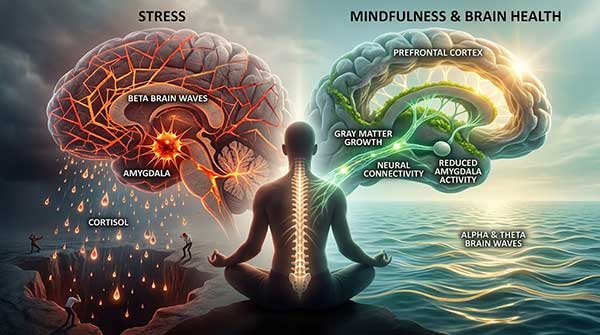
and What Actually Happens in Your Brain
The first time I sat down to meditate, I lasted about forty-five seconds. Then I remembered I needed to buy paper towels. Then I started planning dinner. Then I opened my eyes, checked my phone, and decided meditation was not for me. That was eight years ago. I have been meditating, badly, ever since.
Here is the thing nobody tells you at the beginning: meditation is not about stopping your thoughts. It is about noticing them. The mind’s job is to think. It will think during meditation. It will think about paper towels and dinner and that awkward thing you said three years ago. The practice is not the absence of thought. The practice is the returning. Every time you catch yourself drifting and bring your attention back, that is the meditation. That is the whole thing.
This distinction matters because it changes how we understand what meditation does for stress. It is not a relaxation technique, exactly. It is an observation technique. And observation, it turns out, is the first step in changing how stress moves through your body and mind.
What Happens to Your Body When You Practice Meditation for Stress Relief
When you sit down and bring your attention to your breath, you start to notice things you have been ignoring. The tightness in your shoulders. The shallow breathing. The way your jaw has been clenched for hours. These are the physical signatures of stress, and most of us do not notice them until they become pain or illness.
The source material describes this as the first stage of meditation’s effect: you become aware of how stress shows up in your body. Some people feel it as restlessness — the urge to move, to scratch, to check something. Others notice their heartbeat, their breathing, the tension in specific places. The sensations were always there. Meditation just turns the lights on.
Jon Kabat-Zinn, the founder of Mindfulness-Based Stress Reduction at the University of Massachusetts Medical School, built an entire clinical program around this insight. MBSR, as it is called, has been taught to tens of thousands of patients since the 1980s. The premise is simple: you cannot change what you cannot feel. The first step in reducing stress is learning to detect it in your own body before it takes over.
How a Body Scan Meditation Reveals Hidden Stress Patterns
One of the most direct ways to notice what stress is doing to you is a body scan. You sit or lie down and move your attention slowly from your feet to your head, noticing sensations without judging them. The first time I tried this, I discovered I was holding my shoulders up around my ears. They had been there for hours. Maybe days. The noticing did not fix it immediately. But it gave me a choice I did not have before.
How Meditation Changes Your Relationship to Anxious Thoughts
The second thing that happens is stranger. You start to see your thoughts. Not just have them. See them. The source text describes this as the moment you realize how repetitive your thinking actually is. The same worries. The same replays. The same imagined arguments. They cycle through your mind like ads on a social media feed, and until you meditate, you do not notice how often they appear.
I had this experience in my first month of daily practice. I kept thinking about a conversation I had with a coworker, replaying it, editing it, rewriting my lines. The thought was not new. It had been running for weeks. But I had never noticed it as a pattern. I had just been living inside it, like a fish living in water. Meditation gave me a moment of distance. I was not the thought. I was the one watching the thought.
This is not a mystical claim. Research from Harvard Medical School, including work by neuroscientist Sara Lazar, has shown that mindfulness meditation changes the brain’s structure over time. Areas associated with attention and sensory processing thicken. The amygdala, the brain’s alarm system, shrinks. The changes are measurable on fMRI scans. The practice does not just feel different. It is different, at the level of grey matter.
Why Awareness Is the First Step in Stress Management
The source text says something that sounds almost too simple: noticing is the first light of transformation. But it is true. You cannot change a pattern you cannot see. If you do not know that stress tightens your chest and speeds up your breathing, you cannot catch it early. You cannot intervene. You can only react after the fact, when the damage is already done.
Regular meditation creates a gap between stimulus and response. That gap is where choice lives. The source text describes this as moving from automatic reactions to conscious responses. Instead of snapping at your partner after a hard day, you notice the tension rising and choose to breathe instead. Instead of spiraling into catastrophic thinking at 2 a.m., you recognize the spiral and step out of it. The stress does not disappear. But it stops running the show.
The American Psychological Association has published guidance on meditation and stress, noting that mindfulness practices can reduce symptoms of anxiety and depression and improve overall wellbeing. The research base is broad and growing. A 2014 review in JAMA Internal Medicine found that mindfulness meditation programs showed moderate evidence of improving anxiety, depression, and pain. The effect sizes are not enormous. But they are real. And they accumulate over time.
How to Build a Daily Meditation Habit That Actually Sticks
If you are new to this, start small. Five minutes. Maybe ten. Not thirty. Not an hour. The goal is not to achieve some meditative state. The goal is to show up and notice what happens.
Sit in a chair or on the floor. Close your eyes or soften your gaze. Bring your attention to your breath. Do not try to control it. Just feel it moving in and out. When your mind wanders — and it will, constantly — notice that it wandered. That noticing is the practice. Then bring your attention back. That returning is the practice. Do this over and over. That repetition is the practice.
The source text ends with something that has stayed with me: the goal of meditation is not relaxation. It is self-observation. But relaxation often follows, not as the aim but as the byproduct. You stop fighting your experience. You stop trying to fix yourself. You just watch. And in the watching, something softens. The stress is still there. But it has less power.
I still meditate badly. My mind still wanders. I still think about paper towels. But I catch it faster now. And that catching — that small, repeated act of noticing — has changed more in my life than any productivity system or morning routine ever did. The stress is not gone. But I am no longer running from it. I am just watching. And that, it turns out, is enough to begin.
There are nights when sitting still feels impossible, when the anxiety is too loud and the last thing I want to do is close my eyes and listen to my own breathing. Those are the nights I need it most. Not because meditation fixes the anxiety. Because it lets me sit with it without being consumed by it. That is not nothing. That is the whole skill. Not escaping the storm. Learning to be in the storm without becoming it.