How to Unlock Your Natural Creativity and Build Real Creative Confidence
I have a distinct memory of sitting on a garage floor in Ohio, watching my neighbor, a retired machinist named Frank, rebuild a carburetor. He laid out every tiny spring and screw on a piece of cardboard. He didn’t look like an artist. He looked like a guy who had grease under his fingernails and a Reds game on the radio. But the way he navigated that mechanical puzzle was pure creation. He didn’t have a manual. He had a feel for it. When I said something about how he was “good with his hands,” he laughed. “I ain’t creative,” he said. “I just mess with stuff until it works.”
That sentence haunted me for years. Frank was actively, undeniably creating. He was solving a problem that had no single answer. Yet he carried the same belief that so many of us drag around: that creativity belongs to a special class of people with paint-splattered aprons and berets.
The deepest human dilemma in this source is not that we lack imagination. It is that we have been handed a definition of creativity that is so narrow, so precious, and so tied to performance that we fail to recognize the daily act of making we already do. We are sitting on a goldmine and complaining we don’t have pocket change.
Why Do Adults Believe They Aren’t Creative
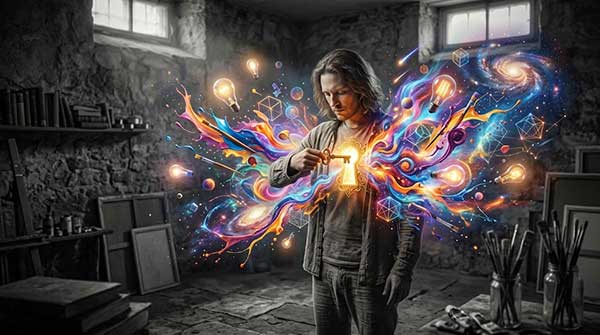
Somewhere between making macaroni art in kindergarten and writing status reports in middle age, we undergo a kind of mass forgetting. We trade finger paints for spreadsheets and decide that creativity is something we “grew out of.” The source text calls this potential a raw mineral. Like a vein of ore in the earth, it is real, it is valuable, and it needs to be processed to be useful.
The problem is that we mistake the raw ore for junk rock. The moment we do something clever, we call it a fluke. The moment we improvise a solution at work, we call it “just being practical.” I have a friend in Austin who can throw together a meal from a seemingly empty fridge that would make a chef jealous. She insists she is just “throwing things together.” She is creating. She is just not calling it that.
There is a specific anxiety that comes with the label “creative.” It feels heavy. It implies you have to be good, or worse, that you have to be a genius. So we retreat. We say, “I’m not the creative type.” We are protecting ourselves from the vulnerability of making something and having it judged. The author refers to the work of Tom and David Kelley, the founders of IDEO, who wrote “Creative Confidence” to address exactly this fear. They spent three decades watching people who claimed they had no creativity suddenly light up when they were given a safe space to experiment. The shift was rarely about learning a new skill. It was about giving themselves permission to look at the raw material they already had.
Redefining Creative Work Beyond The Canvas
We have to blow up the definition. Creativity is not confined to a canvas or a stage. The source text makes a point that stops me cold every time I read it: breathing can be creative. Eating can be creative. The way you hold a conversation with a friend, the way you arrange your living room, the way you solve a scheduling conflict at work—these are all acts of creation.
When we define creativity strictly as the production of art, we relegate most of life to the realm of the mundane. But life is not mundane. It is a series of tiny, constant problems and tensions that require us to synthesize information, trust our gut, and make something new out of the parts available. That is the essence of creation.
Frank in his garage was an artist. He was just using a wrench instead of a brush. The raw metal, the smell of the solvent, the intuitive understanding of how the parts worked together—that was his medium. His creativity was his ability to see the engine not as a broken piece of machinery, but as a completed possibility waiting to be realized.
If you can look at your daily routine and see it as a structure you have built—and are constantly rebuilding—you are an architect. If you can look at a conversation and see it as a dance of listening and responding—you are a performer. The creativity is in the engagement, not in the output.
The Muscle That Atrophies When Ignored
The author compares creativity to a muscle. This is not a metaphor. The neural pathways that allow for divergent thinking, for seeing the unexpected connection between a carburetor and a puzzle, weaken when they are not used. If you spend ten years sitting in a cubicle being told exactly what to do and exactly how to do it, that muscle goes soft.
This is why many of us feel panicked when we are asked to “brainstorm” or “think outside the box.” We have lost the strength to hold ourselves in the space of not knowing. We want the answer immediately because the process of creation is messy and uncomfortable. It requires us to be a beginner. It requires us to be willing to look stupid.
The energy of creativity, when suppressed, doesn’t just disappear. The author notes that if we don’t learn how to process this raw energy, we spend it on complaining or gossip. We use that creative fire to build elaborate narratives of why we are stuck. We become highly creative about our own limitations. We craft perfect, airtight excuses for why we can’t do the thing we want to do. That is the tragic irony. The very skill we claim not to have is the skill we are using to keep ourselves trapped.
What Actually Works in the Messy Middle
So how do we stop the cycle? How do we start processing the raw ore? The source text suggests we need to shift our focus from “proving we are creative” to “observing how we are creative.”
Start paying attention to the moments where you lose track of time. Maybe it is when you are reorganizing a closet, troubleshooting a network issue, or telling a story to a friend. That flow state is the indicator that you are using your natural creativity. It doesn’t matter if you are getting paid for it or if it looks impressive to anyone else. That flow is the signal that you are processing something real.
I started applying this to my own life recently. I hate cooking. I find it tedious. But one night, I ran out of ingredients and had to improvise a sauce for pasta. It was a mess. It took me three times longer than it should have. But for fifteen minutes, I was completely focused on the chemistry of what I was mixing. It tasted terrible, but the act of trying it felt different. It felt like I had woken a part of my brain up.
We also need to stop waiting for the muse. The source text implies that this is a physical, tactile process. It is not about waiting for inspiration to strike. It is about showing up and digging. It is about making the phone call, writing the sentence, moving the furniture, or rebuilding the engine even when you don’t feel like it. The action creates the inspiration. Not the other way around.
If Nothing Else, Do This
Pick one task you have to do today. It can be the most boring, administrative task on your list. Instead of doing it on autopilot, ask yourself: “What is one tiny way I could make this better or different?” Maybe you write your email with a bit of humor. Maybe you take a new route to the meeting. Maybe you stack the dishwasher in a way that challenges the status quo. Just inject one ounce of intentional thought into a routine act. Notice how it feels to be the author of that moment, even if the moment is small. That is the mine. That is the raw ore. You already own it.
Straight Answers to Quiet Doubts
What if I try to be creative and I just fail?
You will fail. That is part of the deal. The Kelley brothers talk about this constantly. The goal is not to avoid failure; it is to build the resilience to survive the failure and learn from it. If you are waiting for a guarantee that you won’t look stupid, you are going to be waiting forever. The only real failure is refusing to engage with the process at all.
Is creativity really just about solving problems?
It is about creation. Problem-solving is the practical application of it. When you are faced with a gap between what is and what could be, and you attempt to bridge that gap, you are creating. Whether that is a solution to a logistics problem or a watercolor painting, the underlying mechanism in the brain is the same. You are making something exist that didn’t exist before.
How do I know if I am actually creative or just deluding myself?
If you made something—an idea, a solution, a meal, a spreadsheet—that wasn’t there before, you are creative. The delusion is in thinking that the title “creative” requires external validation. Frank thought he was just “messing with stuff.” He was actually practicing a high level of intuitive engineering. The proof is in the act, not in the applause.