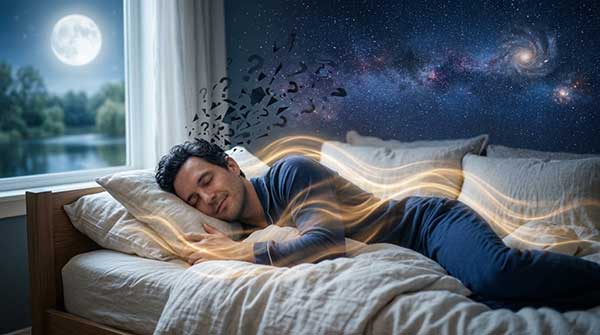
Why Sleep Is the Best Meditation and How to Actually Get More of It
It is 3:14 a.m. and I am staring at the ceiling again. Not thinking anything important. Just awake. The way you are awake when your body has forgotten how to turn itself off. The clock on the nightstand says 3:14, then 3:15, then 3:16. I have been here before. You probably have too. That particular kind of tired where your eyes hurt but your brain will not stop humming.
The Dalai Lama apparently said that the best meditation is sleep. I am not sure if he actually said it, but the quote keeps showing up in articles about rest, and I keep believing it because the nights I sleep well are the mornings I feel like a person instead of a pile of static.
Here is what I have learned, slowly and badly, about sleep. Not from a textbook. From a decade of doing it wrong.
Why Insomnia Is Not a Character Flaw
There was a study published in 2015 that followed adults and looked at how sleep patterns relate to depression. Short sleep — defined as less than five to seven hours — was a risk factor. But so was long sleep, anything over eight or nine hours. Both ends of the spectrum were associated with worse mental health outcomes. The sweet spot is somewhere in the middle, and most of us are not in it.
I used to think I was just not a “good sleeper.” Like it was a fixed trait, the same way some people have green eyes and some people have brown. But sleep is not an eye color. Sleep is a behavior. And behaviors can change.
The source text I keep returning to this month is about sleep hygiene — a term that sounds like you need to wash your pillowcases more often but actually means something much more practical. It means the habits and environment that make sleep possible. And here is the part that should be encouraging: you can learn these habits. You do not have to be born with them.
The Fade Starts Three Hours Before Your Head Hits the Pillow
I have a ritual now that I did not have before. I call it “the fade.” It is not a term I read anywhere. It is just what I call the three hours before bed, the window where I stop being a person who does things and start being a person who rests.
The fade is not complicated. It starts with putting my phone in the other room. Not on the nightstand. Not face-down on the dresser. In the other room. Because the research is very clear on this: exposure to screens before bed suppresses melatonin, the hormone that tells your body it is time to sleep. One study after another has shown the same thing. The blue light is not neutral. It is actively working against you.
I resisted this for years. I told myself I needed my phone to wind down. What I actually needed was the opposite. The phone was not winding me down. It was keeping me up.
The fade is the opposite. It is a slowing. I read something made of paper. I drink something warm. I sit in a room with dim lights and let my thoughts slow down instead of scrolling them into a frenzy.
Your Bedroom Is Not a Living Room
There is a psychology to space. The places you sleep and the places you live should not be the same place. I know that sounds obvious. But look at your own bedroom. Is there a television? A laptop? A pile of laundry that has been there for a week? An exercise bike that is now a clothes rack?
The source text says to keep your bedroom airy and tidy. That is not aesthetic advice. It is physiological. Your brain associates spaces with activities. If your bedroom is where you watch television, work, scroll, and argue with your partner, your brain will not know that it is also the place where sleep is supposed to happen.
I moved my desk out of my bedroom two years ago. The change was not dramatic. It was subtle. But within a few weeks, I noticed that lying down in bed felt different. The room had become a place for rest instead of a place for everything.
What You Watch Before Bed Is Digested All Night
There is a particular kind of exhaustion I used to feel after watching a violent show late at night. I would lie in bed and close my eyes and see the images replaying. I thought I was just tired. I was actually processing.
The source text is blunt about this: watching violent or intense content before bed is a recipe for poor sleep. The mind does not simply switch off when you close your eyes. It continues to chew on what you fed it. Toxic images do not disappear just because you turned off the screen.
I am not saying you have to watch nature documentaries every night. But there is a difference between a show that agitates you and a show that settles you. If you are already struggling with sleep, you cannot afford to add fuel to the fire.
When Chronic Insomnia Needs More Than a Routine
Here is where I have to be honest. Sleep hygiene helps. It helps a lot. But there are nights when no amount of warm tea and dim lighting will quiet the mind. Nights when the anxiety is too loud, the thoughts too sticky. On those nights, no bedtime ritual is enough.
The source text mentions Cognitive Behavioral Therapy for insomnia, and the evidence is strong. A study published in the Journal of the American Medical Association in 2001 found that CBT was more effective than progressive muscle relaxation or placebo for people with chronic insomnia. That was over twenty years ago. The research has only gotten stronger since.
CBT works by addressing the thoughts and behaviors that keep you awake. It challenges the beliefs you have about sleep. The catastrophizing. The “I am going to be so tired tomorrow” spiral. It also gives you practical tools — what to do when you are lying in bed and cannot sleep, how to restructure your relationship with the bed itself.
If you have been fighting insomnia for months or years, do not try to fix it with lavender oil. See a professional. Ask about CBT. The tools are out there. You do not have to white-knuckle your way through every night.
Stress Is a Loop, and Sleep Is the Exit
The cruelest thing about sleep deprivation is that it creates more stress, which makes sleep harder, which creates more stress. The loop is vicious and self-reinforcing. The source text names this directly: chronic stress leads to anxious thoughts at night, which delays sleep, which causes more stress. Around and around.
Breaking the loop requires interrupting it somewhere. For me, it was the evening shower. I know that sounds ridiculous. But it worked. A warm shower before bed — not a quick rinse, but a real one — lowers the body temperature afterward, which signals the brain that it is time to sleep. It also just feels like a ritual. A transition. A door closing on the day.
The source text also mentions aromatherapy. I was skeptical. Then I tried a small bottle of lavender oil that someone gave me as a gift. I put a drop on my pillow. I do not know if it was the lavender or the ritual of applying it, but something shifted. The smell became associated with sleep. The association became a trigger. The trigger became a habit.
Caffeine is another piece. I love coffee. I will never give it up entirely. But I stopped drinking it after two in the afternoon, and the difference in my sleep was immediate. The source text says to avoid caffeine two to three hours before bed. I go further. The half-life of caffeine is five to six hours. That afternoon cup was still in my system at midnight.
What I Still Struggle With
I am not going to pretend I have this figured out. Last week, I stayed up until 2 a.m. watching videos on my phone. I knew it was bad for me. I did it anyway. The fade is not a law. It is a practice. And like any practice, I fall out of it sometimes.
But I fall out of it less than I used to. And when I fall, I get back faster. That is the whole game. Not perfection. Persistence.
The source text ends with a small disclaimer: everyone’s needs are different, and what works for one person may not work for another. That is true. Sleep is personal. Your rhythms are not my rhythms. Your triggers are not my triggers. The work is to figure out what your body needs and then give it to yourself with the same attention you would give to anything else that matters.
Because sleep does matter. It is not a luxury. It is not a weakness. It is the foundation. The best meditation, as the quote says. The one you do not have to practice. The one that practices you.
A Few Things People Keep Asking
What if I wake up in the middle of the night and cannot get back to sleep?
The worst thing you can do is lie there and fight it. Get up. Go to another room. Read something boring under dim light. Wait until you feel sleepy again. The bed should be associated with sleep, not with lying awake and feeling frustrated.
Do I really have to stop using my phone three hours before bed?
No, but you should experiment. Start with one hour and see what happens. The research is clear that screens suppress melatonin, but the exact timing varies from person to person. Find your own threshold. Just know that the threshold exists.
Is it bad to sleep in on weekends?
Yes, mostly. Consistency matters more than total hours. Your body likes rhythm. If you sleep until noon on Saturday and then try to go to bed at ten on Sunday night, your body will not cooperate. Try to keep your wake time roughly stable, even on days off. Your Monday self will thank you.