How to Start Over When Everything Falls Apart
There is a particular kind of morning I keep coming back to. The kind where the alarm goes off and for a few seconds, before memory arrives, there is nothing. No yesterday. No to-do list. No regret. Just the sound of your own breathing in a dark room. Then the weight lands. The remembering. The realization that you have to do it all again.
I used to hate that moment. Now I think it might be the most honest part of the day. Because in that brief space between sleep and waking, you are new. You have not yet become the person who failed yesterday. You have not yet picked up the story you have been carrying for years. You are just breathing. And breathing, it turns out, is always a beginning.
The source text I keep returning to this month says something that sounds almost too simple: every breath is new. Every moment is new. You can begin again at any time. Not next Monday. Not after the holidays. Not when things calm down. Now.
I did not believe this for a long time. I believed in fresh starts the way I believed in New Year’s resolutions — nice in theory, useless in practice. But the more I have sat with this idea, the more I have realized that the problem was never the starting. The problem was the waiting. The belief that a new beginning had to be earned, scheduled, prepared for. That you could not start again until conditions were right.
Conditions are never right. That is the whole point.
Why Letting Things Fall Apart Is Sometimes the Only Way Through
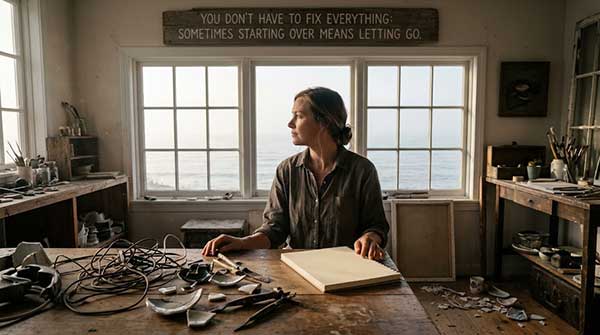
The source text says something that goes against every instinct I have: do not fix it. Do not glue it back together. Let it fall. Let the mess be the mess. Then sit with the mess. Grieve it. Honor it. Do not perform resilience. Do not pretend you are fine. Just be with what is broken.
This is not how most of us are taught to handle failure. We are taught to clean up, move on, stay positive. But there is a cost to that. When you refuse to let things fall apart, you spend enormous energy holding them together. The cracks are still there. You are just covering them with tape. The source text says that constantly trying to tidy and fix is not what makes us human. What makes us human is allowing ourselves to be messy sometimes. To be scattered. To be unfinished.
I have a friend in Denver who lost her job last year. For three months, she kept up the performance. She told everyone she was fine, that she was “taking some time.” She did not tell anyone she was falling apart. Then one Tuesday, she called me crying, and the crying did not stop for an hour. Afterward, she said something I have never forgotten: “I have been holding this together for so long that I forgot I was allowed to break.”
That is the thing. The breaking is not the enemy. The holding is. The holding is what exhausts you until there is nothing left.
How Mindfulness Can Help You Start Fresh Each Day
There is a practice in yoga that the source text mentions, and it applies far beyond the mat. When you do the same pose every day, you can fall into the trap of thinking you know it. You have done it before. You will do it again. But the source text says something subtle: every time you do the pose, you are doing it for the first time. Not because the pose changed. Because you changed. The body that does the pose today is not the body that did it yesterday. The breath is different. The mind is different. The moment is different.
This is not just yoga philosophy. This is how attention actually works. The moment you think you know something, you stop seeing it. You see your idea of it, not the thing itself. The source text calls this the most dangerous feeling: becoming accustomed. Getting used to pain. Getting used to sadness. Getting used to the way things are. Because once you are used to it, you forget there is another way.
Researchers who study mindfulness talk about this as the difference between living on autopilot and living with awareness. Jon Kabat-Zinn, who founded the Mindfulness-Based Stress Reduction program at the University of Massachusetts Medical School, has written about this for decades. The practice is not about fixing yourself. It is about seeing yourself clearly enough to notice when you have slipped into the old grooves. The seeing is the beginning.
How to Stop Repeating the Same Patterns Every Day
There is a simple experiment the source text suggests. If you drive the same route to work every day, change it. If you drink the same coffee every morning, try something different. Not because variety is a virtue. Because the sameness is a kind of sleep. The route becomes so familiar that you do not see it anymore. The coffee becomes so routine that you do not taste it. The life becomes so habitual that you do not live it.
This is not about making your life exciting. It is about waking up. The small changes are not the point. The point is the noticing. When you change the route, you have to pay attention. When you try a different coffee, you have to taste it. The change forces presence. And presence is where new beginnings live.
What It Means to Build Sandcastles Anyway
The source text uses an image that has stayed with me for days. Living is like building sandcastles on the beach. The waves will come. That is their job. They will knock down what you have built. That is not cruelty. That is just the nature of waves. The question is not whether the castle will fall. The question is whether you will keep building anyway. Not with bitterness. Not with resignation. With love. With the full knowledge that the waves will come again, and still choosing to kneel in the sand and build.
I have been thinking about this in relation to my own life. The projects that failed. The relationships that ended. The mornings when I got up and tried again even though I did not feel like trying. The sandcastles I built and lost and built again.
The sun rises every morning whether you are ready or not. The source text says this is not a taunt. It is a reminder. The light comes back. The chance comes back. Not because you earned it. Because it is built into the structure of the world. Every morning is an invitation. The only question is whether you will accept it.
Letting Go of the Need to Have Everything Figured Out
Here is the part I still struggle with. The source text asks a question that undoes me every time: can you start again without carrying yesterday? Not pretending yesterday did not happen. Not denying the pain. But not hauling it around like a suitcase full of rocks either.
The difference is subtle. You can honor the past without being chained to it. You can grieve what broke without letting the grief become your whole identity. You can say, “That hurt, and it mattered, and it is also not the whole story.”
I do not know how to do this perfectly. I am not sure anyone does. But I have started practicing in small ways. When I wake up, I try to stay in the dark room for a minute before reaching for my phone. I try to feel the newness of the day before I fill it with the old noise. Some mornings it works. Some mornings it does not. The trying is the practice.
The source text ends with a whisper that life offers us every morning: can you begin again? The question is not rhetorical. It is an invitation. And the answer, whatever you gave yesterday, whatever you will give tomorrow, can be yes.
Right now. In this breath. In this moment, which has never existed before and will never exist again. You can begin.
That is not motivational speaking. That is just the truth. The breath you are taking right now is a new one. The moment you are in right now is a new one. You can start here. Not next week. Not when you feel ready. Here.
Questions That Keep Coming Back
How do I start over when I have already tried and failed so many times?
The number of failed attempts does not disqualify you from beginning again. It just means you have more information than you did before. The source text is clear: the sandcastle will fall. That is not the problem. The problem is when you stop building. Each attempt is not a waste. It is a rep. A practice. A way of learning what works and what does not.
What if I do not feel ready to let things fall apart?
You probably do not feel ready. Nobody does. The readiness is not a feeling. It is a decision. The source text says to let the mess be the mess, to grieve it, to honor it. That is the opposite of rushing. You do not have to fix anything today. You just have to stop pretending it is not broken. The acknowledgment is the beginning.
Is this just another way of saying “be positive”?
No. The source text is careful to make room for the mess. It is not about slapping a happy face on the rubble. It is about sitting with the rubble and letting it be real. The new beginning is not a denial of the fall. It is what happens after the fall, when you decide — not from denial, but from honesty — that you will build again.