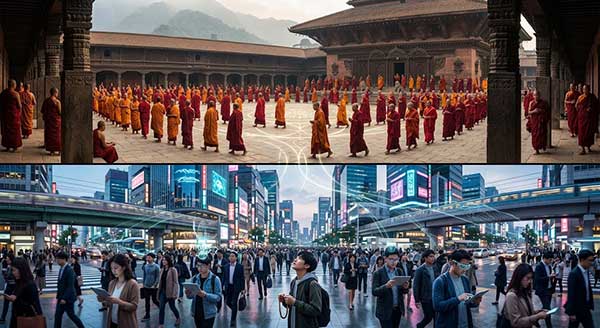
Buddhist Philosophy: Timeless Life Lessons From Buddha That Still Matter Today
The first time I walked into a meditation center in the United States, I was twenty-six, broke, and nursing a grudge I had been carrying for three years. I did not go there for enlightenment. I went because a friend from Seattle kept telling me it would help, and I had run out of better ideas.
The room smelled like old wood and tea. A woman in her sixties with short gray hair sat at the front, and she talked for about fifteen minutes before we meditated. I do not remember most of what she said. But I remember one sentence, because it landed in a way I was not ready for.
“You have been trying to think your way out of a problem that only your heart can solve.”
I did not know it then, but that was Buddhist philosophy. Not the exotic, incense-heavy version. The plain, practical version that has been quietly shaping how people live for more than two thousand years.
The Buddha did not teach in temples. He taught on roadsides, under trees, in the middle of ordinary life. His teachings were not meant to be collected and admired. They were meant to be used. And the strange thing is how well they hold up. Not as relics. As tools.
What Buddhist Philosophy Actually Says About Suffering
Here is the part most people skip. Buddhism does not begin with peace. It begins with the opposite. The first noble truth is that suffering exists. Not as a punishment. Not as a failure. As a fact. Pain, loss, aging, disappointment — these are not anomalies. They are part of the deal.
That framing is more radical than it sounds. We live in a culture that treats discomfort as a problem to be solved. The wrong job, the wrong partner, the wrong city — if you feel bad, something must be wrong. Buddhism says no. Feeling bad is not evidence that your life is broken. It is evidence that you are alive.
The psychologist Mark Epstein, a longtime student of Buddhism and author of “Thoughts Without a Thinker,” has written extensively about this. He trained as a psychiatrist at Harvard and later integrated Buddhist practice into his clinical work. In his books, he argues that Western psychology and Buddhist thought are not competitors. They are asking the same question: how do we relate to pain without being destroyed by it? The difference is that Buddhism does not just offer relief. It offers a way to sit with the pain without running.
The Teaching That Would Not Let Me Go
There is a line from the Dhammapada, one of the oldest collections of the Buddha’s sayings, that I have taped to my desk:
“Hatred is never appeased by hatred. Hatred is only appeased by love. This is an eternal law.”
I used to think that was beautiful and impractical. Then I tried it. Not in a grand way. In a small way. I had been angry at a friend for months. The anger was justified, which made it harder to release. One day, I did something that felt ridiculous: I wrote him a note saying I missed him. I did not mention the fight. I did not demand an apology. I just opened the door. And the anger, which had felt so solid, began to dissolve.
This is not a story about forgiveness as a moral victory. It is about the mechanics of the mind. Resentment is a heavy thing to carry. Letting it go is not weakness. It is weight loss.
The Buddha did not ask people to be nice for the sake of niceness. He was interested in what actually reduces suffering. And it turns out that love, in the broadest sense, works better than resentment. Not because it is saintly. Because it is lighter.
Living in the Present Moment Is Not a Cliché
The Buddhist emphasis on the present moment has been repeated so often that it has gone numb. “Be here now.” “Stay present.” “Don’t worry about the future.” It sounds like a greeting card.
But underneath the cliché is something substantial. The Buddha taught that we create most of our own suffering by living elsewhere — in the past, replaying what went wrong, or in the future, dreading what might. The present moment, whatever it contains, is usually more bearable than the stories we tell about it.
Jon Kabat-Zinn, the founder of Mindfulness-Based Stress Reduction at the University of Massachusetts Medical School, brought this teaching into American hospitals in the late 1970s. His program, now taught around the world, strips Buddhist practice of its religious language and offers it as a clinical intervention for chronic pain, anxiety, and depression. The research base is now substantial. A 2014 review in JAMA Internal Medicine found moderate evidence that mindfulness meditation programs improve anxiety, depression, and pain. The present moment, it turns out, is not just a spiritual idea. It is a measurable resource.
I have a friend in Portland who went through an MBSR course after a burnout diagnosis. She told me once that the hardest part was not the meditating. It was realizing how rarely she was actually where her body was. “I would be sitting in my kitchen,” she said, “and I was never in my kitchen. I was always three rooms ahead of myself.” The practice, she said, taught her how to come back. Not perfectly. Just more often.
The Words We Use Are Medicine or Poison
The Buddha took speech seriously. Not as a matter of etiquette. As a matter of karma — the way our actions shape the world we live in. He taught that words have consequences. They can wound or heal. They can connect or divide. And they are never just words.
There is research that backs this up. The psychologist John Gottman, who spent decades studying marriage at the University of Washington, found that the ratio of positive to negative interactions in a relationship predicts its long-term survival with startling accuracy. Words matter. The tone matters. The little acts of verbal kindness or cruelty accumulate into something enormous over time.
This is hard for me. I am quick with words. Too quick, sometimes. The Buddha’s teaching here is not about being a doormat. It is about recognizing that every sentence is a small act of creation. You are building something with your mouth. The question is what.
Self-Love Is Not Selfishness
There is a teaching in the Buddhist tradition that sounds almost heretical to Western ears: you cannot truly love another person until you have learned to love yourself. Not in the narcissistic sense. In the practical sense. If you are hungry, you cannot feed someone else. If you are drowning, you cannot save anyone.
The psychologist and meditation teacher Tara Brach has built an entire career around this idea. Her book “Radical Acceptance” argues that the root of most psychological suffering is the war we wage against ourselves. The inner critic. The feeling of not being enough. The constant striving to earn worth. Brach, who holds a Ph.D. in clinical psychology, blends Buddhist philosophy with Western therapy in a way that has reached millions of readers. Her core message is simple and ancient: you cannot hate yourself into being better.
I spent years trying. I thought that if I was hard enough on myself, I would finally get it right. The result was exhaustion. Not improvement. The Buddha’s teaching on self-compassion is not a license for laziness. It is a diagnosis. The person who treats herself with contempt will eventually have nothing left to give.
What I Still Struggle With
I want to be honest about how little I actually live up to any of this. I still replay old arguments. I still catch myself comparing my insides to other people’s outsides. I still chase things I know will not satisfy me, because the chasing feels like movement, and movement feels like progress.
The difference now is that I catch it faster. The teaching has not made me perfect. It has made me less confused about the direction. When I am lost, I know where the path is. The walking is still my responsibility.
The Buddha is often quoted as saying, “No one saves us but ourselves.” That line used to depress me. It felt like an abandonment. Now I think it is the opposite. It is a trust. The path is yours. The walking is yours. The arrival, whatever that means, is yours too.
The Smallest Possible Practice
You do not need a meditation cushion or a teacher or a weeklong retreat to begin. You need one moment. One pause. One breath where you notice the air moving in and out, and you choose not to follow the thought that wants to carry you away.
That is the whole thing. Not the escape from suffering. The end of the fight against it. The Buddha did not promise a life without pain. He promised a way to hold the pain without being consumed by it.
That is not a philosophy to admire from a distance. It is a way of walking through the world. It is available at the kitchen sink. In the traffic jam. In the middle of the argument. Not later. Not when things settle down. Now.