Chronic Stress Symptoms: What Your Body Does When You Ignore It for Too Long
The first sign was my jaw. I woke up one morning in Portland and could barely open my mouth. The muscle had locked overnight, tight as a fist. I had been clenching in my sleep without knowing it. Had been clenching for months, maybe longer. My dentist told me the enamel on my back teeth was wearing thin. “Stress,” she said, not as a diagnosis but as a shrug. Like she saw it every day.
She probably did.
Here is the thing about chronic stress: it does not announce itself. It does not arrive with a bang. It seeps in through the cracks and starts rearranging your body while you are too busy to notice. By the time you feel it, it has already been there for a while. You just had not been paying attention.
The American Psychological Association has been tracking stress levels in the United States for years. Their annual “Stress in America” survey consistently finds that adults report higher stress than they believe is healthy. A majority say they are not doing enough to manage it. The gap between what we feel and what we do about it is where the damage happens.
How Chronic Stress Shows Up in Your Gut
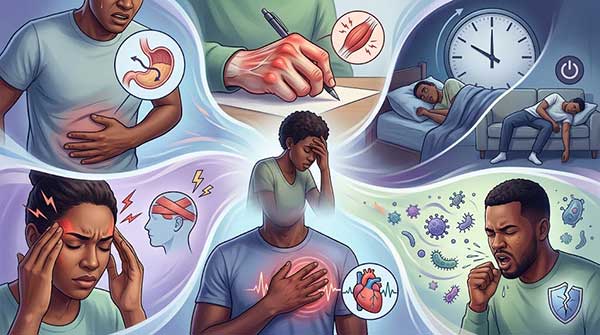
The gut is not just a digestive organ. It is a second brain. The gut-brain axis, the communication network between your enteric nervous system and your central nervous system, is one of the most active areas of neuroscience research right now. John Cryan at University College Cork has published extensively on how gut microbes respond to stress and mood. The short version: what happens in your head reaches your gut fast. Bloating, nausea, irregular bowel movements — these are not just dietary issues. They are often stress signals.
I have a friend in Minneapolis who spent a year seeing gastroenterologists for stomach problems that would not go away. Every test came back normal. The doctors shrugged. Then a nurse asked her, quietly, if she had been under a lot of pressure. She burst into tears in the exam room. The stress was not in her stomach. It was in her life. The stomach was just the messenger.
Stress Pain Lives in the Body
Headaches. Backaches. Shoulder pain that feels like it has been there forever. That stiffness at the base of your skull that never quite goes away. Chronic muscle tension is one of the most common physical responses to ongoing stress. The body prepares for a threat that never arrives, and the preparation itself becomes the injury.
Jaw clenching is a particularly sneaky one. Most people do not know they are doing it until the pain shows up. The temporomandibular joint, or TMJ, takes a beating when you are grinding and clenching through the night. Your dentist can often see the damage before you feel it.
Why Stress Ruins Your Sleep Even When You Are Exhausted
Here is the cruelest trick stress plays. It exhausts you during the day, then refuses to let you sleep at night. The mind races. The body will not settle. You lie there knowing you need rest, knowing the alarm is coming, and the knowing only makes it worse.
The physiology is straightforward. Stress activates the sympathetic nervous system — fight or flight. Heart rate up. Adrenaline up. Cortisol up. Sleep requires the opposite. The parasympathetic system. Rest and digest. When stress is chronic, the body forgets how to switch. The dial is stuck on high alert, even at two in the morning.
The National Sleep Foundation has published guidance on stress and sleep for years. The relationship is bidirectional. Stress worsens sleep, and poor sleep worsens stress. Breaking the loop requires interrupting both sides at once. It is not enough to manage the stress. You have to actively teach the body how to wind down.
Your Skin Is Not Hiding Anything
Skin problems are one of the most visible signs of stress, and one of the most embarrassing to talk about. Rashes that appear out of nowhere. Hives. Acne that will not clear. Flare-ups of conditions that had been under control. The skin is an organ, and it responds to stress like any other organ. Inflammation increases. Healing slows. The barrier breaks down.
The American Academy of Dermatology has long noted the connection between stress and skin conditions like psoriasis, eczema, and acne. Stress does not cause these conditions. But it makes them worse. Much worse. The skin becomes a mirror, and what it reflects is not flattering.
When Your Hands Start Doing Things You Did Not Tell Them To
Nail biting. Hair pulling. Skin picking. Leg bouncing. These are called body-focused repetitive behaviors, and they are astonishingly common under stress. They are not habits in the ordinary sense. They are regulation attempts. The body is trying to discharge nervous energy, and it has found a route that works, however destructively.
The TLC Foundation for Body-Focused Repetitive Behaviors estimates that millions of Americans struggle with these patterns. Trichotillomania, compulsive hair pulling, alone affects an estimated one to two percent of the population. The numbers are probably higher, because people hide it. They are ashamed of it. They think they should be able to stop.
Shame does not stop the behavior. It just makes it secret. And the secrecy feeds the stress, which feeds the behavior, which feeds the shame. The loop tightens.
What Stress Does to How You Eat
Here is where I have the most trouble. Under stress, I eat too much. Or too little. Never the right amount. The appetite goes haywire, and food becomes either a comfort or a threat, but never just food.
The research on stress and eating patterns is clear. Some people restrict. Some people binge. Both are attempts to regulate an overactive stress response. The drive-thru run at 10 p.m. is not about hunger. It is about numbing. The skipped meals are not about discipline. They are about the stomach being too tight to accept anything.
Neither pattern fixes the stress. Both patterns add to it. The body is being asked to carry a load it was never meant to carry, and the eating is just a symptom of the carrying.
What to Do When the Body Starts Speaking
Here is what I have learned. The body does not lie. It does not exaggerate. It just keeps trying to get your attention until you listen. The jaw. The gut. The skin. The sleepless nights. The food. All of it is the same message, sent through different channels: slow down, pay attention, something needs to change.
The first step is noticing. Not fixing. Not judging. Noticing. The second step is moving. Not a workout. Just movement. A walk. Stretching. Anything that tells the nervous system the threat is not immediate. The third step is asking for help. A therapist. A doctor. A friend who will not try to fix it in one conversation.
The source text I keep coming back to this month says it plainly: if the stress has become unmanageable, professional help is not a sign of weakness. It is a form of intelligence. You do not have to white-knuckle your way through a body that is crying out for care.
I think about my jaw. The dentist fitted me for a night guard. It helps. But the real fix was not the plastic. It was learning to notice when I was clenching during the day. At my desk. In traffic. Reading emails. The noticing did not eliminate the stress. It just stopped the stress from living in my body without my knowledge.
That is the whole game, I think. Not beating stress. Not eliminating it. Just becoming a better listener. The body is already talking. The question is whether you are ready to hear it.
A Few Things People Keep Asking
How do I know if my stress is chronic or just a bad week?
A bad week fades. Chronic stress does not. The symptoms — the sleep problems, the gut issues, the muscle tension — keep showing up even after the immediate pressure passes. If you cannot remember the last time you felt rested, that is a signal. If your body is sending the same complaints for weeks or months, that is not a bad week. That is a pattern.
Can stress really cause physical symptoms, or is it all in my head?
The symptoms are real. The gut-brain connection is measurable. The muscle tension is measurable. The sleep disruption is measurable. The fact that stress originates in the mind does not make its effects imaginary. The body and brain are one system. What happens in one shows up in the other.
When should I see a doctor about stress symptoms?
If the symptoms are interfering with your daily life, see someone. If the sleep problems have lasted more than a few weeks, if the gut issues will not resolve, if the pain is constant, if the eating patterns feel out of control — these are signs that the stress has moved beyond self-management. A primary care doctor can rule out other causes. A mental health professional can help with the stress itself. Neither is a last resort. Both are just care.