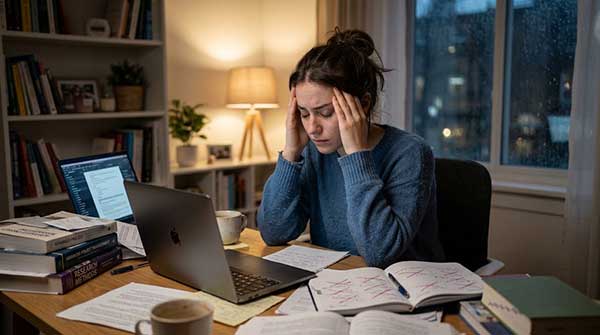
Mindfulness and Procrastination: Stop Escaping and Start Taking Action
I sat in my parked car for twenty minutes last Tuesday, scrolling through nothing, while my apartment sat there waiting for me. I needed to call a friend. It was not a hard call. It was just a phone call. But I could not get out of the car. I kept telling myself I would do it in five minutes. Five minutes passed. Then ten. Then twenty. The call never happened.
That is the thing about procrastination. It is not always about avoiding work. Sometimes it is about avoiding life. The big, heavy, ordinary life that asks you to show up and be seen.
A few years ago, I started noticing a pattern in my own life. Every time I felt unseen, unheard, or unappreciated, I would retreat. The retreat did not look like hiding. It looked like busyness. Endless task management. Reorganizing things that did not need reorganizing. Answering emails from people who did not matter. Anything to avoid the sharp, uncomfortable feeling of being present in a moment that had no guarantee of going well.
The source text I keep thinking about says something I have never heard anyone else say this clearly: procrastination is not a time management problem. It is an emotional regulation problem. When we cannot access a feeling, when we cannot let it move through us, we freeze. We escape. We find a small, safe corner of the day and burrow into it, telling ourselves we are being productive.
What Mindfulness Actually Has to Do With Procrastination
The word mindfulness gets thrown around a lot, but at its core, it is simpler than most people think. It is just the practice of noticing what is happening inside you right now. Not fixing it. Not judging it. Not running from it. Just noticing.
The source material makes a connection that took me years to feel in my own body: the more you increase your body awareness, the less you need to escape. When you can feel the tightness in your chest, the hollowness in your stomach, the vague dread sitting somewhere between your ribs — when you can actually locate it in your body — it loses some of its power to drive you into hiding.
A lot of procrastination is just an attempt to regulate an emotion we cannot name. We feel something uncomfortable, and we reach for the nearest distraction. The phone. The snack. The quick win. The familiar loop of checking and scrolling. It works for a few minutes. Then the feeling comes back, louder, and we reach again.
The cycle only breaks when we stop reaching and start feeling.
The Body Keeps Trying to Tell You Something
The source text says something that sounds almost too obvious to matter: when you move your body, when you breathe, when you feel yourself from the inside, you come home to yourself. And when you are home, you do not need to run.
There is real science behind this. The concept is called interoception — the ability to sense what is happening inside your own body. Researchers have found that people with better interoceptive awareness tend to regulate their emotions more effectively. A 2018 study published in the journal Biological Psychology found that people who could accurately detect their own heartbeat were better at managing stress. They were less likely to be hijacked by their emotions. They had more choice about how to respond.
This matters for procrastination because procrastination is, at its root, a failure of choice. You do not choose to avoid the hard thing. The avoidance chooses you. It happens before you know it is happening, driven by a nervous system that has learned that certain feelings are too dangerous to feel.
The way out is not more willpower. It is more awareness. You have to learn to feel the feeling before it turns into the urge to escape. That is the gap. That is where freedom lives.
What the Procrastination Loop Looks Like From the Inside
I want to describe the loop in a way that will sound familiar if you have ever been stuck in it.
First, there is the thing you are avoiding. It is usually something that matters. Not a chore. A real thing. A conversation. A decision. A piece of creative work that has been waiting for you.
Then there is the feeling. It rises up when you think about the thing. It might be fear. It might be resentment. It might be grief. It might be the accumulated weight of every time you have felt unseen, unheard, dismissed. The feeling is not always obvious. Sometimes it is just a vague sense of pressure in the head or a tightness in the jaw.
Then there is the escape. The phone. The TV. The snack. The sudden, urgent need to organize your desk. The mental list of all the other things you need to do first.
Then there is the aftermath. The shame. The quiet, familiar voice that says you have failed again, that you are lazy, that you will never change. The shame does not help. It just adds another layer of heaviness to the thing you were avoiding. And the cycle repeats.
The source text points at something crucial here: over time, the escape becomes a secondary gain. It is not just an avoidance. It is a strange kind of comfort. The procrastination itself becomes a way of getting something — relief, numbing, a sense of control in a small, contained space — even though the cost is enormous.
What You Can Actually Do Differently
The next time you notice yourself reaching for the escape, try this. Do not fight the urge. Just notice it. Notice the thing you are avoiding. Notice the feeling that rises up when you think about it. Notice where that feeling lives in your body. Is it in your chest? Your throat? Your stomach? Just locate it. That is the practice.
Then take one breath. Not a deep, dramatic breath. Just a normal one. And on the exhale, see if you can stay with the feeling for a few seconds longer than you usually would. Not to fix it. Just to let it be there.
This is not a quick fix. It is a skill. It builds over time. But every time you do it, you strengthen the connection between your body and your awareness. And that connection is the antidote to the escape.
I have a friend in Boulder who started doing this after a period of chronic work avoidance. She did not change her schedule. She did not download an app. She just started pausing, once or twice a day, when she noticed she was about to bolt into distraction. She would put her hand on her chest and say, out loud, “What am I feeling right now?” Most days she could not answer. But the asking was the practice. And the practice changed the loop.
A Question Worth Sitting With
If you are someone who procrastinates a lot, do not ask yourself why you are so lazy. Ask yourself what you are running from. Not what task. What feeling. What would happen if you stopped running and turned toward it?
The answer is not as scary as the running makes it seem. I know because I have tried it. The thing I was avoiding in the car last Tuesday was not the phone call. It was the fear of being a bad friend. The fear that I had waited too long, that the friendship had quietly expired, that I would have to face my own failure to show up. That fear was so big and so old that I had built an entire habit of avoidance around it.
When I finally made the call, my friend answered on the second ring. She was not mad. She was tired. We talked for an hour. The fear was real, but it was not the truth. The truth was waiting on the other side of the feeling, and I only had to feel it long enough to get there.
Procrastination is not a character flaw. It is a signal. It is the body’s way of saying there is something here I cannot hold. The work is not to become more disciplined. The work is to become more willing to feel. The discipline follows. Not all at once. But it follows.
A Few Loose Ends
What if I do not know what I am avoiding?
That is normal. The avoidance is often faster than the awareness. Start with the smallest possible observation. You are sitting at your desk, and suddenly you are on your phone. Do not judge it. Just notice: I was about to work, and now I am here. What happened in between? The gap is where the answer lives. Keep looking. You will find it.
Is procrastination always about fear?
Not always. Sometimes it is about fatigue. Sometimes it is about grief. Sometimes it is about a life that has been built around things you never wanted in the first place. The point is not to diagnose yourself. The point is to get curious. The feeling that drives the escape is always worth paying attention to, whatever it is.
How long before I actually stop procrastinating?
I do not know. The source text does not promise a timeline. But the more you practice staying with the feeling instead of escaping it, the less power the escape has over you. The loop loosens. The gaps between awareness and action get shorter. You will still procrastinate sometimes. But you will understand why. And understanding is the beginning of freedom.