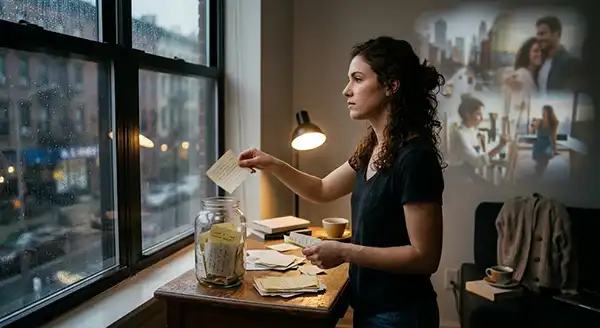
How to Stop Regretting Your Choices and Embrace the Life You Have
The worst question I ever asked myself was simple and devastating: What if?
It came late at night, as it always does. I was lying in bed in my apartment in Austin, scrolling through old photos on my phone. There was a picture of me at twenty-two, standing in front of a college in Boston I had decided not to attend. I had chosen a different school, a different city, a different trajectory. And that night, for reasons I still cannot fully explain, I let myself fall into the hole.
What if I had gone? What if I had taken the other job? What if I had stayed in that relationship instead of leaving? The questions came fast, each one opening another door to a life I would never live. I spent two hours inside those imagined lives, and when I finally fell asleep, I woke up exhausted, as if I had actually walked through all of them.
The philosopher Soren Kierkegaard once said that life can only be understood backward but must be lived forward. I think about that line often. It is true, but it does not help at two in the morning when the what-ifs start circling.
What “The Midnight Library” Gets Right About Regret
Matt Haig’s novel “The Midnight Library” came to me at the right time, the way books sometimes do. It tells the story of Nora Seed, a woman so consumed by regret that she finds herself in a library where every book contains a different version of her life. Each one is the life she would have lived if she had made a different choice. She can step into any of them, try them on, see what would have happened.
The premise is science fiction, but the emotional truth is not. Every person I know has a private library of unlived lives. The one where you stayed in your hometown. The one where you went to law school. The one where you married your first love. The one where you never sent that text, never made that call, never walked away.
Nora tries on these lives and discovers something quietly devastating: none of them are better. They are different, yes. Some are richer, some are more glamorous, some are less lonely. But each one contains its own particular sorrow. Each one has its own regrets, its own losses, its own hidden costs. The perfect life does not exist. There are only trade-offs.
This is the first lesson of the midnight library, and it is a hard one. You cannot escape regret by making different choices. You can only exchange one set of regrets for another.
Why Your Brain Keeps Replaying the Past
There is a name for what happens when you lie in bed and torture yourself with alternate versions of your life. Psychologists call it counterfactual thinking. It is the act of imagining how things could have turned out differently. And it is not always harmful. Sometimes it helps you learn from mistakes. But when it becomes obsessive, it turns into a kind of mental quicksand.
The psychologists Daniel Kahneman and Amos Tversky, whose work on decision-making won a Nobel Prize, were among the first to study regret systematically. They found that regret is not just about the bad outcome. It is about the story you tell yourself about the choice that led there. If you can imagine an alternative action that would have produced a better result, you feel regret. The more vivid the imagined alternative, the sharper the regret.
This is why we torture ourselves with the road not taken. The brain has an almost unlimited capacity to generate alternate realities. It can picture the other school, the other partner, the other city with cinematic clarity. And the clearer the picture, the more it hurts.
But here is what Kahneman and Tversky also found: the intensity of regret fades over time. What feels unbearable at thirty becomes a faint ache at forty, and by fifty it is just a story you tell about who you used to be. The brain cannot sustain the what-if forever. Eventually, the life you have becomes more real than the lives you did not.
What “Sliding Doors” Taught Us About Fate and Choice
The source material I am drawing from this time references a film I watched in a near-empty theater in the late 1990s. “Sliding Doors,” starring Gwyneth Paltrow, tells two parallel stories about the same woman. In one, she catches the train. In the other, she misses it. Everything else follows from that single, seemingly trivial moment.
The film was marketed as a meditation on chance and choice. But looking back, I think it was about something else. The woman’s life changes dramatically depending on whether she catches the train, yes. But the same important people keep showing up. The same themes keep recurring. The same essential conflicts find their way to her, just by different routes.
This is the second lesson. There are certain things in your life that will find you no matter which train you catch. Not because of fate or destiny in the cosmic sense. Because you carry them with you. Your patterns, your wounds, your gifts, your hungers—these do not stay behind when you make a different choice. They travel with you. They shape whatever life you step into.
The therapist and author Esther Perel, who has spent decades studying relationships, makes a similar point in a different context. She says that changing partners does not change the problem if the problem is inside you. You can leave one relationship and start another, but if you have not done the inner work, you will find yourself having the same fights with a different person.
The same is true of the bigger life choices. The other city, the other job, the other version of your life—they are not escape hatches. They are just different rooms in the same house. And you are still you, standing in the middle of them.
The Dangerous Illusion of the Perfect Path
Here is where I have to be honest. I have spent years believing there was a correct version of my life, and that I had somehow missed it. The right career. The right relationship. The right city. The right timing. If I could just figure out where I went wrong, I could course-correct and finally arrive at the life I was supposed to have.
That belief is a trap. It assumes that life is a series of doors, and behind one of them is the good life, and if you pick the wrong door you are stuck in the bad life forever. But that is not how it works. Every door leads to another door. Every choice leads to another choice. The path does not end. The choosing does not end.
The psychologist Barry Schwartz, who wrote “The Paradox of Choice,” has studied how modern people deal with the overwhelming number of options available to them. His research, conducted over decades at Swarthmore College, found that more choice does not make people happier. It makes them more anxious. Because the more options you have, the more you worry that you picked the wrong one.
The solution, Schwartz argues, is not to find the perfect choice. It is to accept that “good enough” is actually good enough. The person who is always scanning for the better option is never satisfied with the option they have. The person who commits to their choice, with all its imperfections, is the one who actually gets to live.
Regret Is Not the Same as Learning
There is a difference between examining your past and drowning in it. The source text makes this distinction with a clarity I have been trying to internalize for years: leave room in your life not for regrets, but for the lessons that come from them.
The lesson is not the same as the regret. The regret is the ache. The lesson is the insight. You can extract the insight without marinating in the ache.
Take the relationship that ended badly. The regret says: I should have tried harder, I should have left sooner, I should have said the thing I did not say. The lesson says: I need to communicate more honestly, I need to notice when I am shrinking, I need to choose partners who can meet me in the middle.
The regret keeps you stuck in the past. The lesson moves you forward. Both are available to you. The question is which one you feed.
Living With the Life You Actually Have
Here is what I have learned, slowly and with great reluctance. The life you have is not a consolation prize. It is not the thing you settle for because you missed the good one. It is the only life that is real. The others are fiction. Beautiful, tempting, heartbreaking fiction. But fiction.
The poet Mary Oliver wrote a line that has become almost clichéd through repetition: “Tell me, what is it you plan to do with your one wild and precious life?” The line is overused, but the question is not. Because the life you are living right now is the only one you get. Not the parallel versions. Not the what-ifs. This one. The one with the messy apartment and the imperfect job and the people who love you in ways you do not always notice.
The midnight library is a beautiful fantasy. But it is a fantasy. You cannot actually step into another version of your life. You can only step more fully into the one you have.
What I Am Doing About the What-Ifs
I still have the midnight library in my head. I still visit it late at night, when the phone is off and the room is dark and the what-ifs start their slow crawl through my mind.
But now I know what I am looking at. The lives on those shelves are not real. They are stories. And stories can teach you something, but they cannot hold you.
The next time you find yourself wandering through your own midnight library, pause. Ask yourself: What am I actually looking for here? Am I looking for a lesson, or am I looking for a place to hide from the life I have?
The lesson is there if you want it. The hiding is there too. Both are available. The choice, as always, is yours.
That is the real message of the midnight library, I think. Not that you should stop wondering about the other paths. But that you should stop believing they are better. They are just different. And different is not the same as better.
The only life that matters is the one you are in. The only choice that matters is the one you make next. Not the one you made ten years ago. The next one. The one you make tomorrow morning, when you wake up and decide how to spend your one wild, imperfect, irreplaceable day.
Questions I Still Turn Over
Is it possible to stop regretting past choices entirely?
I do not think so. Regret is part of how the brain learns. The goal is not to eliminate it. The goal is to stop letting it run the show. Notice it. Learn from it. Let it pass. That is not the absence of regret. That is a healthy relationship with it.
How do I know if I am learning from a past mistake or just dwelling on it?
Learning feels like movement. It produces insight, clarity, a sense of direction. Dwelling feels like spinning. It produces exhaustion, confusion, and the same thoughts over and over. If you are having the same conversation with yourself every night, you are dwelling. If you are having a new conversation, you are learning.
What if I genuinely made a choice that ruined my life?
That is a heavy question, and I do not want to dismiss it. Some choices have real, lasting consequences. But even the worst choice is not the end of the story. You can rebuild. You can start again. Not from zero—you carry the lessons—but from a new place. The life you have may not be the one you planned. But it is still yours. And it is not over yet.