Who Are You Inspiring Without Knowing It? The Hidden Ripple of Your Life
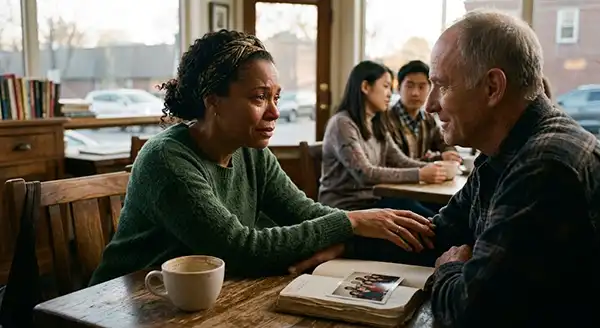
The message came on a Tuesday afternoon in March. I was sitting in a coffee shop in Pittsburgh, trying to finish a project that was not going well, when my phone lit up with a name I had not seen in six years. Her name was Rachel. We had worked together briefly at a nonprofit in Chicago, back when I was twenty-four and mostly terrified of everything. She had been the competent one—calm, organized, unflappable. I had been the one who left meetings early and rehearsed conversations in the bathroom mirror.
She was writing, she said, to tell me something. It had taken her six years to say it. That thing I had said to her once, in the break room, when she was agonizing over whether to leave the job—she had thought about it almost every day since. She had finally quit. She had gone back to school. She was doing work she loved now. And she wanted me to know that the conversation we had that afternoon, the one I barely remembered, was the thing that gave her permission to change.
I sat in that coffee shop with my phone in my hand and felt something I could not name. Not pride, exactly. Something stranger. A kind of vertigo. The realization that a moment I had already forgotten had been quietly shaping someone else’s life for six years.
We have no idea what we are to each other. That is the truth I keep coming back to. We think our impact is small because we cannot see it. But the impact is there, moving through people we have not spoken to in years, changing things we will never know about.
The Science of Unseen Influence
There is a branch of social psychology that studies exactly this. It is called social contagion theory, and its central finding is both humbling and exhilarating: behaviors, emotions, and attitudes spread through social networks in ways that are real, measurable, and largely invisible to the people involved.
The researchers Nicholas Christakis at Yale and James Fowler at UC San Diego published a series of studies in the New England Journal of Medicine and elsewhere showing that happiness spreads through social networks. Obesity spreads. Smoking cessation spreads. Loneliness spreads. Not just between close friends, but between friends of friends. Your behavior influences people you have never met.
A 2014 study in the Journal of the Royal Society Interface found that positive mood, physical activity, and other health behaviors diffuse through social networks in ways that suggest a kind of quiet, continuous influence. The authors used longitudinal data from the Framingham Heart Study to map these effects. What they found was that your choices echo outward, often by two or three degrees of separation. You do something small—a walk, a kind word, a decision to change—and that choice ripples through the people around you, and through the people around them.
This is not mystical. It is network science. And it means something important: the version of your life that feels ordinary to you is, for someone else, a model. A possibility. A door they did not know was open.
The Conversations I Cannot Remember
Here is the strange part. I do not remember the conversation Rachel was talking about. I have tried. I have gone back through old emails, old calendars, old photos. Nothing. The moment that changed her life is, for me, a blank.
This is not unusual. The psychologist Adam Grant, who teaches at the Wharton School and has spent years studying how people help each other, makes a point that has stayed with me: we consistently underestimate the impact of our actions on others. In his research on what he calls “prosocial behavior,” Grant found that people who give advice, support, or encouragement often dismiss their own contribution as trivial, while the recipient experiences it as significant. The giver forgets. The receiver remembers. That asymmetry is built into the way social influence works.
Grant calls this the “invisible impact problem.” We do not see the results of our kindness, our honesty, our willingness to show up, because those results happen in other people’s lives, on their timelines, often years after the fact. The feedback loop is broken. We pour ourselves into moments that feel like nothing, and we never know what they became.
The psychologist Erica Boothby, at the University of Pennsylvania, has studied a related phenomenon she calls the “liking gap.” Her research shows that after a conversation, both people consistently underestimate how much the other person liked them. We walk away from interactions thinking we were awkward, forgettable, a little too much or not enough. The other person walks away thinking, “That was nice. I would like to do that again.” The gap between our self-perception and others’ actual experience of us is wide, and it is almost always wide in the wrong direction.
What I Did Not Know About My Own Life
For most of my twenties, I assumed I was invisible. Not in a dramatic, suffering way. Just quietly. I assumed that the things I did—the emails I sent, the conversations I had, the small acts of showing up—were background noise. That no one was really paying attention. That my life was not making a difference to anyone.
That assumption was wrong. I know that now, not because I became more important, but because I started asking.
A few years ago, I started doing something simple. When someone came to mind—an old teacher, a former colleague, a friend I had lost touch with—I would reach out and tell them what they had meant to me. Not a long message. Just a few sentences. “I was thinking about that thing you said once. It stayed with me. Thank you.”
The responses surprised me. Not because people were grateful. Because so many of them had no idea. The teacher who had written a note on my paper thirty years ago did not remember writing it. The colleague who had talked me through a hard decision did not know the decision had turned out well. The friend who had shown me kindness during a dark season had no idea the season was dark.
The inspiration was real. The awareness was not.
The People Who Shaped Me Without Knowing It
I started making a list. Not a formal list. A mental one. The people who had changed my life without ever being told.
Mrs. Harmon, my fourth-grade teacher, who let me eat lunch in the classroom when the cafeteria was too loud. I never told her what that meant. She probably thought she was just letting a shy kid sit quietly.
My first boss, a woman named Dana, who pulled me aside after a meeting I had botched and said, “You are better than you think you are.” I was twenty-three. I did not believe her. But I remembered the sentence, and it carried me through the next decade.
A stranger on a plane who listened to me talk about my father’s death without flinching, without offering advice, without trying to fix it. Just listened. I never learned her name. She will never know what that twenty-minute conversation did to me.
The list goes on. And what strikes me, looking at it, is how ordinary all of it was. None of these people did anything heroic. They just paid attention. They just showed up. They just, for a moment, treated me like I mattered.
That is the thing about inspiration. It is not usually grand. It is small. It is a sentence. A gesture. A moment of genuine presence. And it lands in ways the giver cannot predict and will probably never see.
Why We Do Not Tell People
The question, then, is why we keep this to ourselves. Why do we let the people who shaped us go through their lives not knowing what they did?
Part of it is awkwardness. It feels strange to message someone out of the blue and say, “You changed my life.” It feels heavy. It feels like you are asking for something, or confessing something, or making the other person responsible for your happiness.
But the research suggests the opposite. The psychologist Amit Kumar, at the University of Texas at Austin, has studied the effects of expressing gratitude. His experiments show that people consistently overestimate how awkward a thank-you message will be and consistently underestimate how much it will mean to the recipient. The person who receives the message feels genuinely moved. The awkwardness is almost entirely in the sender’s head.
Kumar’s work, published in the journal Psychological Science, found that people who wrote gratitude letters were surprised by how positive the recipients’ reactions were. The recipients felt happier, more connected, more valued. The senders had expected discomfort and found joy.
The gap is real. We hold back because we are afraid of being weird, and in doing so, we withhold from people the very thing that would have meant the most to us if the roles were reversed.
What I Am Trying to Do About It
I have started to close the gap. Slowly. Incompletely.
When someone comes to mind who has helped me, I tell them. Not with a big dramatic message. Just a few sentences. “I was thinking about you. That thing you said, that thing you did—it mattered. Thank you.”
The responses have been, without exception, warm. Some people have written back with tears. Some have said, “I needed to hear this today.” Some have said, “I did not know.” All of them have been glad I reached out.
And here is what I have learned on the other side of it: the telling is not just for them. It is for me too. It reminds me that the connections are real. That the web is dense. That the people who have shaped me are still alive, still reachable, still capable of being touched by my gratitude.
The Question I Keep Asking Myself
So, who inspired you?
Not in the abstract. Specifically. Who said the thing you needed to hear? Who showed up when it mattered? Who gave you permission, or comfort, or a different way of seeing?
And here is the harder question: have you told them?
Not because you owe them. Because the telling is a gift. To them, yes. But also to you. It closes the loop. It makes the invisible visible. It reminds both of you that the relationship was real, that the moment mattered, that the influence moved in both directions.
I did not know about Rachel’s six years of quiet transformation until she told me. And when she told me, something in me shifted. Not pride. Relief. The relief of knowing that the small, forgotten moments of my life were not wasted. That they were seeds. That they grew, somewhere, in someone, in ways I never saw.
That is the thing about inspiration. It is mostly hidden. It moves through the world like water underground, surfacing in places you would never think to look. And the only way to see it is to ask.
So ask. Tell the person who changed your life that they changed your life. It will feel awkward. That is fine. The awkwardness is small. The gift is large.
And while you are at it, pay attention to the people who might be inspiring you right now, without your noticing. The coworker who shows up with steady kindness. The friend who listens without fixing. The stranger who smiles at you on the bus. You are being shaped by them too. And someday, maybe, you will be the one writing the message, six years late, to say: that thing you did. It stayed with me. It changed things. Thank you.
We are all, without knowing it, someone else’s Rachel. And someone else’s teacher. And someone else’s stranger on a plane.
The web is dense. The ripples are real. The only question is whether we will see them, and whether we will have the courage to name them out loud.
A Few Things Worth Saying Out Loud
What if the person I want to thank does not remember me?
That is okay. The message is not about being remembered. It is about telling the truth. You are not asking for anything. You are offering something: the knowledge that their life intersected with yours in a way that mattered. Whether they remember the moment or not, they will remember being told.
Is it ever too late to express gratitude?
No. The research on gratitude suggests that the timing matters less than the sincerity. A thank-you that arrives years late is still a thank-you. It still lands. It still means something. Do not let the passing of time convince you that the window has closed. It has not.
What if I do not feel like I have inspired anyone?
You have. You just do not know it yet. The research on social contagion suggests that influence is the default, not the exception. Your choices, your kindness, your willingness to keep going—these things ripple outward whether you see them or not. The only question is whether you will be lucky enough, someday, to hear the story of what you set in motion. And even if you never hear it, the ripple is still moving. It is moving right now.