What Are the Symptoms of Postpartum Depression No One Should Ignore
I am not a mother. I have never carried a child. But I have sat in too many living rooms with women I love, watching them try to explain something they had no words for. The baby would be sleeping in the next room. The house would be quiet. And the woman in front of me would be falling apart, one sentence at a time.
The first was my sister, two weeks after her daughter was born. She called me at noon and said she had been standing in the kitchen for forty-five minutes, unable to decide whether to make toast. “It’s not that I’m tired,” she said. “I’m tired. But it’s not that. It’s like I’m under water. Everything is far away.”
The second was my best friend from college, who admitted over coffee that she was afraid to be alone with her own baby. Not because she thought she would hurt him. Because she was terrified she already had—by not feeling what she was supposed to feel. By looking at his face and seeing only a stranger.
The third was a coworker, a woman I barely knew, who broke down in the break room and told me she had not told anyone because she was sure they would take the baby away. “I’m supposed to be good at this,” she kept saying. “Everyone keeps telling me I’m good at this. Why do I feel like a monster?”
Postpartum depression is not rare. It is not shameful. And it is not something anyone should have to survive in silence. But the silence is everywhere.
According to the Centers for Disease Control and Prevention, about 1 in 8 women in the United States experience symptoms of postpartum depression. The American College of Obstetricians and Gynecologists puts the number even higher in some populations, noting that many cases go unreported because women are afraid or unable to seek help. That is roughly 600,000 women a year in this country alone, carrying a weight most of them were never warned about.
This is not “baby blues.” That phrase gets thrown around like it explains something, but the distinction matters. The baby blues affect up to 80 percent of new mothers, arrive within days of birth, and usually fade within two weeks. Postpartum depression is something else. It is deeper, longer, and far more dangerous when left untreated.
What Does Postpartum Depression Actually Feel Like
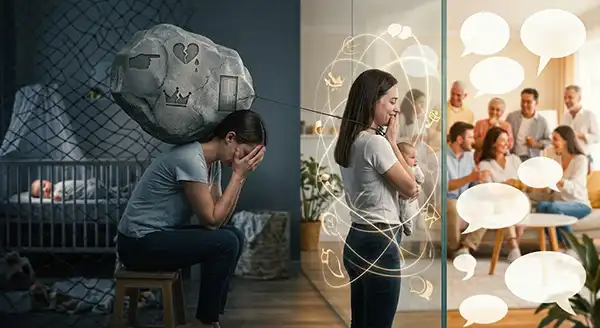
The problem with describing postpartum depression is that it does not look the way people expect. It is not always crying. It is not always visible. Sometimes it is the absence of feeling. The flatness. The sense that the person you used to be has left the building and someone else is doing the mothering now.
The National Institute of Mental Health lists the symptoms without softening them: persistent sadness, anxiety, irritability, difficulty bonding with the baby, overwhelming fatigue, loss of interest in things that once mattered, changes in appetite and sleep, and intrusive thoughts about harming yourself or the baby.
That last symptom is the one nobody talks about. And it is the one that keeps women silent. Because how do you tell someone you love that your brain keeps offering you images you did not ask for? How do you explain that you would never act on them, that the thoughts themselves feel like an assault, when the fear of being judged is so total?
“The scariest part was not the thoughts. It was the fear that if I said them out loud, someone would take my baby away.” — a mother in Portland, in a support group for postpartum depression
That quote has stayed with me for years. It gets at the central horror of this illness: it isolates women at the exact moment they most need connection. The shame becomes a second illness, layered on top of the first.
Why Does Postpartum Depression Happen
Here is what the research actually says. There is no single cause. The condition arises from a collision of biology, psychology, and circumstance.
After birth, estrogen and progesterone levels drop sharply within hours. The thyroid can also dip, producing fatigue and depression. Sleep deprivation, which is universal among new parents, makes everything worse. But the biological shifts are only part of the story.
A 2017 review in the Journal of Clinical Psychiatry found that a personal or family history of mood disorders is one of the strongest predictors of postpartum depression. Women who have experienced depression before pregnancy are at significantly higher risk. So are women with a history of trauma, intimate partner violence, financial stress, or lack of social support.
The CDC also notes that certain groups are disproportionately affected. Black and Latina women, for example, are more likely to experience postpartum depression and less likely to receive treatment. The reasons are structural as much as medical: barriers to care, systemic mistrust, and the crushing weight of a culture that often expects women of color to be strong at all costs.
Postpartum depression is not a character flaw. It is not a sign of being a bad mother. It is a medical condition with identifiable risk factors and effective treatments. But none of that matters if the person suffering cannot say the words.
How to Recognize Postpartum Depression Symptoms in Someone You Love
Here is where the rest of us come in. Because the woman in the middle of it often cannot see herself clearly. She is too busy surviving. Too busy performing. Too busy telling herself she should be grateful, should be happy, should be better than this.
My sister did not recognize her own symptoms. She thought she was just exhausted. It was our mother who finally said, “You have not sounded like yourself in three weeks.” That simple observation, delivered without judgment, was the first crack in the wall.
The symptoms to watch for are not always dramatic. They can be subtle: withdrawing from friends, losing interest in food, becoming unusually quiet or unusually irritable, insisting everything is fine when it clearly is not. The woman who was once meticulous may stop caring about the house. The woman who loved to talk may stop answering the phone.
If you notice these shifts in someone you love, do not wait for her to ask for help. Say something. Not “You should see a doctor.” Something softer. Something like: “I’ve noticed you seem really overwhelmed. I’m here. You don’t have to do this alone.”
The American Psychological Association emphasizes that social support is one of the strongest protective factors against postpartum depression. Not advice. Not solutions. Presence. The simple, steady reminder that she is not invisible.
What Treatment Looks Like
The good news, if there is good news here, is that postpartum depression is treatable. Not easily, not overnight, but treatable.
The first line of treatment is usually therapy. Cognitive behavioral therapy, in particular, has been shown to be effective for postpartum depression. A 2015 meta-analysis published in the Journal of Affective Disorders found that CBT significantly reduced symptoms in new mothers, with effects lasting well after treatment ended. Interpersonal therapy, which focuses on relationships and social roles, is also recommended by the World Health Organization.
For moderate to severe cases, medication may be necessary. Selective serotonin reuptake inhibitors, the most commonly prescribed antidepressants, are generally considered safe for breastfeeding mothers, though the decision should always be made with a doctor who knows the full picture. The National Institute for Health and Care Excellence in the UK has published guidance specifically for postpartum depression, and many American providers follow similar protocols.
Then there is the part no one writes about: the daily work of recovery. The walk around the block. The shower. The ten minutes alone. The decision to eat something, anything, even when food tastes like nothing. The phone call to a friend instead of another hour in the dark.
Recovery is not linear. Some days are better. Some days slide backward. The goal is not to be cured by Tuesday. The goal is to keep showing up.
My sister got better. Slowly. With a combination of therapy, medication, and the stubborn refusal of our family to let her disappear. My friend from college joined a support group and texted me a year later: “I didn’t know other women felt this. Why didn’t anyone tell me?”
That question haunts me. Because the information is out there. It is on government websites and medical portals and the brochures they hand you at the hospital. But it is not being said in the places where it matters: in living rooms, in text threads, in the quiet moments between women who are trying to hold it together.
So I am saying it here.
A Few Things Worth Clearing Up
How is postpartum depression different from the baby blues?
The baby blues arrive early, last a few days to two weeks, and involve mild mood swings, tearfulness, and fatigue. Postpartum depression is more severe and lasts longer. If symptoms persist beyond two weeks, or if they interfere with daily functioning, it is time to seek professional help. The distinction matters because postpartum depression requires treatment.
Can fathers get postpartum depression too?
Yes. The CDC reports that about 1 in 10 new fathers experience paternal postpartum depression, particularly in the first year. The symptoms can look different—more irritability, more withdrawal, more anger—but the underlying condition is real and treatable. The silence around this is just as dangerous as the silence around maternal depression.
What should I do if I think I have postpartum depression?
Tell someone. A doctor, a therapist, a partner, a friend. You do not have to have the perfect words. You just have to start the conversation. If you are having thoughts of harming yourself or your baby, call the National Suicide Prevention Lifeline at 988 or go to the nearest emergency room immediately. Those thoughts are a symptom, not a reflection of who you are.
What I Want You to Know
You are not a bad mother. You are a person in pain, and the pain is telling you lies.
It is telling you that you should be able to handle this alone. That everyone else is doing it better. That the flatness in your chest means something is wrong with you, when in fact it means something is wrong with the support you are not getting.
The body after birth is a storm. The mind after birth is a storm too. Neither storm is your fault. Both storms can be weathered.
But not alone.
The women I love who have walked through this did not do it alone. They did it with therapists and medications and support groups and partners who learned to ask the right questions. They did it by saying the words out loud, one terrifying syllable at a time.
“I need help.”
Three words. They sound so small. They are the heaviest thing in the world to say.
But once they are out, the weight shifts. Not all at once. Not completely. But enough to keep going.
If you are in the middle of postpartum depression, I am not going to tell you it gets better tomorrow. It might not. But it can get better. The research says so. The women I love are living proof.
And if you are watching someone you love go through it, do not wait for the perfect moment. Make the call. Send the text. Show up with food and sit on the floor and do not try to fix anything. Just be there. That presence is not nothing. It is the beginning of everything.
The silence is the enemy. The speaking is the medicine.
So speak. And when you cannot speak, let someone else speak for you.
That is how the healing starts. Not with certainty. With connection. Not with answers. With presence.
You are not alone. You were never alone. And the women who have walked this road before you are already reaching back, ready to walk it with you.