Do Vision Boards Actually Work? What Research Says About Making One That Sticks
The first vision board I ever saw belonged to a woman named Maggie, who was sleeping on my couch in Minneapolis after leaving her husband of eleven years. She had a corkboard propped against the wall, covered in magazine clippings and photographs and torn pieces of paper with words on them. The words were things like “calm” and “safety” and “the ocean.” The images were mostly water, mostly blue, mostly empty space.
I asked her if she really believed in that stuff. She was forty-one, starting over with no job and no plan, and she was cutting pictures of waves out of a travel magazine.
She looked at me for a long time. Then she said, “I don’t know if I believe in it. But it gives me somewhere to look when I can’t sleep.”
That board stayed on my living room wall for six months. I watched her add to it, slowly, the way you add to something that matters. A picture of a small white house near the coast. A map of Oregon. A sticky note that said “I am allowed to want things.”
I have thought about that board many times since. Not because I think it was magic. Because it was doing something real, something I could see but not name. It was giving her a direction to point her attention when the present was too heavy to hold.
What Is a Vision Board and Why Do People Make Them
A vision board is, at its simplest, a collection of images and words that represent what you want your life to become. It is a visual map of a desired future. People make them for careers, relationships, homes, health, travel—whatever they are trying to move toward.
The practice has become wildly popular in the wellness world over the last decade. Pinterest is full of pristine, color-coded examples that look more like interior design projects than tools for self-reflection. But the underlying idea is older than the trend. It is the idea that seeing your goal makes it more real, and that the realness makes it more likely.
There is actually some research on this. The psychologist Gabriele Oettingen, at New York University, has spent decades studying how people pursue goals. Her work on what she calls “mental contrasting” shows that visualizing a desired future can be powerful—but only under certain conditions. The mistake most people make, she argues, is that they visualize the outcome without also visualizing the obstacles. The result is a pleasant fantasy that never turns into action.
Her studies, published in journals like the Journal of Personality and Social Psychology, show that the most effective visualization pairs the dream with the difficulty. You picture where you want to go, and then you picture what stands in the way. That combination, which she calls WOOP (Wish, Outcome, Obstacle, Plan), produces measurable improvements in goal pursuit.
So the question is not whether vision boards work. The question is what kind of vision board you make.
How to Choose What Belongs on Your Vision Board
Here is where most people go wrong. They put too much on the board. The dream job and the dream house and the dream body and the dream vacation all compete for the same square foot of cork. The board becomes a collage of everything you do not have, and looking at it starts to feel like an inventory of lack.
Maggie did the opposite. Her board was sparse. A few images. A few words. Room to breathe. She told me once that she only added something when it made her feel something—not when it looked good, not when it seemed impressive, but when it produced a physical response. A flutter. A release. A quiet yes.
That is the first filter. Not “Should I want this?” but “Do I actually want this?” The two questions are not the same. Most of us have been trained to want things that look good to other people. The vision board is where you get to want things that only make sense to you.
The author and researcher Brené Brown, at the University of Houston, has written about the difference between fitting in and belonging. Fitting in is about becoming what other people approve of. Belonging is about being accepted as you are. The vision board, done well, is a belonging tool. It says: these are the things that matter to me, even if no one else understands.
The practical rule is simple. Before an image goes on the board, ask yourself: Does this feel like mine? Not “Is this a good goal?” Not “Will this impress anyone?” Just: Is this mine? If the answer is not an immediate yes, leave it off.
How to Turn Your Vision Board Into Action
Here is the uncomfortable truth that no one puts on the Pinterest caption: a vision board without action is just decoration. Pretty, inspiring, ultimately useless decoration.
The psychologist Peter Gollwitzer, at New York University, has studied what happens after people set goals. His research on “implementation intentions” shows that the most effective way to follow through on a goal is to decide, in advance, when and where you will act. The simple formula is: “If situation X arises, I will do Y.” The specificity is what makes it work.
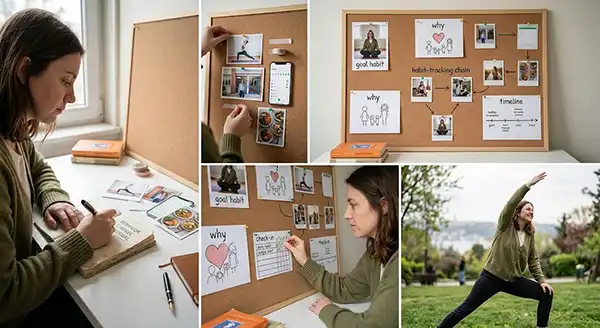
A vision board can support this if you use it differently. Instead of just pasting images, you can attach small action steps. A picture of a finished book, with a note underneath: “Write 300 words before breakfast.” A photo of a mountain trail, with a reminder: “Hike every Saturday morning.” The image is the why. The action step is the how.
Oettingen’s WOOP framework is useful here too. For each item on your board, take two minutes. What is your wish? What is the outcome you want? What obstacle will get in the way? What is your plan for handling that obstacle? The plan does not have to be perfect. It just has to exist.
“A vision without a plan is just a hallucination.” — often attributed to the entrepreneur Will Smith, though the line has been around in various forms for decades
That quote used to annoy me. It felt like something a productivity bro would post on LinkedIn. But there is truth in it. The vision board is the vision. The plan is what happens after you stop looking at the board.
Where to Put Your Vision Board So You Actually Use It
Maggie kept her board in the living room, propped against the wall, impossible to miss. At first I thought this was an aesthetic choice. Then I realized it was a psychological one.
The research on habit formation is clear: cues matter. The psychologist Wendy Wood, at the University of Southern California, has studied how habits form and stick. Her work shows that the physical environment plays a huge role in shaping behavior. If the gym is far away, you will not go. If the healthy food is hidden in the back of the fridge, you will not eat it. If the vision board is in a drawer, you will not look at it.
The board has to be where you are. Not where you think it looks nice. Where you actually spend time. The bedroom wall. The bathroom mirror. The desk. The place where you drink your morning coffee. The point is not the decor. The point is the repetition. You see the board, you remember the goal, you make the choice.
There is a name for this in the design world: environmental design. The idea is that you shape your space to shape your behavior. The board is a cue. The cue triggers the identity. The identity shapes the action. It is not magic. It is mechanics.
But here is the part most people miss. The board also needs to change. A vision board that stays the same for three years is not a vision. It is a fossil. The images that inspired you in January may not move you in June. The goals that mattered during the divorce may not matter after the new job, the new city, the new life.
Maggie updated her board constantly. She would stand in front of it with a cup of tea, adding things, removing things, rearranging the pieces. Once I asked her what she was doing. She said, “Checking in. Some of this is not true anymore. Some of it is more true than it was.”
That is the practice. Not making the board. Tending it.
The Mistake Almost Everyone Makes
The biggest mistake is not the board itself. It is the relationship to the board.
Most people make a vision board in a burst of enthusiasm, hang it somewhere, and then treat it like a to-do list. They look at it and feel the gap between where they are and where they want to be. The gap feels enormous. The board becomes a reminder of failure.
That is not what the board is for.
The board is not a report card. It is a compass. It is not there to measure how far you still have to go. It is there to remind you which direction you are heading. The difference is subtle but enormous.
There is a line from the source text that I have been turning over for days: after you imagine the dream, do not obsess over it. Let time do its work. That is the hardest part for me. I want to control the outcome. I want to check the board and see progress. I want certainty.
But the vision board, like any practice, asks for something quieter. It asks you to hold the image lightly. To let it work on you in the background. To trust that the direction matters more than the speed.
The psychologist and author Adam Grant, at the Wharton School, has written about the difference between goals and systems. Goals are the destination. Systems are the daily practices that move you toward it. The vision board is the goal. The system is what you do after you stop looking at the board.
That is the whole thing, I think. The board is not the work. The board is the reminder of the work. The work is the walking. The daily, unglamorous, often invisible walking toward the thing you said you wanted.
What I Would Tell Someone Who Is About to Make Their First Vision Board
Do not start with the images. Start with the feeling.
Sit somewhere quiet. Close your eyes. Ask yourself what you want your life to feel like. Not look like. Feel like. The feeling is the compass. The images are just the symbols.
Then find images that match the feeling. Not the ones that look good. The ones that make your chest loosen, your breath deepen, your shoulders drop. The ones that produce a small, involuntary yes somewhere in your body.
Then keep the board where you can see it. Not where it looks nice. Where you actually are. The kitchen. The bathroom. The wall across from your bed.
Then, every time you look at it, do one small thing that moves you toward one of the images. Not a grand gesture. A small one. A phone call. A page of writing. A walk. A deposit into the savings account. The action does not have to be big. It just has to be directional.
And then, here is the hard part: let it go. Stop checking. Stop measuring. Stop asking whether it is working. The board is not a test. It is a direction. The direction is enough.
Maggie does not live in Minneapolis anymore. She moved to Oregon two years ago. She has a small white house near the coast, not unlike the one on her board. She sent me a photo once, standing on the porch with a mug of coffee, the ocean behind her. I do not know if the vision board made it happen. I do not think she does either.
What I know is this: the board gave her somewhere to look when she could not sleep. It gave her a direction to point her attention when the present was unbearable. It reminded her, every single day, that she was allowed to want things.
That is not nothing. That is the whole thing.
The board did not create the future. It created the conditions for the future. It held the image steady while she did the slow, hard work of becoming someone who could live inside it.
And that, I think, is what a vision board actually is. Not a magic trick. Not a shortcut. A steadying. A reminder, in the middle of the dark, that there is a direction.
The rest is just walking. And the walking, as it turns out, is enough.