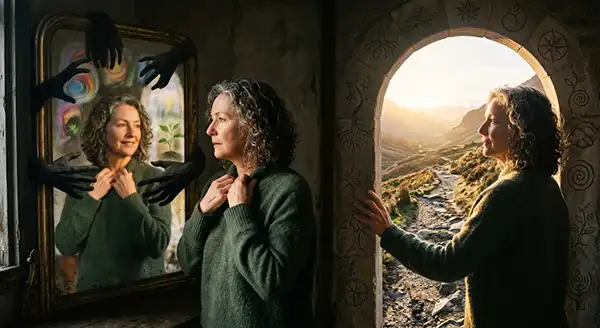
Why the Obsession With Youth Is Quietly Ruining Your Mental Health
The first time I understood how strange our relationship with aging has become, I was standing in a pharmacy in Austin, Texas, staring at a wall of serums. There were serums for fine lines, serums for dark spots, serums for “premature” aging—a phrase that itself deserves a moment of silence. The woman next to me was maybe twenty-six. She had a basket full of products I could not pronounce and a face that had never seen a wrinkle. She caught me looking and shrugged.
“My mom says if I don’t start now, I’ll regret it later,” she said.
I wanted to say: Regret what? That you got older? That your face will someday show evidence that you have lived?
But I did not. Because I understood. The fear was not hers alone. It was in the air we breathe.
The singer St. Vincent has a song called “Los Ageless” that takes the name of Los Angeles and twists it into a meditation on the city’s obsession with never looking your age. The song is satire, but it lands because it is barely exaggerating. The culture we live in does not just value youth. It worships it. And the worship is making us sick.
According to data collected by the American Society of Plastic Surgeons, Americans spent more than $16 billion on cosmetic procedures in a single recent year. That includes Botox, fillers, liposuction, breast augmentation, and an ever-expanding menu of procedures designed to make people look like they have not lived the lives they have actually lived. The numbers have been climbing for decades, and they show no signs of slowing.
But here is the part that does not get talked about enough: the obsession is not making us happier. It is making us more anxious, more depressed, and more afraid of a process that is not only inevitable but—if we could see it differently—profoundly beautiful.
What the Research Says About Appearance Anxiety and Mental Health
The numbers around cosmetic procedures are easy to find. What is harder to see is the psychological cost underneath them.
A study from Florida State University found something that should have made more headlines than it did. Women in their twenties reported more anxiety about their appearance than women in their fifties. Read that again. The women with the fewest wrinkles were the ones most afraid of them. The researchers, Barrett and Toothman, suggested that this was not a random finding. It was a symptom of a culture that trains young women to fear a future they have not even reached yet.
That fear is not harmless. It is not just a preference. It is a source of chronic stress, and chronic stress does real damage to the body and mind. The psychiatrist and neuroscientist Bessel van der Kolk, whose book “The Body Keeps the Score” has become a touchstone for understanding how stress lives in the body, writes that the nervous system does not know the difference between a physical threat and a social one. The fear of aging, of being seen as less valuable because you are less young, triggers the same survival machinery that would activate if you were being chased by a predator. But the predator never goes away. It is always there, in the mirror, in the feed, in the comment section.
A study published in the journal Body Image found that exposure to idealized images on social media increased body dissatisfaction in women across age groups. The effect was stronger in younger participants, but it did not disappear with age. The more time people spent comparing their real faces to filtered ones, the worse they felt about the faces they actually had.
The sociologist Zygmunt Bauman used the phrase “liquid modernity” to describe a world in which nothing is solid, everything is up for reinvention, and identity itself becomes a product to be managed. In that world, the body stops being a home and becomes a project. A thing to be optimized. A thing that is never quite finished.
That is what the youth obsession does. It turns the body into a problem to be solved. And the problem has no solution, because the body will always, eventually, age. The only question is whether you will spend those years fighting the process or living inside it.
The Cosmetic Surgery Paradox
Here is the strange part. The people who are most likely to go under the knife are often the people who are already struggling.
A study by von Soest and colleagues, published in 2012, found that women who underwent cosmetic surgery were more likely to report symptoms of depression and anxiety than those who did not. The surgery did not fix the underlying distress. In fact, with the exception of breast augmentation in some cases, the procedures did not produce lasting psychological improvement at all.
That is the paradox. The industry sells itself as a path to confidence. But the research suggests that the people who seek out the procedures are often the people who were already hurting, and the procedures do not reach the wound. They only change the surface.
I have a friend in Los Angeles, a woman named Claire, who has spent more money on her face than I have spent on my entire education. She is beautiful, by any conventional measure. She is also one of the most insecure people I have ever met. The fillers, the Botox, the laser treatments—they have not made her feel better about herself. They have just given her more things to monitor, more appointments to keep, more evidence that she is in a battle with her own face.
“The worst part,” she told me once, “is that I don’t even know what I’m trying to look like anymore. I’m just trying not to look like myself.”
“We are not afraid of aging. We are afraid of being seen as someone who has aged.” — a therapist in Los Angeles, describing the core of her patients’ appearance anxiety
That sentence stopped me cold. Because it names something true. The fear is not about time. It is about visibility. About being seen as a person who is no longer young, in a culture that equates youth with worth.
The Ageism We Practice Without Noticing
Here is where it gets uncomfortable. The obsession is not just inside us. It is between us.
We compliment people by telling them they look younger than they are. We treat that as the highest form of praise. And the flip side is that we treat looking your age—or, God forbid, looking older—as a failure. A thing to be apologized for. A thing to be hidden.
This is ageism. Not the loud kind, with explicit discrimination. The quiet kind, the one we practice every day without noticing. The one that assumes an older person should not wear certain clothes, should not start certain careers, should not fall in love, should not dance, should not want. The one that treats aging as a series of losses rather than a series of gains.
The psychologist Erik Erikson, whose work on human development has shaped how we understand the entire lifespan, framed old age not as a decline but as a stage with its own task. He called it “integrity versus despair.” The challenge, in his framework, is to look back on your life and feel that it mattered. That task cannot be completed if you are still fighting to look twenty-five. The fighting gets in the way of the meaning.
The author and activist Ashton Applewhite, in her book “This Chair Rocks: A Manifesto Against Ageism,” argues that the fear of aging is not natural. It is learned. It is taught by a culture that profits from our fear, that sells us creams and procedures and pills and promises that if we just try hard enough, we can delay the inevitable. But the inevitable comes anyway. And the only people who are truly free, Applewhite says, are the ones who stop running from it.
How to Live in a Body That Ages Without Losing Your Mind
I am not saying you should stop taking care of yourself. There is a difference between care and obsession, and the line matters.
Care is about feeling good in your body. Obsession is about controlling how your body is seen. Care is sustainable. Obsession is endless. Care makes you more present. Obsession pulls you out of the moment, into a loop of comparison and anxiety.
The psychologist and author Kristin Neff, whose work on self-compassion at the University of Texas at Austin has influenced a generation of therapists, argues that the way out of body anxiety is not more discipline or more products. It is kindness. The willingness to treat your body, at every age, with the same tenderness you would offer a friend who is struggling.
That means catching yourself when you criticize your reflection. It means noticing when you are comparing your face to a filtered image. It means asking, very gently, Who am I trying to look like, and why?
It also means widening the frame. The question is not just “How do I feel about my body?” The question is “What kind of relationship do I want to have with my own aging?” That is a harder question. But it is the one that actually matters.
A therapist I know in Minneapolis, a woman named Ruth who works primarily with women in midlife, says the turning point for her clients usually comes when they realize that the fight against aging is unwinnable. “It sounds depressing,” she told me. “But it’s actually freeing. The moment you stop trying to win, you can finally start living.”
What I Am Learning as I Get Older
I am not old. Not yet. But I am old enough to have started noticing the first signs: the fine lines around my eyes, the gray hair at my temples, the way my face has changed from the one I used to recognize in photographs. And I have watched myself, more than once, reach for the serum instead of sitting with the feeling.
The feeling is not simple. It is not just vanity. It is something deeper, more tender. It is the quiet realization that I am not exempt from time. That the body I have been living in is changing, and will keep changing, and there is no product or procedure that will stop it.
But here is what I am also learning. The moments when I feel most alive have nothing to do with how I look. They are the moments when I am laughing too hard at a friend’s joke, or standing at the edge of the ocean, or writing a sentence that feels true. The face in those moments is not a problem to be solved. It is just a face. A face with a life behind it.
The poet Mary Oliver, who aged with a kind of grace that feels almost radical in our culture, wrote: “Tell me, what is it you plan to do with your one wild and precious life?” The question is not about how to stay young. It is about how to stay alive. And staying alive has never been about preventing wrinkles. It has always been about paying attention.
The obsession with youth is not a sign that we love life too much. It is a sign that we are afraid of it. Afraid of what it will ask of us. Afraid of what it will take away. But the taking away is not the enemy. It is the condition. The only question is whether we will spend our one wild, precious life fighting the terms, or whether we will finally, at whatever age we are, begin to live inside them.
That is the choice. Not between old and young. Between fighting and being. Between the fear of time and the love of it.
And the love, it turns out, is available at every age. It is available now, in this moment, in the body you are already living in, with its wrinkles and its gray hairs and its evidence of everything you have survived.
The body is not a project. It is a record. It is the story of your life, written in skin and bone and the soft lines around your eyes.
Do not erase the story. Read it.
A Few Things I Keep Coming Back To
Is it wrong to want to look good as I age?
Not at all. Wanting to feel good in your body is not the same as being afraid of your body. The difference is in the feeling underneath. If taking care of your appearance feels like self-respect, that is healthy. If it feels like panic, that is information. Pay attention to the difference.
How do I stop comparing myself to filtered images on social media?
You do not stop comparing overnight. You start by noticing when it is happening. Then you ask a quieter question: What am I really looking for when I compare myself to a stranger on a screen? Usually, the answer is not beauty. It is worth. And worth is not something you find in a filter. It is something you build, slowly, in the life you actually live.
Does acceptance of aging mean giving up?
No. Acceptance is not resignation. It is the opposite. It is the release of a fight you were never going to win, so you can put that energy toward things that actually matter. The energy you used to spend worrying about your face is energy you can now spend on your work, your people, your joy. That is not giving up. That is waking up.
A Quiet Invitation
The next time you look in the mirror and feel the old urge to fix, pause. Do not reach for the serum. Do not open the camera. Just look.
Look at the face that has been with you through everything. The face that laughed at your best jokes and cried through your worst nights. The face that is not a problem to be solved but a companion on a long, strange, unrepeatable journey.
That face is not the enemy. It never was. It is the only face you have. And it is, in its own way, exactly right.
Not because it is young. Because it is yours. Because it has lived. Because the lines on it are not flaws. They are proof.
That is the thing the youth obsession does not want you to know: the aging is not a loss. It is a record. A testimony. A map of everywhere you have been.
And the only way to love your life is to stop fighting the body that has carried you through it.
The next time someone tells you that you look young for your age, maybe pause before you smile. Ask yourself what you are really being complimented for. And whether the better compliment might be something else entirely.
You look like you have lived. You look like you are still living. You look like yourself.
That is the one I want. At any age. In any body. That is the only mirror I am trying to find my way back to.
And maybe, if we all stopped running from the aging, we would finally have enough energy to do the things we keep saying we will do someday. The trips. The books. The conversations. The gardens. The dancing in the kitchen.
The life. The actual, ordinary, unrepeatable life.
It has been waiting for us the whole time. And it does not care how old we are. It only cares whether we are here.
So be here. In the body you have. At the age you are. Not fighting the mirror. Looking into it, and seeing, for once, a face that is not a problem but a home.