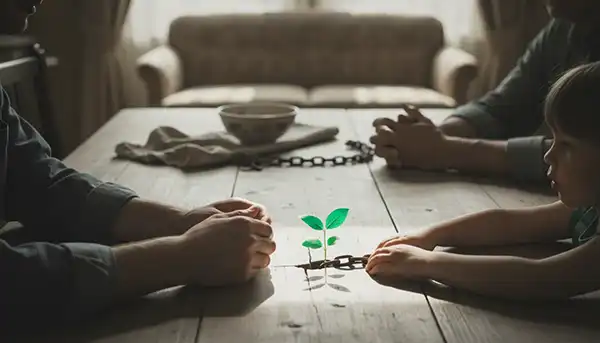
Breaking the Rusty Chain: How Generational Wounds Travel and How to Heal Them
I found the letters when I was forty-one, in a cardboard box at the back of my mother’s closet. She had been dead for three months, and I was finally ready to go through her things. The letters were tied with a blue ribbon, addressed to her mother, postmarked from 1967 to 1974. I opened one at random.
Dear Mama, I hope this letter finds you well. I am fine. The baby is fine. The weather turned cold this week. Please don’t worry about us.
Nothing about the postpartum depression she later told me about. Nothing about the nights she sat in the dark kitchen, too exhausted to cry. Nothing real. Just weather and reassurances and the hollow, polished surface of a woman who had learned early that her feelings were a burden.
I sat on the floor of that closet for a long time, holding the letters, and I understood something I had been circling for years. The wall my mother built between herself and the world was not her invention. It was handed to her. The same way it had been handed to her mother, and her mother before that. A rusty chain of unspoken grief, passed down through generations.
And I was next in line, unless I chose differently.
What the Chain Looks Like When You Are Inside It
When you are wearing the chain, you cannot see it. It just feels like you. The distance. The self-sufficiency. The inability to ask for help. The way you deflect every attempt at closeness with a joke or a change of subject. The chain is not a set of choices. It is a set of reflexes, learned so early they feel like instinct.
The psychiatrist and researcher Bessel van der Kolk, whose book “The Body Keeps the Score” has become essential reading for anyone trying to understand trauma, writes that the wounds we inherit are not just stories. They are patterns. They are nervous system settings. The child who learns that her feelings are too much learns not to feel them. The adaptation keeps the child safe. But the adult who is still running the adaptation is living a life that is not quite her own.
I have a friend in Columbus, a woman named Diane, who embodies this in ways that break my heart. She is one of the kindest people I know. She is also one of the most walled-off. She has been in therapy for six years, and only in the last two has she started talking about her father—a man who provided everything materially and nothing emotionally. “I learned that needing anything was dangerous,” she told me once. “So I stopped needing. And then I forgot how.”
That forgetting is the chain. It does not announce itself. It just tightens.
Why Awareness Is the Breaking Point
The chain is not broken by force. It is broken by awareness. The kind you have to live, daily, in the small moments when the old reflex rises and you have to choose differently.
The psychologist and author Daniel Siegel, at the UCLA School of Medicine, has spent his career studying how early attachment patterns shape the brain. His work on interpersonal neurobiology shows that the patterns we inherit are not destiny. The brain is plastic. It can change. But the change happens through repeated, conscious attention to the patterns themselves. Siegel calls this “mindsight”—the ability to see your own mind at work, to notice the old reflex before it becomes a behavior.
I have been practicing mindsight for years now, badly and incompletely. The other day, my son was upset about something small—a missed bus, a lost homework assignment—and I felt the old reflex rise. The urge to dismiss. It is not a big deal. You are fine. The sentences my mother would have said to me, in a tone that meant: your feelings are too much.
I caught myself. I took a breath. And I said, “That sounds really hard. I’m sorry.”
The change was small. But I had broken the chain, just a little, in that moment.
What the Research Says About Generational Patterns
There is a growing body of evidence that these patterns are not just psychological. They are physiological. The researcher Rachel Yehuda, at Mount Sinai, has studied the descendants of Holocaust survivors and found measurable changes in their stress hormone systems. The trauma of one generation shaped the biology of the next. The chain is not a metaphor. It is real, and it lives in the body.
The therapist and author Mark Wolynn, whose book “It Didn’t Start With You” has reached millions of readers, argues that many of the fears and patterns we carry do not originate in our own lives. They come to us through the family system, passed down like heirlooms no one wanted. The work, he says, is not to blame the ancestors. It is to see the pattern clearly enough to stop repeating it.
“Until you make the unconscious conscious, it will direct your life and you will call it fate.” — Carl Jung
The first time I heard that quote, I was twenty-four and thought it was about other people. Now I understand it is about all of us. The unconscious patterns do not feel like patterns. They feel like fate.
The Loneliness That Feels Personal but Is Not
Here is a truth that has saved me more than once: the loneliness you feel inside the chain is not as personal as it seems. It feels private. It feels like proof that you are uniquely broken, uniquely unlovable. But the loneliness itself is shared. It is one of the most common human experiences there is.
The author and researcher Brené Brown, at the University of Houston, has spent her career studying this. Her research on shame and vulnerability shows that the feeling of being “not enough”—the feeling at the core of the chain—is nearly universal. The people who seem most together are often the ones carrying the heaviest load. The walls they have built are not signs of strength. They are signs of fear.
I think about that when I see someone being cold or distant or dismissive. It is easy to take it personally. It is harder, and truer, to see it as what it usually is: a person inside a chain, fighting a war they did not start. The walls are not about you. They are about what happened before you arrived.
That does not excuse cruelty. But it helps me not absorb it. I can set a boundary without adding another layer of blame.
How to Break the Chain, One Small Choice at a Time
The chain is broken the way everything worth doing is broken: slowly, imperfectly, in the small moments when no one is watching.
The first step is to notice the pattern. Not to fix it. To notice it. When the old reflex rises—the urge to dismiss, to withdraw, to hide—just see it. Name it, if you can. This is the chain. This is the old story. This is not who I am. This is what I learned.
The second step is to choose differently, even a little. Not a grand gesture. A small one. The phone call you usually avoid. The honest sentence you usually swallow. The boundary you usually fail to set. The small choices are the only ones that matter, because they are the only ones that compound.
The third step is to be patient. The chain took generations to forge. It will not break in a season. The work is not to become flawless. The work is to keep returning, again and again, to the choice that is a little freer than the one before.
The other day, I noticed myself getting defensive about something small—a comment my daughter made about the dinner I had cooked. The old reflex was right there: I worked all day and this is the thanks I get. I caught it. I breathed. And I said, “I wanted to make something nice. I’m sorry it didn’t work out.”
The defensiveness passed. The connection held. It was a small thing. But the small things are the whole thing.
A Note for Those Who Feel Too Broken to Start
I know that feeling. The feeling that the chain is too heavy, that the patterns are too deep, that you have already passed the damage on and it is too late. I want to tell you, as gently as I can: it is not too late. The chain is broken one link at a time, and every link you break is a gift to someone who comes after you.
If the weight feels like more than you can carry alone—if the loneliness is constant, if the old stories are dark, if the walls have become a prison—please talk to someone. A therapist. A doctor. A trusted friend who will sit with you in the dark. The National Alliance on Mental Illness offers resources and support. You can call or text 988 if the despair feels like too much. Those calls are not a sign of failure. They are a form of courage.
The chain is real. But so is the breaking. And the breaking begins with a single, small, terrifying act of awareness.
What I Know Now
I am fifty-two years old. I have spent half my life inside the chain and the other half learning to break it. I am not free of it. But I am freer than I was, and that freedom has changed everything.
The other day, my daughter called me from college, upset about something she could not quite name. She talked for a long time, and I listened. I did not try to fix it. I did not tell her it was not a big deal. I just said, at the end, “I’m glad you called. I love you. You are not alone.”
There was a long pause. Then she said, very quietly, “I know, Mom. I know.”
That is the chain breaking. Not with a crash. With a quiet, ordinary moment of connection that would have been impossible two generations ago.
The letters from my grandmother are still in the box. But I have stopped reading them as evidence of all that was missing. I read them now as evidence of something else. The chain. The wall. The quiet, inherited loneliness that my mother carried her whole life and could not put down.
She did not break the chain. But she loosened it, just a little, in the ways she could. And I am loosening it more. And my daughter, if I have done anything right, will loosen it more still.
That is the only work that matters. The small, daily, unglamorous work of noticing the chain, and choosing, again and again, to break one link.
The chain is not unbreakable. It never was. It just needed someone to see it clearly enough to start.
So see it. Not with shame. With clarity. The chain is not your fault. But the breaking of it is your gift.
And the gift, once given, keeps giving. To your children. To their children. To the generations that will come after, carrying a little less weight, because you chose to put some of it down.
That is the whole thing. The chain is there. The awareness is there. The choice is there.
And every single one of us has the power to break the next link.
So break it. Not all at once. Just one link. Today.
The future is waiting. And it is lighter than you think.