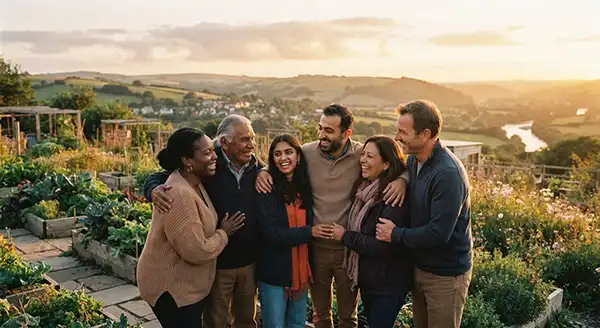
Why Wellbeing Is Bigger Than Self-Care: The Journey From “I” to “We”
I was thirty-six years old the first time I went on a wellness retreat. It was a small farm in the Hudson Valley, three hours north of New York City. There was yoga at sunrise, meditation after lunch, and a lot of very expensive green juice. I had booked it because I was exhausted—not just tired, but the deep, grinding kind of tired that sleep does not fix. My job was stressful. My relationships felt thin. My body ached. I thought a weekend of self-care would fix me.
It did not. The yoga was fine. The meditation was fine. The green juice was fine. But the whole time, I had a quiet, unsettling feeling that something essential was missing. I was doing all the right things. I was focusing on my breath, my body, my inner world. And I felt more alone than ever.
What I did not understand then, and what I have spent the last decade trying to learn, is that wellbeing is not an individual project. It is a relational one. The self-care industry sells us the promise of individual repair—fix your sleep, fix your diet, fix your mind—and that promise has value. But it misses the deeper truth: we are not separate selves in need of individual maintenance. We are connected beings, and the connection itself is the medicine.
The English language hides a clue, and once you see it, you cannot unsee it. Look at the words. Illness. Wellness. Illbeing. Wellbeing. What changes between them? A single letter. The first one. I becomes we. When the I becomes we, illness becomes wellness. The language is telling us something our culture keeps forgetting.
What Wellbeing Actually Means
The word wellbeing is a compound: well, meaning good or healthy, and being, meaning existence or state. Its roots reach back to images of springs and wells—a source of living water, something that flows and renews itself. In that sense, wellbeing is not a destination you arrive at. It is a way of flowing. A quality of aliveness.
The eastern traditions—yoga, qigong, tai chi—have understood this for millennia. They do not separate the body from the mind, the individual from the collective, the human from the natural world. The western wellbeing movement has borrowed heavily from these traditions, often without acknowledging the debt. And in borrowing, it has sometimes lost the very thing that made them work: the understanding that the self is not a container to be filled but a connection to be tended.
The researcher and author Jon Kabat-Zinn, who founded the Mindfulness-Based Stress Reduction program at the University of Massachusetts Medical School, has spent decades teaching a version of mindfulness that is deeply rooted in this understanding. His work shows that mindfulness is not about escaping to a quiet room. It is about waking up to your life—your body, your relationships, your place in a larger whole. The quiet room helps. But the point is the waking.
The Four Dimensions We Keep Trying to Separate
When I first started trying to understand my own exhaustion, I did what most of us do. I treated the symptoms separately. I went to a doctor for my body, a therapist for my emotions, a meditation class for my mind. It was as if I were three different people, each with a different problem, each requiring a different specialist.
But the body is not separate from the mind. The emotions are not separate from the thoughts. The spirit is not separate from the flesh. They are one system, constantly talking to each other, constantly shaping each other. The psychiatrist Bessel van der Kolk, in his book “The Body Keeps the Score,” has shown how trauma lives not just in the mind but in the body, in the nervous system, in the muscles and the breath. The body remembers what the mind tries to forget. And the body’s health is never just physical.
I think about that now when I feel the old exhaustion creeping back. The tightness in my chest is not just physical. It is emotional. The racing thoughts are not just mental. They are spiritual. The fatigue is not just tiredness. It is a signal that something in the whole system is out of alignment.
Physical wellbeing is real. It matters how we eat, how we move, how we sleep. But physical wellbeing cannot be achieved in isolation. The person who eats perfectly and exercises daily but lives in constant isolation is not well. The person who meditates every morning but hates their work is not well. The person who has fixed their sleep but lost their sense of meaning is not well. The parts are only as healthy as the whole they belong to.
The Dimensions We Forget
There is a phrase I keep coming back to: environmental wellbeing. It is the idea that our health depends on the health of the world around us. The air we breathe. The water we drink. The food we eat. The neighborhoods we walk through. We cannot be well in a sick environment. No amount of individual effort can overcome toxic air or poisoned water.
The same is true socially. We cannot be well in isolation. The Harvard Study of Adult Development, one of the longest-running studies of human life ever conducted, has been tracking the same families for over eighty years. Its director, the psychiatrist Robert Waldinger, has said that the single most important finding is simple: good relationships keep us healthier and happier than almost anything else. Not money. Not fame. Not achievement. Relationships.
That finding should have changed more than it has. We live in a culture that treats self-care as an individual responsibility—buy the right products, follow the right routines, optimize the right metrics. But the research keeps pointing in the other direction. The deepest wellbeing is not found alone. It is found together.
The Shift From I to We
I have started paying attention to the language I use, and it has been revealing. When I am struggling, I say “I.” I am tired. I am stressed. I am failing. The I is isolated, carrying everything alone, the way I was taught to carry it.
But when I am well—truly, deeply well—the language shifts without my noticing. It becomes “we.” We are figuring it out. We are going to be okay. We had a good weekend. The we is not just a word. It is a state of being. It is the recognition that my life is not mine alone, that my wellbeing is entangled with the wellbeing of everyone around me.
There is a moment I keep coming back to, from the early days of the pandemic. I was standing on my porch in Austin, feeling scared and isolated, when my neighbor—a woman in her seventies named Ruth—called across the fence. “I made too much soup,” she said. “Do you want some?”
It was a small thing. A container of soup. But it shifted something in me. The isolation cracked. The I became a we, just for a moment, and in that moment I felt better. Not because the soup was nourishing, though it was. Because the connection was.
That is the thing the wellness industry cannot sell. It can sell you a yoga mat and a meditation app and a subscription to organic meal delivery. It cannot sell you the feeling of your neighbor calling across the fence with too much soup. That feeling is free, and it is the whole point.
What the Crisis Is Asking of Us
I do not want to sound naïve. The world is on fire. Climate change, political division, economic precarity, the slow unraveling of the institutions that used to hold us. These are real crises, and they are not solved by neighborly soup.
But the crises are also invitations. They are asking us to reconsider what wellbeing means in a world that is connected. The old model—individual achievement, individual accumulation, individual health—has brought us to this point. It has produced remarkable wealth and profound isolation. It has built a world of private wellness and public sickness.
The alternative is not to abandon individual care. It is to expand it. To recognize that my health depends on your health, and yours on mine. That the air I breathe is the air you breathe. That the water I drink is the water you drink. That the fear in my body is not separate from the fear in yours.
The word that keeps appearing in my thoughts is wholeness. Not perfection. Wholeness. The willingness to hold all the parts—body, mind, heart, spirit, community, planet—and to tend them together, even when it is messy.
I am not good at this. I still slip back into isolation. I still try to fix myself alone. But I am learning to notice the slip, and to turn back toward the we.
The other day, Ruth called across the fence again. This time I was the one with too much bread. I brought her a loaf, warm from the oven, and we stood in the shared space between our houses and talked about nothing important—the weather, the birds, the strange relief of getting older. And I felt, for a moment, the thing I had been chasing on all those retreats.
Not self-care. Something older and simpler. The presence of another person, and the quiet knowledge that I am not alone.
That is the wellbeing the language has been trying to tell us about. The wellbeing that lives in the space between I and we. The wellbeing that cannot be bought, only practiced.
The crisis is real. But so is the possibility. And the possibility, it turns out, is waiting in the space between us.
If you are feeling the weight of isolation right now—if the I has become too heavy—please reach out. To a friend. To a neighbor. To a therapist, if the weight is more than you can carry. The National Alliance on Mental Illness has resources. The Suicide and Crisis Lifeline is available by calling or texting 988. Connection is not a luxury. It is the medicine.
And the medicine is always available, if you know where to look.
The next time you feel the old isolation rising, try a small experiment. Do not turn inward. Turn outward. Call someone. Share something. Bring the soup. The wellbeing you are looking for is not inside you. It is between you and the world.
That is the whole journey. From I to we. From illness to wellness. From isolation to connection.
And the road between them is shorter than you think. It is the distance of a single letter. It is the distance of a single act of reaching.