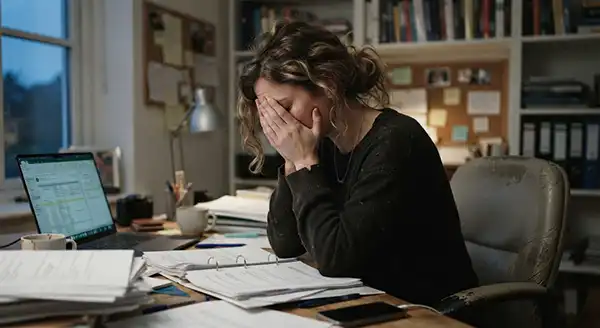
How Stress Lives in Your Body and What to Do When It Settles In
The first time I understood that stress was physical, I was thirty-two years old, sitting in a dentist’s chair in Portland, Oregon, with my jaw locked so tight I could barely open my mouth. The dentist, a calm man with kind eyes, pressed gently along my cheek and asked if I had been under a lot of pressure lately.
I laughed. Not because it was funny. Because it was true. I was working sixty hours a week at a marketing agency, caring for a mother with early dementia, and sleeping maybe five hours a night. The stress was not a feeling anymore. It was a place I lived. My jaw was just the part of my body that had decided to speak up first.
Here is what I did not know then, and what I have spent the years since learning: stress is not just a mental state. It is a full-body event. The mind worries, and the body carries the worry in ways we do not always recognize until something starts to hurt.
The American Psychological Association has been tracking stress in the United States for years, and the pattern is consistent. Most adults report levels of stress they believe are unhealthy. And most of us do not connect that stress to the physical symptoms we experience every day. We treat the headache. We medicate the stomach. We complain about the insomnia. But we do not ask what the body is trying to say.
The Gut Knows Before You Do
There is a reason the stomach is sometimes called the second brain. The gut and the brain are connected by the vagus nerve, a thick cable of communication that runs from the base of the skull down through the chest and into the abdomen. When the brain perceives threat—a deadline, an argument, a bill you cannot pay—the gut hears about it instantly.
The researcher and physician Gabor Maté has written extensively about this connection. His work on stress and illness, collected in books like “When the Body Says No,” shows that chronic emotional stress does not just make us feel bad. It changes our physiology. It alters digestion. It disrupts the gut microbiome. It weakens the immune system.
I have felt this in my own body. During the worst stretch of my life—the sick mother, the relentless job—my stomach was a constant source of trouble. Bloating. Nausea. A dull ache that would not go away. I saw specialists. I tried elimination diets. Nothing helped until I started treating the stress instead of the symptoms.
The gut was not the problem. The gut was the messenger.
Why Your Sleep Turns Against You
Stress and sleep are locked in a cruel feedback loop. The more stressed you are, the harder it is to sleep. The less you sleep, the more stressed you feel. Around and around it goes.
The researcher and sleep scientist Matthew Walker, at the University of California, Berkeley, has spent his career showing how stress hormones disrupt the architecture of sleep. When your nervous system is in fight-or-flight mode, your body does not want to rest. It wants to stay vigilant. The result is a mind that will not quiet down at 2 a.m., a heart that keeps beating too fast, and a morning that arrives before you have really rested.
I remember lying awake during that hard year, staring at the ceiling, watching the clock turn from 1:47 to 3:15 to 4:02. The thoughts would not stop. The worries would not stop. The body was exhausted, but the nervous system was on high alert, convinced that rest was dangerous.
That is what chronic stress does. It convinces the body that there is a tiger in the room, even when the tiger is just an inbox.
The Pain That Has No Single Home
Stress pain does not stay in one place. It moves. It lives in the jaw, the neck, the shoulders, the lower back. It shows up as tension headaches, as a tight band around the skull, as a dull ache between the shoulder blades.
I have a friend in Seattle, a physical therapist named Dana, who says she can tell which of her patients are carrying stress just by the way they hold their bodies. The shoulders up around the ears. The jaw set tight. The breath shallow and high in the chest. “The body keeps a record,” she says. “It is all there if you know how to read it.”
The psychiatrist and researcher Bessel van der Kolk, in his book “The Body Keeps the Score,” made this argument in the most compelling way I know. The body does not just house the mind. It remembers what the mind has not processed. The stress you do not feel—the stress you push down, ignore, override—does not disappear. It takes up residence in the tissues. It becomes tension. It becomes pain. It becomes the thing that finally forces you to pay attention.
The Small Habits That Show Up Under Pressure
When the stress gets high enough, the body starts looking for relief in whatever form it can find. For some people, that means eating. The old comfort foods. The sugar, the salt, the fat. For others, it means the opposite—a loss of appetite, a stomach too tight to accept food.
I have been both people. During the hardest months, I bounced between the two. Some days I could not stop eating. Other days the thought of food made me nauseous. The eating was not about hunger. It was about regulation. The body was trying to calm itself down, and it was using the only tools it had.
There are other habits too, the ones we do not talk about as much. Nail biting. Hair pulling. Skin picking. These are called body-focused repetitive behaviors, and they are surprisingly common under stress. They are not a character flaw. They are a nervous system trying to discharge energy it does not know what else to do with.
What the Pandemic Did to Our Bodies
The pandemic did not just stress us out. It changed the baseline. The uncertainty. The isolation. The constant low-grade fear. The loss. All of it landed in our bodies in ways we are still only beginning to understand.
The researcher and author Tara Brach, who teaches meditation and mindfulness, has written about the particular exhaustion of living through prolonged uncertainty. The nervous system is not built for this. It is built for short bursts of stress followed by long periods of rest. It is not built for a threat that goes on for years.
If you have noticed that your body feels different now than it did three years ago—if you are more tired, more achy, more reactive—you are not imagining it. You are not weak. You are living through something real, and your body has been carrying it.
I noticed it in myself. The shorter fuse. The constant fatigue. The way I would startle at loud noises. The way my stomach tightened at the news. The body was not just responding to the moment. It was responding to the accumulation.
How to Take Care of Yourself When the Stress Will Not Stop
Here is what I have learned, slowly and imperfectly, about caring for a body that is under siege.
The first is routine. The nervous system craves predictability. When everything feels uncertain, a simple daily rhythm—waking at the same time, eating at the same time, moving at the same time—is a form of reassurance. It tells the body that some things are still stable.
The second is movement. Not necessarily exercise. Movement. The walk around the block. The stretch in the kitchen. The dance in the living room to a song you loved when you were younger. The body needs to discharge the stress it has been holding. Movement is how it does that.
The third is attention to what you are consuming. Not just food—though that matters too—but media. The scroll. The headlines. The constant exposure to other people’s curated lives and the world’s endless disasters. The researcher and author Cal Newport has written about the cost of constant digital attention. The brain was not built to process this much information, this much fear, this much otherness. Cutting back is not weakness. It is hygiene.
The fourth is connection. Not the performative kind. The real kind. The phone call to a friend who lets you be tired. The walk with a neighbor. The meal with someone who knows your story. The body calms down in the presence of other calm bodies. That is biology, not opinion.
The fifth is professional support when the weight is too much. I want to say this clearly, because it matters. If the stress has become overwhelming—if the sleep will not come, if the sadness has settled in, if the old ways of coping are no longer working—please talk to someone. A doctor. A therapist. A counselor. The National Alliance on Mental Illness offers resources. The Suicide and Crisis Lifeline is available by calling or texting 988. Reaching out is not failure. It is care.
What the Body Is Trying to Tell You
The jaw that clenches. The stomach that knots. The sleep that will not come. These are not random symptoms. They are messages. The body is not betraying you. It is trying to get your attention.
I did not understand that for a long time. I treated my body like a machine that needed to be managed, medicated, pushed through. I did not realize that the body was not the enemy. The body was the ally, the first responder, the one who had been carrying the weight of my life without complaint until it could not anymore.
The other night, I caught myself clenching my jaw again. The old reflex, rising up in the middle of a difficult conversation. And instead of ignoring it, I stopped. I put my hand on my face. I breathed. I said, very quietly, I see you. I hear you. We are going to get through this together.
It felt ridiculous. It also felt true.
The stress is not going away. The world is not going to suddenly become calm. But I am learning to treat my body with a little more tenderness, a little more respect, a little more attention.
Because the body is not just the thing that carries the stress. It is the thing that carries me.
And it has been asking, for a very long time, to be noticed.
So notice it. The tight jaw. The aching gut. The sleepless nights. They are not the enemy. They are the signal.
The signal is simple: Something needs to change. Something needs care. And the care starts here, in the body, in the breath, in this exact moment.
That is the whole practice. Not the elimination of stress. The attention to it. The willingness to listen when the body speaks.
And the body, it turns out, has been speaking all along. It was only waiting for me to listen.