Change Your Perspective: Is Everything Actually Always Working Out?
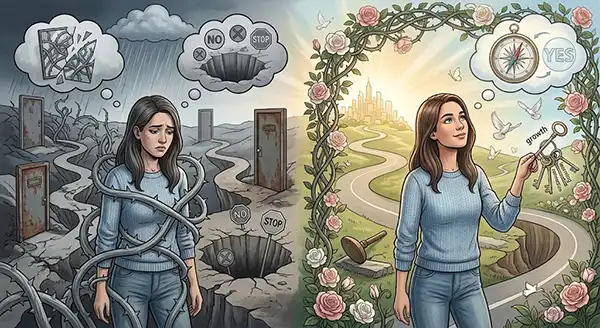
The short answer is yes and no—life isn’t always easy, but the universe itself operates with a rhythm that is remarkably consistent. Research in cognitive behavioral therapy shows that our perception of life as “falling apart” often reflects our mental framing rather than objective reality, and shifting that frame can significantly improve well-being.
I was twenty-seven the first time I truly understood what it meant to change my perspective. I had just been passed over for a promotion I had spent two years working toward. I was devastated. I spent a week replaying every conversation, every project, every moment I could have done better. I convinced myself that my career was over, that I’d never be respected, that I had somehow failed at the one thing I cared about most.
Then I took a walk. It was early spring in Chicago, and the trees along the lakefront were just starting to bud. I sat on a bench and watched the water for what felt like hours. And I noticed something strange: the lake didn’t care about my promotion. The sun set anyway. The birds kept doing whatever birds do. The world was moving forward with the same rhythm it always had, completely indifferent to my personal crisis.
That moment didn’t fix my problem. But it shifted something in me. I realized that while my career felt like everything, it was actually just one part of everything. And the parts that were still working—my health, my friendships, my ability to sit quietly and watch the water—were still there, still steady, still whole.
Change block type or style
Move Paragraph block from position 5 up to position 4
Move Paragraph block from position 5 down to position 6
Change alignment
Change text alignment
Displays more block tools
What Does It Mean to Say “Everything Is Always Working Out”?
It sounds like toxic positivity. It’s not. Saying everything is working out isn’t about denying pain or pretending problems don’t exist. It’s about recognizing that life operates on a scale far larger than our immediate disappointments. The sun rises. The seasons change. The planet continues its orbit. These are not metaphors—they are facts. And they have been happening reliably for billions of years.
Philosophers and psychologists have long noted that human suffering often comes from a mismatch between our expectations and reality. We expect things to go smoothly. We expect people to treat us fairly. We expect our plans to unfold without interference. When they don’t, we feel that life is “going wrong.”
But what if “going wrong” is actually part of the process? What if the detours, the delays, the disappointments are not signs that the universe has abandoned you but rather that you’re being redirected—often toward something you couldn’t have planned for? A 2021 study on post-traumatic growth found that people who experienced significant adversity often reported deeper meaning and stronger relationships precisely because of their struggles, not despite them.
Why Is It So Easy to See What’s Wrong?
Cognitive psychology has a name for this: negativity bias. Our brains are wired to notice threats and problems more readily than opportunities and blessings. This was useful when we were dodging predators on the savanna. It’s less useful when we’re trying to find peace in a complex, modern life.
Psychologists Daniel Kahneman and Amos Tversky demonstrated that loss aversion—the tendency to feel losses more intensely than gains—is a fundamental feature of human cognition. We remember the one criticism more vividly than the nine compliments. We dwell on the job we didn’t get longer than we celebrate the one we have.
This bias is not your fault. It’s evolutionary. But it is also something you can work with. When you notice yourself focusing exclusively on what’s wrong, you can pause and consciously shift your attention to what’s still working. Not to deny the problem, but to put it in perspective.
A 2020 study from the University of California, Berkeley, found that people who practiced a brief daily gratitude exercise reported significantly lower levels of anxiety and higher levels of life satisfaction after just eight weeks. Gratitude doesn’t make problems disappear. But it makes them feel smaller—more manageable.
How Does the Universe Stay “On Track” While We Don’t?
Here’s a question worth sitting with: why does the sun rise without fail, the seasons change without interruption, the tides flow without hesitation—yet we struggle with something as simple as our own mood?
The answer is that the universe operates according to principles that are vastly older and more stable than our individual lives. The laws of physics don’t change based on who got a promotion or who ended a relationship. The earth keeps spinning regardless of how we feel.
This is not a dismissal of human suffering. It’s an invitation to see ourselves as part of something larger. We are not the center of the universe. We are in the universe, subject to the same rhythms, the same cycles, the same underlying order that has sustained everything for billions of years.
When we align ourselves with that order—when we stop fighting the current and start flowing with it—life feels less like a battle and more like a dance. The problems don’t disappear. But they stop feeling catastrophic. They become manageable. Part of the pattern.
What About People Who Are Genuinely Suffering?
I need to be careful here. Saying “everything is always working out” can feel dismissive to someone who is in acute pain—who has lost a loved one, been diagnosed with a serious illness, or is facing financial ruin.
That’s not what I’m saying. I’m not saying suffering isn’t real. I’m saying suffering is part of the process. The trees don’t grow without weathering storms. The rivers don’t carve canyons without persistent pressure. Growth often requires discomfort.
A 2019 study published in Psychological Review found that the most resilient people are not those who avoid adversity but those who interpret adversity as meaningful. They ask: What can I learn from this? How can I grow? What does this experience reveal about what I truly value?
This isn’t about pretending everything is fine. It’s about recognizing that even when things are not fine, they are still part of something bigger. The pain doesn’t invalidate the larger order. It’s nested within it.
How Can You Practice a Broader Perspective?
Here are a few practices that have helped me—and that research supports.
Start with the basics. Take a moment to notice what is still working. Your breath. Your heartbeat. The ground beneath your feet. These are not small things. They are the foundation of everything else.
Expand your time horizon. When you’re upset about something, ask yourself: Will this matter in a year? In five years? In twenty years? Most of what feels catastrophic in the moment fades significantly with time. Perspective isn’t just about looking at the present from another angle—it’s about looking at the present from the future.
Observe nature. Go outside. Watch the sky. Watch the trees. Notice that the world continues to function without your input. This isn’t a threat to your importance—it’s a reminder that you are part of something larger than yourself.
Reframe your setbacks. Instead of asking “Why is this happening to me?” ask “What is this teaching me?” The first question leads to rumination. The second leads to growth.
A Note on Mental Health
If you are feeling persistently hopeless, anxious, or overwhelmed, please reach out to a licensed mental health professional. Cognitive reframing is a powerful tool, but it is not a substitute for clinical care. Depression and anxiety are real medical conditions that often require more than a shift in perspective.
If you are having thoughts of harming yourself or others, call or text the 988 Suicide & Crisis Lifeline immediately. You are not alone.
What readers usually ask
Does saying “everything is always working out” mean I should ignore my problems?
No. It means you should acknowledge your problems without letting them define your entire reality. You can feel pain and still recognize that life has a larger order. The two are not mutually exclusive.
What if I try to change my perspective and it doesn’t work?
Perspective shifts rarely happen overnight. They take practice. Start small. You might not be able to see the bigger picture in the middle of a crisis, but you can notice one thing that is still working. One small shift can create space for more.
Is this just spiritual bypassing?
It can be, if you use it to avoid difficult emotions. But if you use it to hold difficult emotions within a larger context, it’s not bypassing—it’s resilience. The goal isn’t to escape pain. It’s to stop pain from becoming the only thing you see.
I still struggle with perspective. I still catch myself spiraling, catastrophizing, convincing myself that everything is falling apart. But now I have a tool: I ask myself whether this is a mountain or a molehill. And then I look outside. I watch the trees. I feel the ground. I remind myself that I am not the first person to struggle, and I won’t be the last.
The universe has been turning for billions of years. It has never stopped. Not for wars. Not for plagues. Not for personal tragedies. It keeps going. And that’s not coldness—it’s constancy. A reminder that you are not alone, not abandoned, not out of step with the larger order.
You are part of something that has always been working out—not in the sense of being easy, but in the sense of being continuous. The rhythm continues. The sun still rises. And you are still here, which means you are still part of it.
That’s worth holding onto.