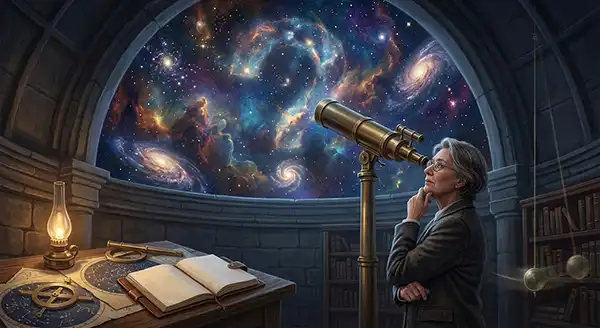
The Mystery of the Cosmos: Why Does Anything Exist at All?
The short answer is that no one knows for certain—and that might be the most honest and humbling answer we can give. The question of why there is something rather than nothing has occupied philosophers, physicists, and theologians for millennia. Modern cosmology suggests that our universe may be a self-contained system that doesn’t require anything external to create or sustain it, yet the mystery remains: what breathed life into the equations of physics, transforming them into the vast, awe-inspiring cosmos we inhabit? As cosmologist Martin Rees writes, “The deepest mystery lies in the answer to this question: why has everything come into existence?”
I remember the first time I truly felt the weight of that question. I was twenty-two, camping in the Mojave Desert with a friend from college. We had driven hours away from the nearest city, and when night fell, the sky opened up in a way I had never seen before. Thousands of stars. The Milky Way stretched across the darkness like a river of light. I lay on my back for what felt like hours, just staring. And the thought that kept rising in my chest wasn’t scientific or theological—it was simply: why? Why any of this? Why am I here to see it? That night didn’t give me answers. But it gave me something else: a sense that the ordinary life I had been living—the grades, the job applications, the constant striving—was only a tiny fragment of something much larger. And that awareness, once it took root, never fully left me.
What Does It Mean to Ask Why Anything Exists at All?
The philosopher Gottfried Wilhelm Leibniz posed what many consider the most fundamental question of all: “Why is there something rather than nothing?” It seems like a simple question. But the more you sit with it, the more it unravels everything you thought you knew. Nothingness, it turns out, is not the simple default state we imagine. As one philosopher put it, “nothingness fails to be a real possibility.” The very concept of “nothing” is so strange, so counterintuitive, that some philosophers have argued the question itself rests on a false presupposition. If nothingness isn’t even a coherent idea, then the existence of something isn’t a puzzle—it’s just the way things are.
Yet we keep asking. Because the existence of the universe, with all its complexity, its laws, its beauty, its suffering—it demands some kind of explanation. As physicist Sean Carroll has noted, modern physics suggests that the universe can exist “all by itself as a self-contained system, without anything external to create or sustain it.” But that doesn’t answer the deeper question: why does such a system exist at all? Philosophers have offered several broad categories of answers. Some argue that existence is a “brute fact”—it simply is, and there’s no deeper explanation. Others suggest a transcendent agency created the world. Some point to the laws of nature as the necessitating force. And still others propose the existence of a multiverse—an endless ensemble of universes, of which ours is just one. Each answer raises as many questions as it resolves.
How Does Modern Cosmology Approach the Question?
Cosmologists like Martin Rees have taken up questions that were once the exclusive domain of philosophers and theologians. In his book Our Cosmic Habitat, Rees explores the possibility that our universe is just one part of a vast “multiverse”—an ensemble of universes, each with its own physical laws and constants. In this view, our universe seems strangely “biophilic,” or hospitable to life, not because it was designed that way, but because we happen to live in one of the rare universes where life is possible. This is the anthropic principle: the observation that the universe must be compatible with the conscious beings who observe it. It’s not an explanation—it’s a filter. It doesn’t tell us why the universe exists. It just reminds us that if it didn’t exist in a way that allowed us to ask the question, we wouldn’t be here to ask it.
Rees writes that “the most encompassing problem for science is to understand how a creation event, simple enough to be described in a brief formula, could have led, 13 billion years later, to the complex cosmos of which we are a part.” He also notes that “the nature of space and time, understood more deeply, may allow our perception of the cosmos to expand to encompass other universes beyond our own.” This is the frontier of modern cosmology: not just understanding our universe, but understanding whether our universe is one of many—and what that means for our place in the grand scheme of things.
Why Does the Universe Seem So Strangely Hospitable to Life?
One of the most striking features of our universe is how finely tuned it appears to be for the existence of life. The fundamental constants of physics—the strength of gravity, the mass of elementary particles, the cosmological constant—all seem to fall within an extraordinarily narrow range that allows stars, planets, and eventually life to form. This “fine-tuning” has led some to argue for design. But Rees offers a different perspective: if our universe is just one of a vast number of universes in a multiverse, each with different physical laws, then it’s not surprising that we find ourselves in one that supports life. We couldn’t exist in any other kind.
Whether you find this explanation satisfying or not, it forces a kind of humility. We are not the center of the cosmos. We are not its purpose. We are, at best, a local phenomenon in a universe—or multiverse—that is vastly larger and more complex than we can fully comprehend. And yet, as Carl Sagan famously put it, “We are stardust.” The atoms in our bodies were forged in the cores of ancient stars. We are not separate from the cosmos—we are a part of it, a way for the universe to know itself. That realization can be either humbling or empowering. In my experience, it’s both.
What Does the Cosmic Perspective Do to Our Sense of Meaning?
There’s a psychological concept called the “cosmic perspective”—the sense of seeing oneself in the context of the vastness of the universe. Research has shown that inducing this perspective can lead to feelings of insignificance, but also to awe, wonder, and a deeper sense of connection. Existential psychology, building on the work of Viktor Frankl, argues that the personal sense of meaning in life is fundamental for mental health. Even in a cosmos that may be indifferent or purposeless, humans have the capacity to create meaning. As one review put it, “although the cosmos lacks intrinsic purpose, humans continue to seek and sustain meaning amid existential ambiguity.”
This is the paradox of the cosmic question. The same awareness that can make us feel small can also make us feel profoundly grateful. We are here. We are conscious. We can ask the question. That, in itself, is a kind of miracle. I’ve found that when I’m caught up in the daily grind—the deadlines, the bills, the small frustrations—returning to this perspective helps. Not to escape my problems, but to see them in context. They are not the whole story. They are a small part of a much larger one. And that larger story is still unfolding, still mysterious, still worthy of wonder.
How Can We Live With the Mystery?
The question of why anything exists at all may never have a final answer. And that’s okay. The search itself is valuable. It opens us up to awe, to humility, to a deeper appreciation of the gift of existence. One of the most profound things we can do is simply to notice. To look up at the night sky and feel the weight of it. To walk outside and see the trees, the birds, the clouds—not as background noise, but as participants in the same grand unfolding. To recognize that the same physical laws that govern distant galaxies also govern the beating of our hearts.
This isn’t about finding a definitive answer. It’s about cultivating a stance—a posture of wonder and gratitude toward the sheer fact that anything exists at all. As the psychologist Paul Brockleman writes, a profound sense of wonder and awe is inseparable from our understanding of the universe—of its great age, its immensity, and its astonishing complexity. We don’t have to understand everything to be moved by it. We don’t have to explain everything to be grateful for it. We just have to be present.
A Note on When the Questions Become Overwhelming
If contemplating the vastness of the cosmos leaves you feeling anxious, insignificant, or depressed, you’re not alone. Existential dread is a real experience, and it can be overwhelming. If these feelings are persistent or interfere with your ability to function, please reach out to a licensed mental health professional. A therapist can help you explore these questions in a way that supports your well-being rather than undermining it. If you’re having thoughts of harming yourself or others, call or text the 988 Suicide & Crisis Lifeline immediately. You are not alone, and help is available.
Questions people often ask
Does modern physics prove there’s no purpose to the universe?
No. Physics describes how the universe works—it doesn’t tell us why it exists or what meaning we should derive from it. Science and meaning operate in different domains. You can accept the findings of cosmology and still find profound purpose in your life. The two are not in conflict.
Isn’t it depressing to think we’re insignificant in the grand scheme?
It can be, if you focus only on the insignificance. But many people find the cosmic perspective liberating. If we’re not the center of the universe, then we’re also not responsible for everything. We can let go of the weight of cosmic importance and focus on what matters locally—our relationships, our communities, our own growth. The shift is from “I must be important” to “I am part of something important.”
How do I stay grounded when I think about these big questions?
Anchor yourself in the present moment. Notice your breath. Feel your feet on the ground. Connect with people you love. The big questions are important, but they don’t have to consume you. You can hold them lightly, like a beautiful and mysterious object you’re examining—not a weight you’re carrying. Wonder doesn’t require constant attention. It just requires occasional presence.
I still don’t have an answer to the question that kept me staring at the Mojave sky all those years ago. Why anything exists? I don’t know. But I’ve come to see that not knowing is not a failure. It’s an invitation. To wonder. To appreciate. To live with open eyes and an open heart. The universe doesn’t owe us an explanation. But it has given us something else: the capacity to ask the question. And that capacity, in itself, is extraordinary. We are the part of the cosmos that can look back at itself and marvel. That’s not nothing. That’s everything.