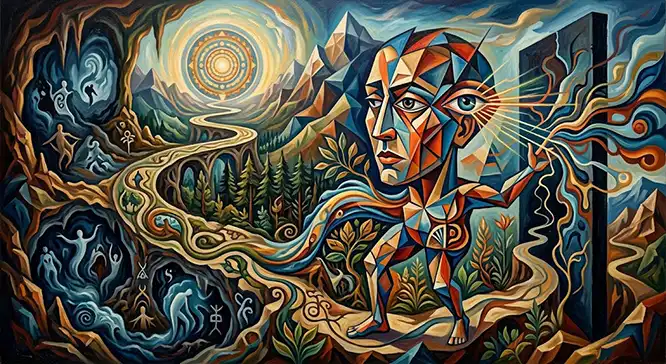
The New World Is Already Here: What You Need Is Eyes Ready to See
Carl Jung left this world in 1961. Sixty years ago. And yet the framework he built—the collective unconscious, the archetypes, the shadow work—still feels like frontier territory. We’re still catching up to what he was pointing at. That alone should give us pause. If a man who died six decades ago was sketching the contours of a map we’re still learning to read, what does that say about the certainty we attach to our current beliefs?
Here’s the uncomfortable truth I keep coming back to: everything we think we know is provisional. Every “truth” we hold tightly is just a placeholder until the next layer of understanding emerges. Science doesn’t work in absolutes. It works in approximations. And the same applies to our personal philosophies, our spiritual frameworks, our sense of what’s real.
The moment we forget that, we stop growing. We start defending. And defending a position is very different from exploring it.
The Trap of Certainty
I’ve watched myself do this more times than I’d like to admit. I form a belief, I hold it close, and then I start treating it as fact. Not because the evidence is overwhelming, but because certainty feels safer than doubt. It’s a comfort mechanism, not an intellectual one.
But here’s the thing about certainty: it closes doors. When you’re sure about something, you stop questioning it. You stop looking at it from different angles. You stop being curious. And curiosity is the engine of growth.
Jung understood this. He built his entire framework on the idea that the psyche is vast, mostly unknown, and constantly unfolding. He didn’t offer final answers. He offered tools for exploration. He pointed toward the territory and said, “Go see for yourself.”
That’s a radically different posture from the one most of us adopt. We want conclusions. We want someone to tell us what’s true and let us move on. But the psyche doesn’t work that way. The universe doesn’t work that way. Everything is in process, including us.
The Artist’s Courage
Picasso didn’t become Picasso by painting what people expected. He became Picasso by painting what he actually saw—even when what he saw didn’t match the accepted standards of the time. The cubist eye wasn’t wrong. It was just different. And difference, when expressed honestly, becomes contribution.
The same applies to you. Your unique lens—the way you see color, the way you interpret emotion, the way you understand connection—is not a distortion. It’s your signature. The problem is that most of us are trained to fit our vision into pre-existing categories. We’re taught that there’s a correct way to see things, and that our job is to align with it.
But what if alignment isn’t the point? What if the point is to bring your particular wavelength into the world, fully and without apology, so that the whole spectrum becomes richer?
That’s not narcissism. That’s contribution. The world doesn’t need more copies. It needs originals. And originality isn’t about being weird for the sake of it. It’s about being honest about what you actually perceive, even when it doesn’t match the consensus.
Smooth Transmission
There’s a concept in the text that I keep turning over in my mind: the idea that our work isn’t to be happy, but to achieve “smooth transmission.” That phrasing caught me off guard because it reframes the whole project. Happiness becomes a byproduct, not the goal. The goal is to allow what’s genuinely you to move through you without obstruction.
That means clearing out the debris. The inherited beliefs that don’t actually fit. The trauma responses that have become default settings. The fear of judgment that makes you edit yourself before you’ve even finished a thought. All of that creates friction. It distorts the signal.
Smooth transmission is what happens when the channel is clean. When you’re not second-guessing your perceptions. When you’re not filtering your expression through layers of “should” and “shouldn’t.” When you trust that what emerges from you is valuable simply because it’s yours.
That’s not an easy place to get to. But it’s a direction worth moving in.
Let me tell you something I rarely admit
I still catch myself editing my perceptions. I’ll have an intuition about something—a feeling, a hunch, a sense of what’s true—and I’ll immediately question it. Is this reliable? Is this just wishful thinking? Is this something I’m projecting?
Sometimes those questions are useful. But sometimes they’re just noise. They’re the internalized voice of doubt that has nothing to do with discernment and everything to do with fear. The fear of being wrong. The fear of looking foolish. The fear of trusting yourself and having that trust betrayed.
I’m working on that. Not to eliminate the questions, but to know which ones are worth asking and which ones are just obstacles.
What I’ve learned about perception
The way you see the world isn’t passive. It’s active. You’re not just receiving information—you’re constructing meaning. And the construction happens through your particular lens, shaped by your history, your sensitivities, your wounds, and your gifts.
That means two people can look at the same thing and see something entirely different. Not because one is right and the other is wrong. Because they’re bringing different instruments to the observation.
This is both humbling and liberating. Humbling because it means your perspective isn’t the only one. Liberating because it means you don’t have to defend it as absolute truth. You can offer it as your truth, and let others do the same.
A question that keeps showing up
What would you see if you stopped trying to see things correctly? If you let go of the need to align with what you’ve been told is true and just looked—really looked—at what’s in front of you? The answer might surprise you. It might be simpler than you expect. It might be stranger. But either way, it would be yours.
Most of us don’t trust our own eyes. We look at something, then immediately check to see if our perception matches the accepted version. We’re constantly cross-referencing, adjusting, fitting our experience into the mold. That process has a cost. It dulls the sharpness of your vision. It makes your experience less vivid.
What if you stopped doing that? Just for a day. Just to see what happens. What if you trusted your own seeing, your own feeling, your own intuition, without immediately running it through the filter of “is this normal?”
Let’s get practical for a second
Start small. Pick something ordinary—a tree, a cup, the way light falls on a wall—and look at it for a full minute. Not to analyze it. Just to see it. Let your eyes wander over it. Notice the details that you usually skip. And when your mind starts categorizing or judging, just come back to the act of looking.
This sounds simple, but it’s not. We’ve been trained to glance, not to see. The practice of extended attention is a form of rebellion against the speed and superficiality of modern life. And it’s also a way of reclaiming your own perception.
From there, extend it to more complex things. A conversation. A feeling. A memory. Look at it without the usual filters. See what emerges when you let it be what it is, rather than what you think it should be.
Here’s what I keep circling back to
The new world isn’t coming. It’s already here. It’s always been here. What changes is our readiness to see it.
That’s not mystical. It’s practical. When you’re locked into a certain way of seeing, you miss what’s right in front of you. You mistake the map for the territory. You confuse your beliefs with reality.
The shift isn’t about acquiring new information. It’s about clearing the lens. It’s about letting go of the frameworks that no longer serve you so that you can perceive what’s actually there, rather than what you’ve been told to expect.
That takes courage. It takes patience. It takes a willingness to be wrong about things you’ve held dear. But the reward is contact with something real—something that doesn’t depend on your beliefs or your fears to exist.
A few things worth sitting with
The illusions we carry aren’t always obvious. They’re embedded in language, in habit, in the structures we take for granted. Questioning them isn’t a rejection of everything you’ve learned. It’s a refinement. It’s saying, “I want to see more clearly, and I’m willing to adjust my lenses to do that.”
The work isn’t about reaching a final destination. It’s about staying in motion. It’s about remaining open to revision, to surprise, to the possibility that your current understanding is partial. That’s not weakness. That’s honesty.
And honesty, applied consistently, has a way of cutting through the noise. It doesn’t guarantee comfort. But it guarantees contact. And contact with what’s real is worth more than a thousand comfortable illusions.
Where this leaves me
I don’t have it all figured out. I don’t think anyone does. But I’m learning to trust my own seeing a little more, and to distrust the voice that says “this doesn’t fit.” Maybe that’s the real practice—not acquiring certainty, but becoming comfortable with not having it.
The new world is here. It’s not in some distant future. It’s in this moment, if you’re ready to see it. And being ready isn’t about having the right answers. It’s about showing up with your eyes open, your mind curious, and your heart willing to be surprised.
That’s enough. That’s always been enough.