How to Open New Doors: What Zen Understanding Really Means
The first time I understood the difference between knowing about a thing and truly understanding it, I was forty-seven years old, standing in a garage in Burlington, Vermont, with motor oil up to my elbows. I had been restoring a 1972 Triumph motorcycle for eleven months. I had read three manuals cover to cover. I had watched hours of YouTube tutorials. I could have explained the carburetor’s function to you in my sleep.
And then, one Tuesday evening, I felt the wrench slip. Just a fraction of an inch. Just enough to tell me I had been tightening the bolt at the wrong angle. And in that half-second, something shifted. Not just the bolt. Something in me. All the reading, all the videos, all the diagrams—they had been floating around in my head like furniture in a showroom. But this was different. This was the moment the knowledge moved into my hands.
The Japanese have a word for this. They call it satori—though that word gets thrown around a lot in the West, usually by people who have never sat still for more than five minutes. The Zen teacher D.T. Suzuki, who spent much of his life trying to translate this experience for American audiences, wrote about it as a kind of direct seeing. Not learning something new. Seeing something you already knew, but from the inside.
I am not a Buddhist. I am a retired high school teacher. I vote in every election. I floss. But I have spent the last decade of my life trying to understand what happened in that garage, and the closest I have come is this: there is a world of difference between hearing about a thing and becoming the kind of person who has lived it.
Why Understanding Is Different From Knowing
Most of us walk through our days knowing about a great many things. We know about the war in the news. We know about the economy. We know about the neighbor’s divorce. We know about mindfulness, about exercise, about how to eat better. The knowing is not the problem. The problem is that the knowing never becomes anything.
The philosopher and Zen practitioner Alan Watts, who did as much as anyone to bring these ideas to American audiences in the 1950s and 60s, used to talk about the difference between the menu and the meal. You can study the menu for years. You can memorize every word. You can even become an expert on menus. But you will never know what the food tastes like until you take a bite.
I spent most of my life as a menu expert. I knew about things. I read. I listened. I nodded along in conversations. And underneath all that knowing, there was a quiet hunger I could not name. A sense that I was standing outside something, looking in through a window.
The Triumph changed that. Not because I fixed the bike—though I did, eventually. Because fixing the bike required me to stop reading and start feeling. The manuals could tell me what to do, but they could not tell me what the metal wanted, what the threads could take, what the engine needed when it was cold versus hot. That kind of knowing does not come from words. It comes from hours of sitting with the thing, making mistakes, skinning your knuckles, and going back again.
The psychologist Mihaly Csikszentmihalyi, who spent his career at the University of Chicago studying what makes people feel most alive, called this kind of absorption “flow.” His research showed that people are happiest not when they are relaxing, but when they are completely engaged in something that challenges them. The challenge is not the enemy of understanding. It is the doorway.
How Life Experience Becomes a Key That Opens New Doors
Here is what I have come to believe, after ten years of turning this over: every time we truly understand something—not just learn about it, but learn it from the inside—we acquire a new key. And every key opens a door we could not even see before.
When I was teaching, I saw this happen in my students every year. The kid who could not sit still in class, the one everyone had written off, would discover something—woodworking, poetry, the cello, trigonometry—and suddenly his whole face would change. Not because he had become smarter. Because he had found a door he did not know existed, and the door opened, and behind it there was a whole room full of other doors.
That is the thing about understanding. It is not a destination. It is a hallway. Each room you enter reveals three more rooms you could not have imagined from the outside. The more keys you carry, the more of the world becomes available to you.
I have a friend, a man named Robert who lives in Portland, Oregon. He is a retired postal worker. Never went to college. Never traveled outside the country. Two years ago, he started learning Spanish at the public library, mostly because he was lonely and the classes were free. Last spring, he went to Mexico for the first time. When he came back, he told me something I have not forgotten.
“I did not know I was missing a whole world,” he said. “I thought I knew what the world looked like. But I only knew what my world looked like. There were other worlds the whole time, and I did not have the key.”
Robert is sixty-six years old. He is learning Portuguese now. Not because he needs it. Because the first key showed him there were more doors.
What Happens When We Face a Door Without the Right Key
Of course, there is another side to this. The moment you encounter a door you cannot open, you have a choice. You can walk away. You can pretend the door does not exist. You can decide that the room behind it is not worth entering. Or you can start looking for the key.
Most of us, most of the time, walk away. Not because we are lazy. Because the walking away feels safer. The door is unfamiliar. The lock is complicated. The key is not in our pocket. And so we retreat to the rooms we already know, the ones where the furniture is familiar and the light is predictable.
I have done this more times than I can count. I have walked away from friendships because I did not understand what the other person was going through. I have walked away from ideas because they did not fit into the framework I already had. I have walked away from entire versions of myself because I was afraid of what I would find if I stepped through.
The Zen teachings are not gentle about this. There is a koan from the Chinese master Wumen Huikai, collected in the book “The Gateless Gate,” that has followed me for years. It asks: if you are free, then tell me—does the sound come to the ear, or does the ear go to the sound?
When I first read that, I thought it was nonsense. Now I understand it as a question about orientation. Are you waiting for the world to explain itself to you? Or are you moving toward it, ears open, hands out, willing to be changed by what you find? The answer shapes everything.
How to Cultivate a Beginner’s Mind Every Day
The Japanese Zen teacher Shunryu Suzuki—no relation to D.T. Suzuki, though both men spent their lives bringing Zen to the West—wrote a book called “Zen Mind, Beginner’s Mind.” In it, he says something that has become almost a cliché in meditation circles: “In the beginner’s mind there are many possibilities, but in the expert’s there are few.”
The cliché has not made the truth any less true. The expert mind is full. It has already decided. It knows. The beginner’s mind is open. It is willing to be surprised. It understands, deep down, that it does not understand.
I think about this every time I catch myself being an expert. Not in the professional sense—I am retired now, no one is asking me to be an expert about anything. But in the small, daily ways. The moment I assume I know what my wife is going to say before she says it. The moment I decide a politician is wrong without actually listening to their argument. The moment I pick up a book and put it down after three pages because I have already decided I disagree with it.
The beginner’s mind is not about pretending you know nothing. It is about remembering that what you know is always partial. There is always more. There is always a door you have not opened. There is always a key you have not found.
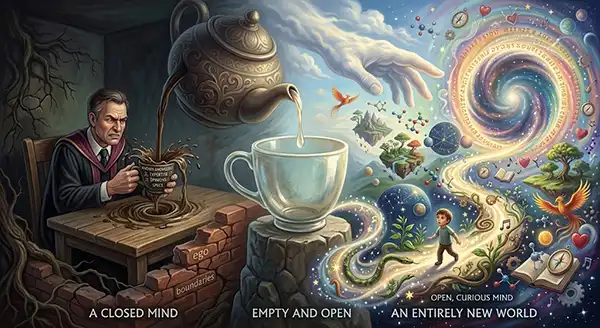
“If your mind is empty, it is always ready for anything; it is open to everything. In the beginner’s mind there are many possibilities, but in the expert’s there are few.” — Shunryu Suzuki
That emptiness is not a lack. It is a capacity. It is the difference between a cup that is full—and can hold nothing more—and a cup that is empty, ready to receive.
The Difference Between Hearing With Ears and Seeing With Your Eyes
There is a line in the Zen literature that I have never been able to shake. It says: you cannot understand by listening with your ears. Only when you begin to hear with your eyes do you come close to the truth.
I am not going to pretend I understand that fully. I am not a Zen master. I am a retired teacher who fixes motorcycles and takes long walks in the Vermont woods. But I have had moments—brief, unremarkable, impossible to explain—when the boundary between my senses seemed to soften. When I was not just looking at the trees, but seeing them. When I was not just hearing the river, but being heard by it.
Those moments do not last. They cannot be forced. But they leave something behind. A residue. A sense that the world is larger and stranger and more alive than I usually give it credit for. And a hunger, quiet but persistent, to pay more attention.
The writer and naturalist Annie Dillard, in her book “Pilgrim at Tinker Creek,” wrote that the secret of seeing is to see what you are not expecting. Most of us walk through the world seeing only what we already believe is there. The beginner’s mind is the willingness to be surprised. To look at the familiar as if it were new.
That is not just a spiritual practice. It is a practical one. It is how scientists make discoveries. It is how artists make work. It is how teachers reach students who have been written off. It is how marriages survive decades of familiarity.
A Question I Keep Coming Back To
The older I get, the more I suspect that life is not a problem to be solved. It is a room to be entered. Over and over, through door after door, with whatever keys we have managed to gather.
The question is not whether you have enough keys. The question is whether you are still willing to use the ones you have. To turn the handle. To step into the unknown room. To let yourself be changed by what you find there.
I have a neighbor, a woman in her seventies named Margaret, who took up pottery two years ago after her husband died. She is terrible at it. The mugs come out lopsided. The bowls have cracks. But every Thursday, she drives to the community studio and spends three hours with her hands in the clay. She told me once that the pottery saved her life.
“It is not about making something beautiful,” she said. “It is about learning to be surprised by my own hands.”
That is the whole thing, I think. Not mastery. Not expertise. Surprise. The willingness to be a beginner, again and again, for the rest of your life.
What I Would Tell My Students Now
If I could go back to my classroom, I would not talk so much about the curriculum. I would not spend so much time on the tests. I would tell the students one thing, over and over, until they were sick of hearing it:
You do not have to know everything. You just have to stay curious. The knowing will come. The curiosity is the thing that keeps you alive.
I would tell them about the motorcycle. About the wrench slipping. About the moment when all the reading became understanding. And I would tell them that the same thing is available to them, in whatever they love, whether it is mathematics or music or the way a particular shade of light falls on a particular wall at a particular time of day.
The door is there. The key is there. The only thing that has ever been missing is the willingness to turn the handle.
A Quiet Note for the Ones Who Feel Stuck
I want to be careful here. I know that not everyone is in a place where they can pick up a new hobby or learn a new language or start a new chapter. Some seasons are for surviving, not expanding. And if the fog is heavy—if the world feels flat and the doors all seem locked—that is not always a spiritual problem. Sometimes it is a medical one. If the lack of curiosity feels more like numbness, if the absence of motivation feels more like despair, it might be worth talking to someone. A doctor. A counselor. A trusted person who can help you see what you cannot see on your own. There is no shame in that. It is not a failure of spirit. It is a form of care.
The doors will still be there when you are ready. They are patient.
A Last Look Out the Window
I am sitting in my kitchen now, looking out at the yard. The light is fading. The birds are doing whatever birds do at this hour. And I am aware, in a way I was not aware ten years ago, that I do not know what any of it means.
I do not know why the light looks the way it looks. I do not know why the birds sing the way they sing. I do not know why the sight of my own hands on the table—hands that have fixed motorcycles and held children and buried parents—fills me with something that feels almost like gratitude.
But I am not troubled by the not knowing. Not anymore. The not knowing is not a wall. It is a doorway.
And I am still, after all these years, learning to step through.