How to Stay Calm When Negative Events Keep Piling Up
You know the feeling. You wake up, reach for your phone, and the first thing you see is another headline that makes your stomach drop. The economy. The virus. The climate. The latest disaster, personal or global, scrolling past in an endless feed. You have not even had coffee yet, and your nervous system is already bracing for impact.
“Can’t it just stop?” you think. “Can’t I get one week without something falling apart?”
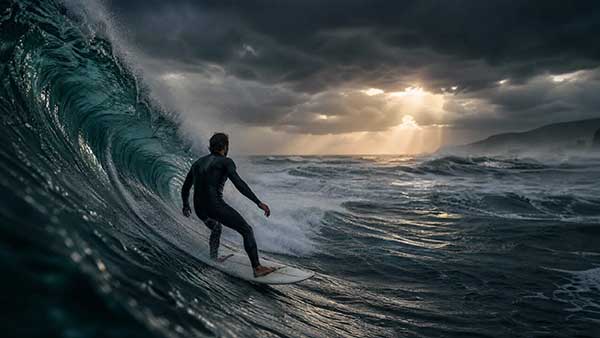
The answer, if you are being honest, is no. Not because the universe is cruel. Because waves keep coming. That is what waves do. The question is not whether the water will get rough. The question is whether you will learn to ride it.
Jon Kabat-Zinn, the man who brought mindfulness into American medicine through his work at the University of Massachusetts Medical School, said it better than anyone I know: “You can’t stop the waves, but you can learn to surf.” He built an entire clinical program, Mindfulness-Based Stress Reduction, around that insight. The program has been taught in hospitals and clinics across the country for over forty years. The research backing it is solid — reduced anxiety, lower blood pressure, better sleep, less chronic pain. But the core teaching is simpler than any study. The waves will not stop. Your relationship to them can change.
Here is what that actually looks like, not in a meditation hall, but in the middle of a terrible Tuesday.
Notice What You Actually Do When Something Goes Wrong
Before you can change anything, you have to see what is already happening. Not what you wish you did. What you actually do.
When the bad news lands — the email, the phone call, the text message — your body moves before your mind catches up. Maybe you snap at someone. Maybe you go quiet. Maybe you open the news app and doomscroll for an hour, as if reading about more bad things will somehow make the first bad thing feel smaller. Maybe you start rehearsing an argument you are not actually having.
None of this is a failure. It is automatic. It is the nervous system doing what it has been trained to do. But you cannot interrupt a pattern you cannot see.
The first skill, then, is observation. Not judgment. Observation. You are not trying to fix the reaction. You are just trying to see it. “There it is again. The tightening in my chest. The urge to check the news. The voice in my head saying this always happens to me.”
Seeing it is not nothing. Seeing it is the beginning of freedom.
Get Curious About What Is Happening in Your Body
Here is where it gets interesting. The reaction is not just in your head. It is in your body. And your body has a lot to say if you are willing to listen.
When the stress hits, where do you feel it? Is your jaw clenched? Your stomach tight? Your shoulders up around your ears? Is your breath shallow, caught high in your chest? Are your hands cold? Your face hot?
These physical sensations are not random. They are data. They tell you how your nervous system is responding to the threat. And the simple act of noticing them — of moving your attention into the body instead of staying lost in the spiral of thoughts — can begin to settle the system down.
This is not new-age nonsense. It is basic physiology. The body and brain are in constant conversation. When you bring awareness to physical sensation, you activate the prefrontal cortex, the part of the brain that helps regulate emotion. You are not just feeling the stress. You are observing yourself feeling the stress. And that small shift changes everything.
Researchers at the National Center for Complementary and Integrative Health have studied this for decades. Body awareness practices — mindfulness, yoga, breath work — all share the same mechanism: they train you to notice physical sensation without immediately reacting to it. Over time, that training changes the brain. The automatic reaction becomes a choice point. The wave still comes. But you do not have to be knocked over by it.
Notice the Story You Are Telling Yourself
The body reacts. But the mind interprets. And the interpretation is usually worse than the event itself.
The thought comes in so fast you barely notice it. “This always happens to me.” “I never get a break.” “I am not good enough to handle this.” “I deserved this.” The thought feels like fact. It is not. It is a story. A very old story, worn smooth by repetition, that your mind reaches for whenever the ground shakes.
There is a therapeutic approach, developed by the psychologist Albert Ellis in the 1950s and refined by generations of cognitive behavioral therapists since, that focuses on exactly this. Ellis called it the ABC model: Activating event, Belief, Consequence. The event is neutral. The belief — the story you tell yourself about the event — is what creates the emotional consequence. Change the belief, and the consequence changes.
This is not about positive thinking. It is about accurate thinking. The thought “this always happens to me” is not accurate. It is a distortion. You have survived every bad day so far. That is not always. That is evidence of resilience.
Catching the story in the act is the third skill. It takes practice. The story is fast. But it can be caught. And when you catch it — when you see it as a story rather than a fact — you take its power away.
The Reward for Showing Up: It Changes
Here is the part that kept me going when the practice felt pointless. The change does not arrive all at once. It arrives in almost imperceptible increments. You observe your reaction for weeks and notice nothing different. Then one day, mid-crisis, you hear yourself say, “Oh, my jaw is doing that thing again.” That is the shift. That is the surfboard under your feet.
The transformation is not about eliminating the waves. It is about changing your relationship to them. The wave comes, and instead of being submerged, you feel it lift you. Not because the water got calmer. Because you learned how to move with it.
The source material I worked from describes this process with a beautiful simplicity: first you notice, then you describe, then you follow the transformation. The following is the reward. Not a life without trouble. A life where trouble no longer owns you.
What Actually Helps When You Are Underwater
None of this works if you are running on empty. You cannot practice emotional regulation when your basic systems are depleted. Sleep. Food. Movement. Connection. These are not luxuries. They are the foundation.
The source text offers a list of “good activities” — reading, painting, yoga, walking, talking with people you love. It would be easy to skim past this as generic self-care advice. That would be a mistake. These activities are not treats. They are tools. They are how you recharge the nervous system so it has enough energy to do the harder work of regulation.
I know this from the inside. When I am exhausted, I have no capacity for observation. The waves just take me. But when I have slept, when I have moved my body, when I have spent time with someone who makes me laugh, I have a fighting chance. The surfboard is still there. I just need to be rested enough to climb on it.
What I Am Still Learning
I want to be honest about how hard this is. Some days the waves are too big. Some days I forget there is a surfboard at all. Some days I snap at someone, or doomscroll for an hour, or tell myself the old story about how everything bad always happens to me.
The difference now is that I catch it. Not immediately. Sometimes hours later. But I catch it. And the catching is the practice. The practice is the point.
Kabat-Zinn’s words have become a kind of anchor for me. The waves will not stop. That is not a curse. That is the ocean. That is the texture of being alive. The only real question is whether you will spend your life fighting the water or learning to ride it.
I am still learning to ride. Some days I fall. Some days I stay on for a few seconds and feel the impossible joy of moving with something bigger than myself. Those seconds are worth the falls.
The next time the wave hits — and it will hit — do not waste your energy cursing the water. That energy is the surfboard. Use it. Notice the body. Name the story. Breathe. And let the wave carry you, even for a moment, instead of burying you.
That is the whole practice. Not escaping the ocean. Learning to surf.