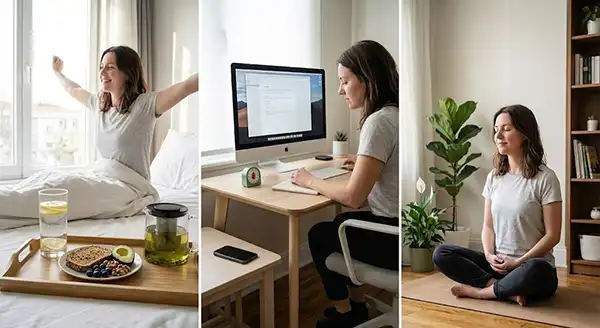
and Stay Sharp All Day
I hit a wall around three o’clock most afternoons. Not a dramatic wall. A quiet one. The kind that settles in behind your eyes and makes you reread the same sentence four times without absorbing it. For years I thought it was physical fatigue. Then I realized I had barely moved all day. My body was fine. My mind was running on fumes.
Mental energy is not the same as physical energy. You can be completely still and utterly exhausted. You can lie on the couch for hours, doing nothing, and still feel like your brain has been through a marathon. The exhaustion is real. It is just located in a different organ.
This is not a metaphor. The brain consumes a disproportionate share of the body’s energy—roughly twenty percent of your daily calories, despite accounting for only about two percent of your body weight. Thinking is expensive. Worrying is expensive. Holding a dozen half-finished tasks in your head at once is very expensive. And most of us are running a deficit without knowing it.
The good news is that mental energy can be replenished. Not with caffeine. Not with willpower. With specific, repeatable habits that give the brain what it actually needs.
Why Mental Energy Matters More Than You Think
Here is the thing most people miss. Mental energy is not just about feeling alert. It is about everything that depends on alertness. Focus. Decision-making. Emotional regulation. Motivation. Creativity. Patience. The ability to sit with a hard problem instead of reaching for your phone.
When your mental energy is low, all of these suffer. You make worse decisions. You snap at people you love. You procrastinate on things that matter. You reach for sugar, or screens, or anything that offers a quick hit of stimulation to cover the exhaustion underneath.
The psychologist Roy Baumeister spent years studying this at Florida State University. His research on what he called “ego depletion” showed that self-control and decision-making draw from the same limited mental resource. Use too much of it in one area, and there is less available for everything else. The brain gets tired the way a muscle gets tired. And like a muscle, it can be trained, rested, and replenished.
How Gratitude Changes Your Mental Energy
The first suggestion in the source material I am working from is gratitude. Not the performative kind where you list five things because a journal told you to. The real kind, where you deliberately turn your attention toward what is working instead of what is broken.
This is not Pollyanna thinking. It is neuroscience. Robert Emmons, the psychologist at the University of California, Davis who has studied gratitude for decades, has found that regular gratitude practice changes how the brain processes information. It strengthens the neural pathways associated with positive emotion. It reduces activity in the stress response system. People who practice gratitude sleep better, report fewer physical symptoms, and have more energy.
The reason is simple. Mental energy is drained by rumination—the endless, repetitive looping of negative thoughts. Gratitude is the opposite of rumination. It is not about denying what is hard. It is about widening the frame so that the hard thing is not the only thing in view.
When you practice gratitude, you are not just being nice. You are training your brain to look for what is nourishing instead of what is depleting. Over time, that shift changes your baseline. The world does not get easier. But your mind stops working so hard against it.
Why Your Social Circle Either Feeds or Drains You
There is a reason some people leave you buzzing and others leave you hollow. Social interaction is not neutral. It either gives energy or takes it.
The source text puts it simply: surround yourself with people whose energy lifts yours. This is not about avoiding everyone who is struggling. It is about recognizing that energy is contagious. A 2014 study published in the Journal of the Royal Society Interface found that mood and energy levels spread through social networks. Spend time with someone vibrant, and some of that vibrancy transfers. Spend time with someone perpetually drained, and you will feel the pull too.
This is not a judgment. It is physics. Some people are in a season of depletion, and they need support. But you cannot pour from an empty cup. You need people in your life who fill you up, not just people who need filling.
The trick is to notice. After you spend time with someone, ask yourself: Do I feel more or less like myself? Do I feel lighter or heavier? The answer tells you everything you need to know.
How to Declutter Your Mind and Free Up Mental Space
Here is a mistake I made for years. I used my brain as a to-do list. I held appointments, tasks, worries, and half-formed ideas in my head all at once, then wondered why I was so tired.
The brain was never designed to be a storage device. It is a processing device. When you overload it with things to remember, you leave less processing power for actually thinking.
The solution is embarrassingly simple: get it out of your head and onto paper. Or into a calendar. Or a notes app. Anywhere but your own working memory.
The productivity consultant and author David Allen built an entire system around this insight. His book “Getting Things Done” is not really about productivity. It is about cognitive offloading. When you write things down, you free the brain to do what it does best—think, create, connect—instead of what it does worst—remember.
I started doing this after a particularly brutal month. I wrote down everything. Every appointment. Every task. Every worry. The effect was immediate. I slept better. I thought more clearly. I stopped waking up at three in the morning remembering things I had forgotten to do.
The mind needs space. Clutter fills the space. The less clutter you carry, the more energy you have.
Why Sunlight and Fresh Air Are Not Just for Your Body
There is a reason that walk around the block clears your head. It is not just the movement. It is the light.
Sunlight regulates something called the circadian rhythm—the body’s internal clock that governs sleep, wakefulness, hormone release, and energy levels. When you spend too much time indoors under artificial light, that clock gets scrambled. You feel tired when you should be alert, alert when you should be tired.
Researchers at the University of Colorado Boulder have studied this extensively. Their work shows that even a few days of camping, with natural light exposure, resets the circadian clock and improves mood and energy. You do not need to go camping. You just need to go outside.
The effect is not psychological. It is biological. Daylight enters through the eyes, signals the brain, and the brain adjusts its chemistry. Ten minutes in the sun can do more for mental energy than another cup of coffee.
Why Fun Is Not a Reward—It Is a Requirement
Somewhere along the way, we started treating fun as a luxury. Something you get to do after the work is done. After the chores. After everyone else’s needs are met. And because the work is never done and the chores never end and the needs never stop, the fun never happens.
That is a mistake. Not a moral mistake. A metabolic one.
Play, joy, amusement—these are not escapes from life. They are part of the fuel that makes life possible. The psychologist and play researcher Stuart Brown, who founded the National Institute for Play, has argued for decades that play is a biological necessity, not a cultural indulgence. His research shows that play stimulates the brain, improves problem-solving, and increases emotional resilience.
The source text says it plainly: make time for fun. Not because you deserve it. Because your brain needs it. The laughter, the curiosity, the pointless delight—these are not the opposite of productivity. They are the foundation of it.
What I Am Experimenting With
I am not good at most of this. My default is still to push through, to white-knuckle it, to treat my brain like a machine that should just keep running because I told it to. The machine keeps running. And then it overheats.
What I am learning, slowly, is that mental energy is not something you can force. It is something you cultivate. You create the conditions, and the energy follows. Not all at once. Not perfectly. But consistently enough to notice a difference.
The days I practice gratitude are better than the days I do not. The days I go outside are better than the days I stay in. The days I spend with people who fill me up are better than the days I spend alone with my own spiraling.
None of this is rocket science. Most of it is embarrassingly basic. But basic is not the same as easy. And easy is not the same as automatic.
The next time you feel the afternoon wall, do not reach for the coffee. Try one of these instead. Go outside. Call someone who makes you laugh. Write down everything in your head. Spend two minutes actually noticing what is good in your life.
The wall will still be there. But it will be lower. And you will have more energy to climb it.