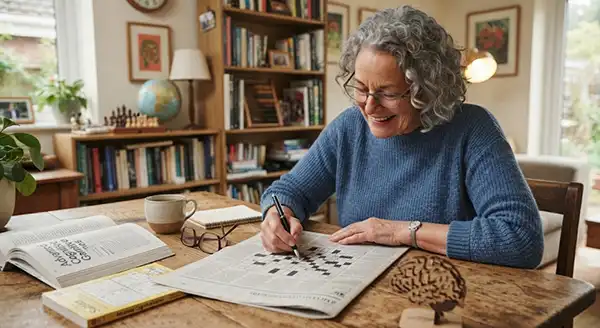
The Brain That Gets Used, Wins
The man was eighty-five years old, and he had just learned to play chess. Not well, not yet. But he was learning. Every afternoon, he sat across from his grandson and moved pieces across the board, making mistakes, asking questions, slowly building patterns that had not existed in his brain a month earlier. When someone asked him why he was bothering at his age, he shrugged. “What else am I going to do? Sit around and wait to forget things?”
That question cuts to the heart of what we know about the aging brain. For decades, the prevailing view was that cognitive decline was inevitable, that memory faded like an old photograph, and that there was nothing to be done about it. That view is wrong. The brain is not a fixed organ with a predetermined expiration date. It is a living, adaptable system that responds to how you use it. And the people who use it most—who challenge it, stretch it, refuse to let it coast—are the ones who keep it sharp.
Before we go further, a brief but important note: this article explores brain health, memory, and cognitive function from a general, educational perspective. It is not a substitute for professional medical advice. If you are experiencing significant memory loss, confusion, or cognitive changes that interfere with your daily life, please consult a qualified healthcare professional. Only a trained specialist can assess whether your concerns are related to normal aging, a treatable condition, or something that requires medical attention.
The Science of a Working Brain
The term “working memory” gets thrown around a lot, but it is worth understanding what it actually means. Working memory is not the same as long-term memory. Long-term memory is where you store facts, experiences, and skills. Working memory is what you use to hold and manipulate information in the moment. It is the mental scratchpad where you keep a phone number while you dial it, or the thread of a conversation while you formulate your response.
Dr. Tracy Packiam Alloway, a professor of psychology at the University of North Florida, has spent her career studying working memory. She has published over seventy-five journal articles and books on the topic, and her research has shown that working memory is a stronger predictor of academic and professional success than IQ. The reason is simple: working memory is what allows you to learn, to adapt, and to solve problems in real time.
Alloway’s work has also shown that working memory is not fixed. It can be trained. Studies have demonstrated that working memory training produces measurable improvements in both trained and untrained tasks. A meta-analysis published in npj Digital Medicine found that computerized working memory training yields moderate benefits relative to control groups. And an eight-week training program has been shown to improve not just memory but also inhibitory control and visuospatial processing. The brain is plastic, even in older adults.
This is not about becoming a genius. It is about maintaining the capacity to think clearly, to learn new things, and to stay engaged with the world. And the good news is that you do not need a PhD in neuroscience to do it. The strategies are simple, accessible, and backed by research.
Why Speaking Faster Might Help You Remember
Here is a counterintuitive tip: talking faster might strengthen your short-term memory. Research on speech rate and memory span has shown that the speed at which you articulate words is related to how many items you can hold in your short-term memory. Faster speech rates are associated with larger memory spans.
The mechanism is not entirely clear, but one theory is that faster speech allows you to rehearse more information in the same amount of time. Your brain cycles through the material more quickly, which keeps it active in working memory. This is not about speaking so fast that no one can understand you. It is about a comfortable, brisk pace that keeps your cognitive engine running.
There is also evidence that the distinctiveness of words matters. Words that sound different from each other are easier to remember than words that sound similar. This is why varying your vocabulary and exposing yourself to new words can be beneficial. The brain pays more attention to novelty, and that attention strengthens the memory trace.
The Games That Actually Work
You have probably heard that brain games can improve memory. The question is which ones actually work. The research suggests that games requiring active recall and manipulation of information are more effective than passive activities.
One simple exercise is to give yourself a category and a time limit. “How many animals can I name that start with the letter P in thirty seconds?” This type of exercise forces your brain to search, retrieve, and inhibit incorrect responses. It is a workout for your working memory.
Another effective strategy is to practice mental arithmetic. Adding numbers in your head, without a calculator, engages multiple cognitive systems. It requires holding numbers in memory, manipulating them, and tracking the result. This is the kind of challenge that strengthens neural connections.
The key is to push yourself slightly beyond your comfort zone. If it is too easy, it is not doing much. If it is too hard, it is frustrating. The sweet spot is the place where you have to concentrate, where you are not entirely sure you can do it, but you try anyway.
The Power of Fifteen Minutes
Physical exercise is one of the most well-documented ways to improve cognitive function. And you do not need to spend hours at the gym to see the benefits. Research has shown that as little as fifteen minutes of moderate exercise can improve cognitive performance.
A study published in The Journal of Physiological Sciences found that fifteen minutes of dynamic exercise at moderate intensity improved performance on the Stroop test, a measure of cognitive flexibility and attention. Another study from the University of Geneva showed that fifteen minutes of intensive exercise improves memory, including the acquisition of new motor skills. The mechanism involves increased blood flow to the brain, particularly the prefrontal cortex, which is responsible for executive functions like planning, decision-making, and impulse control.
This is not about becoming an athlete. It is about moving your body consistently. A brisk walk, a short bike ride, a set of jumping jacks—anything that gets your heart rate up and your blood flowing. The effect is immediate and cumulative. Each session provides a short-term boost, and over time, the benefits compound.
What Language Reveals About Your Brain
There is a reason why learning new words is good for your brain. Vocabulary is not just about communication; it is about cognitive reserve. The more words you know, the more connections your brain has to draw on when it needs to retrieve information.
One strategy is to introduce new words into your daily vocabulary. Choose a word you do not normally use and make a point of using it in conversation. This forces your brain to retrieve the word, to integrate it into your mental lexicon, and to associate it with context. Each new word is a new neural pathway.
The same principle applies to varying your language. Using different words to describe the same thing, or exposing yourself to different styles of writing and speaking, keeps your brain flexible. It prevents the kind of mental rut that comes from repeating the same phrases and ideas.
When Thinking Is Better Than Talking
Here is a tip that might seem counterintuitive: sometimes it is better to think about your plans than to talk about them. There is research suggesting that articulating a plan can sometimes reduce your motivation to follow through. The act of talking about it gives your brain a sense of completion, which reduces the drive to actually do it.
This is not a universal rule. For some people, talking about their plans helps them clarify their thinking and commit to action. But if you find that you are always talking about what you are going to do and never actually doing it, it might be worth trying a different approach. Keep your plans internal. Let them simmer in your mind. Let the anticipation build.
The brain responds to anticipation. When you hold a goal in your mind without immediately acting on it, you are engaging your working memory and your executive functions. You are planning, evaluating, and preparing. These are all valuable cognitive exercises.
The Age Question
There is a persistent myth that memory decline is inevitable after a certain age. It is not. While some cognitive changes are normal, significant decline is not a foregone conclusion. Research has shown that people in their eighties can still improve their memory with the right interventions.
A study from Harvard Health emphasizes that lifestyle factors—exercise, diet, sleep, social engagement, and mental stimulation—are the most powerful tools for maintaining cognitive health. These are not things you do once and forget. They are habits you build over time.
The brain is not a muscle, but it responds to use in similar ways. The people who keep their brains sharp are the ones who keep using them. They read, they learn, they stay curious. They do not accept the narrative that decline is inevitable. They challenge it, every day, with every small act of engagement.
What This Means for You
The research is clear: the brain you use is the brain you keep. The strategies outlined here are not complicated. Speak at a brisk pace. Learn new words. Play games that challenge your memory. Move your body for fifteen minutes a day. Think about your plans before you talk about them. And never, ever tell yourself it is too late.
The eighty-five-year-old learning chess did not wait for permission. He did not assume his brain was past its prime. He simply started. And starting is the only thing that ever works.
Your brain is not a finite resource. It is a living system that grows with use and atrophies with neglect. The choice is yours. You can let it coast, or you can keep it engaged. You can accept the narrative of decline, or you can write a different story.
The evidence is on your side. The tools are in your hands. The only question is whether you will use them.