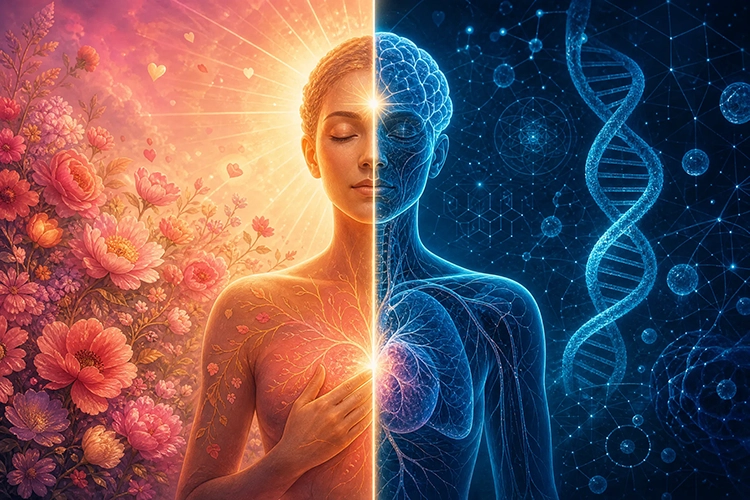
When the Promise of Mind-Body Healing Turns Into Blame
There is a quiet, desperate moment that occurs in doctor’s offices around the world every single day. A lab report comes back with an unexpected mark, an ultrasound reveals an unwanted shadow, or a chronic pain settles into a joint with no obvious structural explanation. In that precise second, the ground beneath your feet shifts. The body, which you have inhabited so comfortably for decades, suddenly feels less like a home and more like a traitor.
In the face of somatic betrayal, human psychology craves one thing above all else: meaning. Randomness is terrifying. The idea that a cellular mutation or an autoimmune flare-up could happen to us simply due to bad genetic luck or environmental noise leaves the ego feeling entirely defenseless.
It was into this vast existential void that Louise Hay stepped decades ago.
Her backstory reads like a harrowing study in human resilience. Having survived childhood abuse, abandonment, and profound trauma, Hay eventually constructed a philosophical framework that captivated millions across the globe. Her premise was deceptively simple: your body is a mirror of your mind. Physical illness is not an arbitrary biological catastrophe, but the physical manifestation of unhealed emotional debt—suppressed anger, unforgiven past injuries, and a chronic lack of self-love.
When Hay claimed to have cured her own terminal cancer through intense emotional processing, nutritional shifts, and radical forgiveness, she didn’t just offer a memoir. She offered a blueprint for absolute personal agency.
The psychological allure of this philosophy is immense. If a migraine is merely perfectionism pressing against your temples, or if stomach distress is simply your inability to digest a new idea, then illness is no longer a random tragedy. It becomes a puzzle. And more importantly, if your thoughts created the disease, then your thoughts possess the sovereign power to unmake it.
To a mind paralyzed by fear, this trade-off feels like an incredible bargain. You exchange the cold helplessness of being a victim of biology for the immense responsibility of being the architect of your own healing.
And to a certain extent, modern science agrees with the foundational premise that mind and body are inextricably linked. Psychoneuroimmunology—the study of how psychological processes interact with the nervous and immune systems—has repeatedly demonstrated that our subjective emotional life carries profound somatic weight.
When you harbor chronic resentment or live in a state of suppressed fear, your sympathetic nervous system remains perpetually engaged. The brain’s hypothalamic-pituitary-adrenal (HPA) axis floods the bloodstream with cortisol and adrenaline. Over months and years, this sustained inflammatory alarm state can impair cellular repair, disrupt gut biome diversity, and weaken immune surveillance. Emotional posture is not merely abstract thought; it is chemistry.
The Spiritual Guilt Paradox
Yet, herein lies the tragic paradox of radical self-healing philosophies: the very framework that promises ultimate empowerment can quickly curdle into a subtle, devastating form of cruelty.
What is the Spiritual Guilt Paradox?In holistic psychology, it is the toxic cognitive state where radical self-healing dogmas inadvertently cause chronic patients to view their worsening physical illness as a personal failure or spiritual shortfall, adding deep emotional guilt onto medical trauma.
When we reduce complex, multi-factorial biological diseases down to emotional shortfalls, we inadvertently invent a new form of victim-blaming. If loving yourself completely is the ultimate cure for cancer, then what does it mean when a tumor continues to grow? Under the cold logic of absolute mind-over-body control, a worsening illness ceases to be a medical tragedy and becomes a personal failure—a sign that you didn’t forgive deeply enough, didn’t repeat your affirmations with enough conviction, or secretly harbor a toxic reservoir of subconscious resentment.
The person fighting for their life is suddenly saddled with a secondary, invisible illness: profound spiritual guilt.
True wisdom lies in holding the mind-body connection with immense grace rather than rigid dogma. Your thoughts, beliefs, and emotional hygiene possess incredible power to help reduce perceived stress and promote a greater sense of safety, creating the optimal internal environment for recovery. Practicing radical self-love and releasing old grievances are inherently valuable endeavors that dramatically elevate the quality of human life.
Flourishing emotionally, however, is not an insurance policy against biological mortality. The body is an intricate, fragile ecosystem operating within a chaotic physical world. Cells divide, genes mutate, viruses infect, and tissues age—not because you failed to love yourself today, but because you are alive.
Reclaiming true agency over your health does not mean demanding absolute tyranny over your biology. It means treating your body with gentle compassion when it thrives, and with even greater tenderness when it falters. Self-love was never meant to be a medical weapon to force cells into submission; it was meant to be a quiet, unshakeable sanctuary while you navigate the unpredictable journey of being human.
Medical Disclaimer: The information provided in this article is for educational and informational purposes only and is not intended as medical or psychological advice, diagnosis, or treatment. Always seek the advice of a qualified mental health professional or physician regarding any clinical condition.