How Play Therapy Helps Children Heal From Trauma and Find Their Way Back to Hope
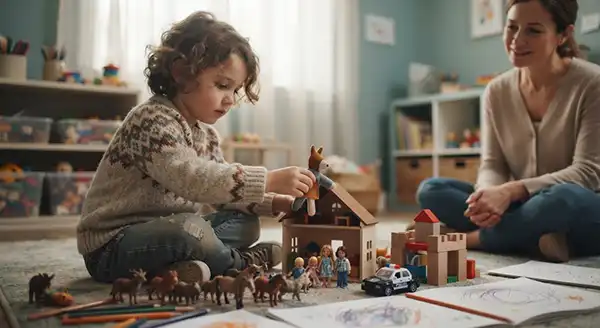
The first child I ever worked with as a play therapist was a seven-year-old boy I will call Ethan. He had been removed from his home three weeks earlier. The reasons were the kind you do not say out loud in polite company, but they were there, in the way he flinched when I moved too quickly, in the way he scanned the room for exits before he would sit down.
I had just finished my training. I had the certificate. I had the supervision hours. I had read Virginia Axline’s “Dibs in Search of Self” twice and underlined half of it. I thought I knew what I was doing.
Ethan taught me otherwise.
For the first three sessions, he did not speak. Not to me. Not to the toys. He sat on the floor of the playroom and built walls out of blocks, then knocked them down, then built them again. The walls got higher each time. The knocking got harder. I sat on the floor with him, watching, narrating, trying to be present without being intrusive.
On the fourth session, he picked up a stuffed dog from the shelf and held it against his chest. He did not say anything. He just held it. Then he put the dog inside the block walls and said, very quietly, “Safe now.”
That was the entire session. He had been waiting for someone to witness the building.
What Play Therapy Actually Is and Why It Works
Play therapy is not just “playing with toys.” It is a structured, evidence-based mental health intervention. The Association for Play Therapy, the national professional organization in the United States, defines it as “the systematic use of a theoretical model to establish an interpersonal process wherein trained play therapists use the therapeutic powers of play to help clients prevent or resolve psychosocial difficulties.”
The key word in that definition is “powers.” Play is not a distraction. It is a mechanism. For children, play is the natural language of the brain. The pioneering therapist Garry Landreth, who founded the Center for Play Therapy at the University of North Texas, liked to say that “toys are children’s words and play is their language.” A child who cannot tell you what happened to them—because they lack the vocabulary, because they lack the safety, because the memory is stored in the body and not in words—can show you what happened. They can move it. They can reshape it. They can try on different endings.
This is not a metaphor. There is neuroscience underneath it. Bessel van der Kolk, the trauma researcher at Boston University and author of “The Body Keeps the Score,” has spent decades documenting how trauma lives in the nervous system. The memories are not stored as narrative. They are stored as sensation, as fragments, as images. Talk therapy, which depends on language and linear thinking, often cannot reach them. Play bypasses the language barrier entirely. It goes straight to the body, to the image, to the felt experience.
A child who was in a car accident may not be able to say “I felt trapped and terrified.” But give them a toy car and a box, and they will crash the car into the box over and over, each time trying to find a way out. The play is the processing. The repetition is the healing.
The Difference Between Playing and Healing Through Play
Here is the part that surprised me most when I started practicing: not all play is therapy. A child can play for hours and never touch the wound. The role of the therapist is to hold the space, to reflect, to help the child feel seen in the playing.
Axline, whose 1964 book “Dibs in Search of Self” remains the foundation of child-centered play therapy, articulated eight principles. The therapist must develop a warm, friendly relationship. The therapist must accept the child exactly as they are. The therapist must establish a feeling of permissiveness so the child can express feelings freely. The therapist must be alert to the feelings the child expresses and reflect them back in a way that helps the child understand them.
The magic is not in the toys. It is in the witnessing.
I think about Ethan and his block walls. He was not building for fun. He was building a container for the dog, and the dog was him, and the walls were the only safety he had ever known. He was showing me something he could not say: “I need to know that something can hold me without hurting me.”
My job was not to interpret that for him. My job was to be there, on the floor, watching, accepting, not rushing. The interpretation would have been for my benefit. The presence was for his.
What Happens When Children Relearn How to Imagine
There is a line in the source material that has stayed with me: trauma passes through children, and their desire to heal, and the dreams they build for that healing, show the boundless capacity of the human spirit to recover.
I have seen this over and over. The child who was in a house fire builds a fire station out of blocks and puts it out. The child who witnessed violence puts the bad guy in jail and gives the good guy a family. The child who was neglected feeds a doll, again and again, until the feeding becomes enough.
The psychologist and author Peter Levine, who developed Somatic Experiencing, writes about the importance of “completing” the survival response that got frozen during trauma. The animal in the wild shakes off the freeze. The child in the playroom shakes it off through story. The play is not a memory. It is a renegotiation.
This is why the imagination matters. A child who has been through hell and can still imagine a different ending is a child who is healing. The imagination is not an escape from reality. It is a tool for reality. It lets the child practice, in symbolic form, what they could not do in the actual event. It lets them become the agent instead of the victim.
I have watched children go from listless and silent to vivid and alive in the span of weeks. The shift is not always dramatic. Sometimes it is just a small sound, a made-up word, a moment of eye contact. But it is always a shift toward something. Toward possibility. Toward a future that is not simply a repetition of the past.
“Play is the child’s natural medium of self-expression.” — Virginia Axline
That sentence, written over sixty years ago, still holds. The child who cannot say “I am afraid” can draw the fear. The child who cannot say “I am angry” can punch the clay. The child who cannot say “I miss her” can bury a doll and then dig it up again.
The Role of the Therapist in Holding the Space
Let me be honest about what this work actually looks like. It is not glamorous. Most of it happens on the floor, in rooms with low shelves and sand trays and puppets that have seen better days. The hours are strange. The emotional toll is real. And the progress is often so gradual that you do not see it until you look back.
A colleague of mine, a licensed clinical social worker in Cleveland who specializes in play therapy, once told me that the hardest part of the work is not the children. It is staying out of the way. “Your job is not to fix them,” she said. “Your job is to be present enough that they can fix themselves.”
That is a harder skill than it sounds. The urge to intervene, to interpret, to comfort, to direct—it is constant. But the research is clear that non-directive approaches, where the therapist follows the child’s lead, are often more effective than directive ones. A 2019 meta-analysis in the Journal of Counseling & Development found that child-centered play therapy produced significant improvements in behavioral problems, anxiety, and trauma symptoms across multiple studies. The effect sizes were not enormous, but they were consistent. The method works. Not because the therapist does more. Because the therapist does less.
I learned this with Ethan. Every time I tried to suggest something—”Would you like to use the puppets today?”—he would look at me like I had broken a spell. The sessions where I sat quietly and reflected what I saw were the sessions where he went deeper. The less I led, the more he showed.
What the Children Taught Me About My Own Imagination
Here is something I did not expect. The work changed me.
I had forgotten how to play. Not literally—I could still throw a ball, could still build a tower. But the open, unstructured, aimless kind of playing, the kind that children do naturally, had gone dormant in me. I had replaced it with productivity. Every hour needed a purpose. Every activity needed an outcome.
The children did not care about outcomes. They cared about the moment. The block tower was not built to be finished. It was built to be built. The destruction of the tower was not a loss. It was part of the building.
I started to notice this in my own life. The walks I took without a destination. The afternoons I spent doing nothing. The small, purposeless acts of making—a sketch, a meal, a garden—that I had stopped allowing myself because they were not “productive.” The children, without meaning to, were teaching me to imagine again. To daydream. To let the mind wander without forcing it toward a goal.
The psychologist and author Stuart Brown, who founded the National Institute for Play, has argued for years that play is not just for children. It is a biological necessity for adults too. His research suggests that play is linked to creativity, resilience, and emotional regulation. The adult who cannot play is an adult who is cut off from part of what makes them human.
The Questions That Stay With Me
I am not working with Ethan anymore. He moved to a different placement. I do not know where he is now. That is part of the work too. The endings are rarely clean. You build a relationship, you witness something profound, and then the system moves them and you never see them again.
But I think about him more than I thought I would. The walls he built. The dog he protected. The word “safe” in his small, quiet voice.
I think about what he was really doing, in that room, with the blocks and the stuffed animals and the strange adult sitting cross-legged on the floor. He was not just playing. He was practicing something he had never been able to do: he was building a world where he could choose what happened next.
That is the gift of play therapy. Not the interpretation. Not the technique. The chance to practice, in miniature, the life you want to live. The chance to imagine, before you have the words, what safety might feel like.
The children do not know they are healing. They are too busy playing. And that, I think, is exactly the point. The healing happens not because they are working at it, but because they are free enough, for one hour, to stop working at it entirely.
They are free to be children. And in that freedom, something in them remembers what it felt like before the world got heavy. Something remembers that the future is not fixed, that the ending is not written, that there is still room to dream.
What I Would Tell You If You Asked
A parent asked me once, after a session, “Is he getting better?”
I wanted to say yes. I wanted to give her a progress report, a percentage, a timeline. Instead I said, “He’s telling his story. That’s the part that matters right now.”
She looked disappointed. I understand. We want results. We want to know that the suffering is leading somewhere.
But healing does not work on a deadline. The walls come down slowly. The dog comes out of the block house when it is ready. The child speaks when the silence has done its work.
What I can tell you is this: the imagination is not a luxury. It is the first tool the child reaches for when the world falls apart. It is how they survive before they have the words to understand. And it is how they rebuild, afterward, when the words still are not enough.
The children taught me that. Not in a training manual. On the floor, with the blocks, with the puppets, with the long, sacred silences that fill a room when a child is finally allowed to be exactly where they are.
I am still learning to play like that. We all are. The adults, I mean. We forget. The children remember. And if we are wise enough to sit with them—not to direct them, not to fix them, just to be there—they will remind us.
The walls come down. The dog comes out. The voice returns.
And the child, who was never as broken as we feared, shows us that the capacity to heal was never lost. It was just waiting for a safe place to play.