How to Find Meaning in Suffering: What Your Hardest Seasons Are Trying to Teach You
The day the biopsy results came back, I was standing in the frozen foods aisle of a Kroger in Columbus, Ohio, holding a bag of peas against my chest where the tumor was. The phone rang. The doctor said the word I had been waiting for and dreading for three weeks. And I remember thinking, very clearly, This is the worst thing that has ever happened to me.
I was wrong about that. But I would not understand why for another eighteen months.
What I know now, from the other side of surgery and radiation and a fear so deep it felt physical, is that the worst thing that ever happened to me was also, in a way I could not have predicted, one of the most important. Not because cancer is a gift—it is not, and anyone who says otherwise has never had it—but because the wound itself forced me to become someone I had been too scared to become before.
There is a paradox at the center of healing that most people never get taught. The cure and the disease are not opposites. They are partners. The pain and the meaning are not separate. They arrive together, tangled up, and you cannot have one without the other.
The question is whether you can see it.
What the Word “Healing” Actually Means When You Stop Romanticizing It
In American culture, we treat illness as an interruption. A glitch. Something to be fixed and forgotten, like a flat tire on the way to somewhere more important. We do not ask what the illness might be saying. We ask how fast we can make it go away.
The physician and author Rachel Naomi Remen, who spent decades working with cancer patients at Commonweal in California, wrote about this in her book “Kitchen Table Wisdom.” She argued that healing is not the same as curing. Curing is about eliminating the disease. Healing is about becoming whole. You can be cured without being healed. And you can be healed without being cured.
That distinction saved me. Not in the dramatic, movie-moment way. Quietly, over months, like water wearing down a stone. Because I was not cured—not in the way I wanted to be, not quickly, not cleanly. But I was healing. The wound was doing something to me. It was changing the way I saw my life, my relationships, my own strange stubborn hold on being alive.
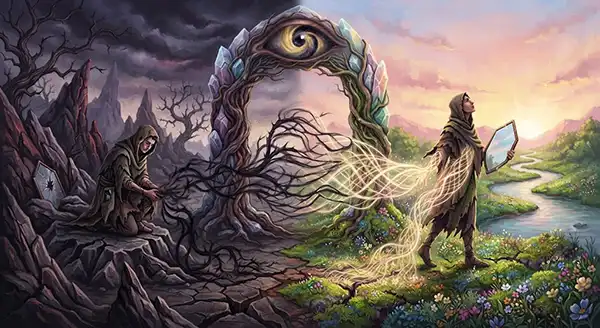
“The wound is the place where the light enters you.” — often attributed to Rumi, quoted by Rachel Naomi Remen
I had read that line years before I got sick and rolled my eyes at it. It felt like something you put on a candle. But when the wound is your own, the line stops being decorative. It becomes a fact. The light does not enter the places that are already whole. It enters the cracks. That is not a spiritual platitude. That is anatomy.
What the Research Says About Growth After Trauma
There is a body of research on this that gave me something to hold onto when the fear was loudest. It is called post-traumatic growth.
The psychologists Richard Tedeschi and Lawrence Calhoun at the University of North Carolina at Charlotte coined the term in the 1990s. They had noticed something strange in their work with trauma survivors. A small but significant number of people did not just recover from terrible events. They changed. They became more appreciative, more connected, more aware of what mattered. The trauma did not make them better because it was good. It made them better because it broke something open.
A 2018 study in the Journal of Traumatic Stress found that roughly half to two-thirds of trauma survivors report at least some positive change in the aftermath. The growth does not cancel the suffering. The two coexist. You can be shattered and grateful in the same hour. The gratitude does not mean the shattering was worth it. It means the human spirit has a strange capacity to find meaning even in the rubble.
I am not saying cancer was a gift. I want to be clear about that, because the “everything happens for a reason” brigade makes me want to scream. Some things happen because bodies fail, because cells mutate, because chaos is real. The meaning is not in the event. The meaning is in what you do with it afterward.
That distinction matters. The search for meaning is not the same as the search for blame. One opens. The other closes.
The Day I Stopped Fighting and Started Listening
Here is what I learned, slowly and badly, about how to actually find the lesson in the pain.
For the first six months after my diagnosis, I fought. I fought the fear, fought the fatigue, fought the unfairness of it. I was furious at my body for betraying me, at God for letting it happen, at the universe for being the kind of place where people get cancer and children go hungry and nothing ever feels safe.
The fighting was exhausting. It did not change anything. The cancer was still there. The fear was still there. I was just burning through my remaining energy trying to push against something that could not be pushed.
Then one afternoon, I was lying on the couch, too tired to even hold a book, and I caught myself in the middle of a thought. I was arguing with my own life. I was telling it what it should have been instead of looking at what it actually was.
And I heard, very quietly, the voice of the therapist I had started seeing after the diagnosis. She was a woman named Ruth, and she had a way of asking questions that felt like open doors.
“What if you didn’t have to like it?” she had said once. “What if you just had to see it?”
That sentence came back to me on the couch. The fighting had been my way of not seeing. If I stayed angry enough, I did not have to feel the fear underneath. If I stayed busy enough, I did not have to sit with the grief.
Seeing was harder than fighting. But it was also the only thing that worked.
How to Practice Seeing the Gift Without Becoming a Cliché
The practice, if you can call it that, is embarrassingly simple. It is not a technique. It is a turning.
When you are in the middle of something hard, you ask yourself: What is this teaching me? Not what is this doing to me. Not whose fault is this. What is this asking of me?
The answer is not always available. Sometimes it comes months later, in the shower, in the car, at three in the morning when you cannot sleep. But the question creates a space. And the space is where the meaning can find you.
The author and researcher Brené Brown, at the University of Houston, has spent years studying what makes people resilient. Her research shows that the people who navigate suffering best are not the ones who deny the pain. They are the ones who can hold the pain and the meaning at the same time. They do not pretend the wound is not there. They just refuse to let the wound be the only thing that is there.
I started doing this in small, almost embarrassing ways. The fatigue that forced me to slow down—could it be teaching me something about the pace I had been running for years? The fear that woke me at night—could it be pointing me toward something I had been avoiding? The loss of my hair, my energy, my sense of control—could it be showing me what was actually left when all the performance was stripped away?
I did not like the answers. They were not comfortable. But they were true.
The illness was teaching me that I had been living like I had forever. The fear was teaching me that I had been avoiding the things I most wanted but was too scared to reach for. The loss was teaching me that my identity had been built on sand—on achievement, on productivity, on being needed—and that none of it was solid enough to stand on when everything else fell away.
I am not grateful for the cancer. I will never say that. But I am grateful for what the cancer forced me to see. And the gratitude and the anger live in the same body, at the same time, without canceling each other out.
Why the Journey Matters More Than the Destination
There is a line in the source material that has been echoing in my head for weeks: the path takes you through narrow passages, but those passages lead to beautiful views. The question is whether you can feel the value of the journey while you are still on it.
That is the hard part. When you are in the narrow place, when the walls are close and the light is far away, it is nearly impossible to feel the beauty of where it might lead. The fear is too loud. The pain is too present. You cannot see the view because you are too busy trying not to panic in the dark.
But here is what I know now, from the other side: the journey itself is the point. Not the arrival. Not the healing. The walking.
The psychologist and author Kelly McGonigal, at Stanford, has written about this in her work on stress. Her research suggests that the people who thrive are not the ones who avoid difficulty. They are the ones who find a way to make meaning of it. The meaning does not erase the difficulty. But it changes what the difficulty does to them.
I used to think healing was a destination. A place I would arrive, one day, when the fear was gone and the body was strong and the future felt safe again. I do not think that anymore. Healing is not a place. It is a way of walking. It is the practice of turning toward what hurts and asking, with genuine curiosity, what it might be trying to tell you.
The path does not end. The view does not arrive all at once. But if you keep walking, if you keep asking, the narrow places start to feel less like traps and more like gateways. The walls become a passage. The dark becomes a kind of light.
What I Would Tell You If We Were Sitting Together
You are probably not sick. Not the way I was. But you are carrying something. A grief. A fear. A regret. A wound that has not fully healed.
And you are probably fighting it. Arguing with it. Telling it what it should have been instead of seeing what it actually is.
What if you didn’t have to like it? What if you just had to see it?
That is the question. The only one that matters, really. Not “why is this happening” but “what is this teaching me.” Not “how do I make it stop” but “what is it asking of me.”
The answer will not come all at once. It will come in fragments, in the quiet moments, in the spaces between the fear and the anger. But it will come. Because the wound, whatever it is, is not just a wound. It is a doorway. And the light—the strange, impossible light—is already starting to press through the cracks.
You do not have to be grateful for the wound. You do not have to pretend it was worth it. You just have to be willing to see what it is showing you.
That is the whole thing. Not the curing. The healing. Not the arrival. The walking.
And the walking, as it turns out, is enough. It has always been enough. The only thing that was ever missing was your willingness to be there for it—to be present, to be curious, to be open to the possibility that the worst thing might also, in some impossible way, be one of the most important things that ever happened to you.
That is not a cliché. That is the truth. And it is available to you, right now, in whatever narrow place you find yourself in.
The question is whether you can see it. And the answer, I promise you, is yes. You just have to look.