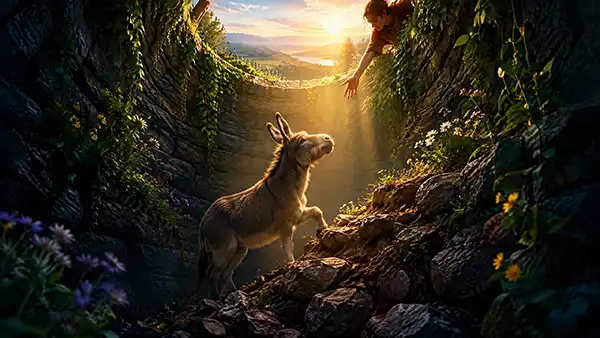
I Was the Donkey
I have been in the well. Not a literal well. A well of circumstance, of expectation, of other people’s plans for what my life was supposed to look like. The dirt was falling. It was falling for years. And I did what the donkey did. I panicked first. Then I went quiet. Then I figured out that the dirt was not the end of me unless I let it be.
The story of the donkey and the well is usually told as a parable about resilience. Life will throw dirt on you. Shake it off and step up. I have told that version myself, to other people, when they were in wells of their own. The version is not wrong. It is just incomplete. And the incompleteness is where the real story lives.
What the first year taught me
The first year in the well is the hardest. Not because the dirt is heaviest then. Because you do not yet know what the dirt is. You do not know if it is solid or liquid. You do not know if the people throwing it are aiming at you or just filling a hole. You do not know if the well has a bottom.
I spent that year trying to understand what was happening. I asked why. I asked who. I asked what I had done to deserve it. The questions did not produce answers. They produced more questions. The dirt kept falling while I was asking.
Somewhere in the second year, I stopped asking why. Not because I had found the answer. Because I had realized that the answer did not matter. The dirt was falling whether I understood it or not. The only thing that would stop it was getting out.
Some neighbors aim. Some just fill.
The story says the farmer and the neighbors were not malicious. They were just filling the well. The well needed to be filled. The donkey was collateral damage. The donkey was not the target.
That was not my experience. Some of the people throwing dirt were aiming. Not all of them. But enough. The manager who assigned me the impossible project and then criticized me for not completing it. The friend who asked how my writing was going and then changed the subject before I could answer. The relative who told me I was brave for trying and then laughed when I said I might succeed.
The dirt was not random. It was targeted. It was designed to bury. The shaking off was not enough because the shovels were aimed at my head.
I learned to distinguish. Some people were filling the well. Some people were trying to bury me. The first group I could work with. The second group I had to leave. The leaving was the hardest thing I have ever done. It felt like failure. It felt like admitting that I could not handle what they were doing. It was neither of those things. It was survival.
Exhaustion is not in the story
The donkey in the story shakes off every shovelful. Every single one. The donkey steps up. The donkey walks out. The story is over. The donkey is fine.
I was not fine. I got out. But I was not fine. The shaking off had cost me something. The stepping up had cost me something. The belief that escape was possible, maintained for years while the dirt was falling, had cost me something. The cost was not visible in the story. The cost was visible in me.
I had trouble sleeping. I had trouble trusting. I had trouble believing that the ground would not open up again. The well had left a mark. Not a scar. A hypervigilance. A constant readiness for the next shovelful.
The research on allostatic load, developed by Bruce McEwen at Rockefeller University and published in the New England Journal of Medicine in 1998, describes what was happening to my body. The cumulative cost of chronic stress. The wear and tear on the systems that keep the organism alive. I was not just tired. I was depleted. The depletion did not show in the story. It showed in my life.
Nobody climbed down
The story does not include the neighbor who put down the shovel. The one who saw what was happening and refused to participate. The one who climbed down into the well. The one who called for help that was actually help.
I did not have that neighbor. I had neighbors who threw dirt. I had neighbors who watched. I had neighbors who said they were sorry but did not stop. I did not have the one who climbed down.
I have since learned that the neighbor who climbs down is the most important person in the story. Not because they save the donkey. Because they change the conditions. They make the well less lonely. They make the dirt less heavy. They make the shaking off less exhausting. The donkey still has to climb. But the climbing is possible because someone is there.
The research on social support and recovery, synthesized by Shelley Taylor at the University of California, Los Angeles, in her 2011 book Social Neuroscience, has consistently found that the presence of supportive relationships is one of the strongest predictors of recovery from adversity. The support does not change the well. It changes the experience of the well. The person who is not alone climbs differently.
The well that took years
There is another story I have not told. The story of the well I did not escape. The relationship that took years to leave. The job that took years to quit. The belief about myself that took years to question. The dirt was falling. I was shaking it off. I was stepping up. And I was not getting out.
The reason was not that the dirt was liquid. The reason was that I had accepted the farmer’s definition of the situation. The farmer said the well needed to be filled. The farmer said the donkey was not worth saving. I accepted the premise. I did not question the frame.
The donkey in the story does not question the frame. The donkey does not say: wait, why are you filling this well while I am in it? The donkey does not say: this well does not need to be filled. The donkey just uses the dirt.
The using is important. But the questioning is more important. The person who uses the dirt without questioning the frame gets out of one well and falls into another. The person who questions the frame learns to recognize wells before falling into them.
I did not learn that until later. I learned it in therapy. I learned it in the slow, unglamorous work of examining the beliefs I had absorbed without noticing. I learned it by asking questions I had never thought to ask. The questions did not change the past. They changed the future.
Rejecting the farmer’s premise
The premise was that I was the kind of person things happened to. Not the kind of person who made things happen. The premise was old. I had absorbed it before I could evaluate it. It had shaped my choices, my relationships, my career, my sense of what was possible.
The premise was not true. But it had been true for so long that it felt like the truth. The donkey had the same problem. The donkey believed the farmer’s assessment. The donkey believed it was old and worthless. The donkey did not question whether the farmer was qualified to make that assessment.
The research on self-verification theory, developed by William Swann at the University of Texas at Austin and published in Psychological Review in 1987, explains why. People seek confirmation of their existing beliefs about themselves, even when those beliefs are negative. The belief is familiar. The familiar is comfortable. The comfortable is safe. The safe is a well.
Rejecting the premise was not a single decision. It was a practice. It was noticing every time I accepted someone else’s definition of me. It was asking whether the definition was accurate. It was choosing a different definition when the old one was not accurate. The practice was slow. The practice was uncomfortable. The practice worked.
Finding the person who is not throwing dirt
The donkey never asked for help. The donkey was surrounded by neighbors who were actively throwing dirt. There was no one to ask. The donkey was alone in the well. The donkey got out alone.
I am not the donkey. I had people. I did not always know I had them. I did not always use them. But they were there. The person who listened without trying to fix. The person who said me too. The person who sent a message at the right moment. The person who did not throw dirt.
If you are in a well, and the dirt is falling, and the neighbors are aiming, and the shaking is not working, the question is not whether you can be the donkey. The question is whether you can find the person who is not throwing dirt. The person who is not there to fill the well. The person who is there for you.
A 2025 study published in the Journal of Consulting and Clinical Psychology by researchers at the University of Washington examined the role of social support in recovery from trauma across 2,000 adults. The findings showed that participants who reported high levels of social support recovered faster and more completely than those who did not. The support did not change the trauma. It changed the trajectory of the recovery.
If the patterns described here are accompanied by persistent sadness, anxiety, or distress that interferes with sleep, appetite, work, or relationships, the appropriate response is not to try harder to manage it alone. It is to speak with a mental health professional who can assess what is happening and recommend an appropriate course of care. The research on cognitive behavioral therapy, trauma-informed care, and other evidence-based treatments is robust. Support is not a sign of weakness. It is a recognition that some wells are deeper than any one person can climb out of alone.
The well I am still in
I am not out of every well. There are still moments when the dirt falls. There are still people who aim. There are still beliefs I have not fully questioned. The practice is not finished. The practice is not supposed to be finished.
The difference is that I know what I am doing now. I know the dirt is not personal. I know the well has a bottom. I know the shaking is possible. I know the stepping is possible. I know the neighbors who aim are not the whole story. I know the person who climbs down is the person I needed and the person I can be.
The donkey got out. The donkey walked away. The donkey did not look back. The story ends there. My story does not end there. My story includes the aftermath. The exhaustion. The hypervigilance. The recovery. The learning. The questioning of the premise. The finding of the people. The practice of not accepting the farmer’s definition.
If you are the donkey, and the dirt is falling, and the well feels endless, the story you have been told is not the whole story. The story you have been told ends with walking away. The story that is true continues. It continues with the recovery. It continues with the learning. It continues with the people. It continues with you.