The Unconscious Is Not a Basement: What the Mind Does When You Are Not Looking
The unconscious is not a hidden room with thirty fixed rules. It is not a small child, a computer program, or a separate entity that can be reprogrammed like software. It is a collection of automatic processes—perception, memory, habit, emotion regulation—that operate outside awareness and shape behavior in ways that are real, measurable, and often misunderstood. Many popular claims about the subconscious are metaphors that have been mistaken for mechanisms. Some are useful. Some are misleading. A few are harmful. This article examines what the research actually supports, what it qualifies, and what it rejects.
Why the hidden mind is not a hidden room
The idea that the mind has a conscious surface and a subconscious basement is older than psychology itself. Freud popularized the metaphor, but he did not invent it. The metaphor is useful for conversation. It is useless for science. The brain does not store thoughts in rooms. It processes information through distributed networks that are always active, always interacting, and never fully separable into conscious and unconscious compartments.
Timothy Wilson at the University of Virginia calls the system the adaptive unconscious. His research, summarized in Strangers to Ourselves, shows that the mind performs most of its operations outside awareness not because those operations are hidden, but because they are efficient. Conscious processing is slow, serial, and effortful. Automatic processing is fast, parallel, and cheap. The brain defaults to automaticity because automaticity keeps you alive.
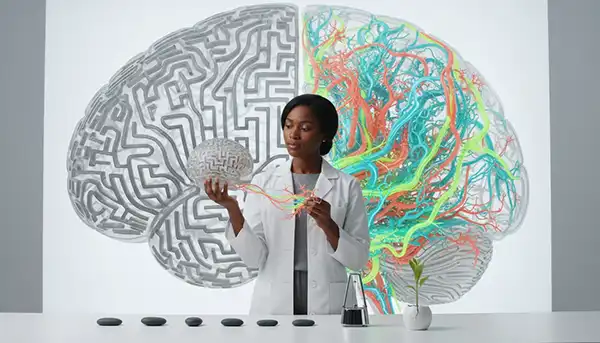
I call the structured network of associations, habits, and implicit memories that emerges from this automaticity the implicit architecture. It is not a place. It is a pattern. It is built from experience, reinforced by repetition, and expressed in behavior before it is expressed in words.
Automaticity is not a personality
John Bargh at New York University spent decades studying how automatic processes shape social behavior. His experiments demonstrated that subtle cues—a word, a smell, a temperature—can influence judgment and action without the person noticing. In one famous study, participants who held a warm cup of coffee rated a stranger as warmer than participants who held an iced coffee. The temperature of the cup changed the temperature of the judgment. The participants did not know it. They would have denied it if asked.
The finding is not a parlor trick. It is a demonstration of how the implicit architecture works. The brain associates warmth with social warmth because early experiences linked physical comfort to care. The association is not a belief. It is a prediction. The prediction shapes perception before conscious thought arrives.
Ap Dijksterhuis at Radboud University in the Netherlands extended the research into what he called unconscious thought theory. His studies showed that for complex decisions, participants who were distracted after receiving information made better choices than participants who deliberated consciously. The distraction allowed the automatic system to process the information without the interference of conscious bias. The finding has been debated, and the effect is not universal. But the direction is consistent with the broader literature: the mind is doing more than you know.
Implicit memory and the stories it tells
The implicit architecture is built from memory, but not the kind of memory you can recall on demand. Implicit memory is procedural, associative, and emotional. It is the memory that lets you ride a bike, recognize a face, and flinch at a tone of voice. It is also the memory that carries the residue of old experiences into new situations.
Richard Nisbett and Timothy Wilson at the University of Michigan published a landmark paper in 1977 titled “Telling More Than We Can Know.” They demonstrated that people confidently report reasons for their choices that have nothing to do with the actual causes. In one study, participants chose a pair of stockings based on position rather than quality, but they invented elaborate explanations about texture and color. The explanations were not lies. They were confabulations. The conscious mind was narrating a story it had not authored.
The implicit architecture does not speak in sentences. It speaks in associations. A tone of voice can trigger a memory of a parent. A smell can trigger a feeling of safety. A deadline can trigger a fear that was learned in childhood. The triggers are not always accurate. They are always fast.
Emotion is not a subroutine
Many popular accounts of the subconscious treat emotion as a separate module that can be controlled or overridden. The neuroscience does not support this. Emotion is not a subroutine. It is a dimension of every cognitive process.
Antonio Damasio at the University of Southern California studied patients with damage to the ventromedial prefrontal cortex. These patients could reason logically, but they could not make decisions. They lacked the emotional signals that normally guide choice. Damasio’s somatic marker hypothesis showed that emotion is not the opposite of reason. It is a necessary part of it. The feeling is the information.
Joseph LeDoux at New York University has shown that the amygdala, the brain’s threat-detection center, can respond to a stimulus before the cortex has time to process it. The response is not a thought. It is a reflex. The reflex can be accurate, as when it detects a snake. It can be inaccurate, as when it detects a criticism. The accuracy depends on the learning history, not the present reality.
The five-year-old myth
The claim that the subconscious is fully formed by age five and cannot be changed afterward is one of the most persistent myths in popular psychology. It is not supported by the research.
The brain remains plastic throughout life. Neuroplasticity does not mean that change is easy. It means that change is possible. The habits and associations that were laid down early are strong because they have been reinforced for decades. They are not immutable. They are resistant.
A 2024 study in Nature Neuroscience examined the effects of learning new skills on brain structure in adults aged sixty to eighty. The participants who learned a new language, a new instrument, or a new sport showed measurable increases in gray matter density in regions associated with memory and executive function. The participants who engaged in familiar activities did not. The novelty was the mechanism.
The five-year-old myth is harmful because it tells people that their patterns are fixed. The message is not just wrong. It is demoralizing. The person who believes they cannot change will not try.
Reprogramming is not a software update
The metaphor of the subconscious as a computer program is seductive because it suggests that change is a matter of installing new code. The metaphor is misleading. The brain is not a computer. It is a biological system that changes through experience, repetition, and feedback.
You cannot reprogram yourself by repeating affirmations in a mirror. You can change your implicit architecture by changing your behavior, your environment, and your relationships. The change is slow. It is not dramatic. It is real.
A 2025 study in the Journal of Personality and Social Psychology found that people who made small, consistent changes to their daily routines showed greater long-term improvement than people who attempted large, dramatic changes. The small changes were sustainable. The large changes were not.
When “my subconscious made me do it” becomes a dodge
There is a version of the subconscious narrative that becomes an excuse. “I can’t help it. It’s my programming.” The statement is not a description. It is a surrender. The implicit architecture influences behavior. It does not determine it. The gap between impulse and action is where choice lives.
The research on self-regulation has shown that the capacity to inhibit impulses is not a fixed trait. It is a skill that can be developed. The skill is not about suppressing the impulse. It is about noticing the impulse and deciding what to do with it. The deciding is the freedom.
What actually shifts behavior
If you want to change the implicit architecture, you do not start with the unconscious. You start with the conditions that shape it. The research on habit formation has identified several levers.
The first is repetition. A behavior becomes automatic when it is repeated in a stable context. The context is the cue. The repetition is the reinforcement. The automaticity is the result.
The second is environment. The implicit architecture is shaped by what is present. If you want to eat less sugar, remove the sugar from the house. If you want to read more, put the book on the pillow. The environment is not a backdrop. It is a collaborator.
The third is feedback. The brain learns from consequences. Immediate feedback is more powerful than delayed feedback. The person who wants to change a habit needs to find a way to make the consequences visible and immediate.
The limits of neuroplasticity
Neuroplasticity is not infinite. The brain changes within constraints. Some patterns are deeply embedded and may require professional support to shift. The person who has experienced trauma, chronic anxiety, or depression may find that self-directed strategies are not enough. The appropriate response is not to try harder alone. It is to seek help.
A note on professional support
If the patterns you are trying to change are accompanied by persistent sadness, anxiety, or distress that interferes with sleep, appetite, work, or relationships, the appropriate response is not to try harder to reprogram your subconscious. It is to speak with a mental health professional who can assess what is happening and recommend an appropriate course of care. The research on cognitive behavioral therapy, trauma-informed care, and other evidence-based treatments is robust. Effective support exists. The support is not a sign that you have failed to manage your own mind. It is a recognition that some patterns require more than individual effort to change.
The architecture you already carry
The unconscious is not a basement. It is not a child. It is not a computer. It is the sum of everything you have learned, everything you have practiced, and everything you have felt. It is the architecture of your automatic life. It is not you. It is what you have built. And what you have built can be rebuilt. Not quickly. Not easily. But actually. The first step is to stop looking for a hidden room and start looking at the habits, environments, and relationships that shape the life you are already living. The architecture is not the enemy. It is the material. The material is available. The work is yours.