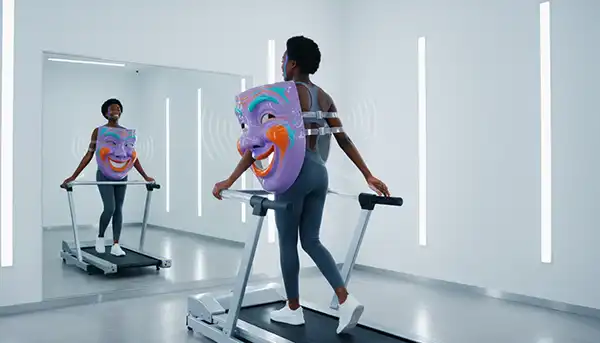
The Mask Is Not the Problem: On Fear, Exposure, and the Slow Work of Being Seen
The fear of self-disclosure persists because you learned, early and thoroughly, that being seen was dangerous. It is not a sign of weakness. It is a survival adaptation. The mask was not created because you were false. It was created because you were unprotected. The work is not to rip it off in a single act of courage. It is to lower it gradually, in conditions safe enough for the nervous system to learn that exposure does not equal annihilation. If the fear is severe and persistent, the most responsible next step is not another self-help technique but a mental health professional who can help you distinguish ordinary guardedness from treatable anxiety or trauma.
I call the cost of this hiding the self-concealment tax: the accumulating psychological and relational expense of concealing the parts of yourself you believe would be rejected. It is paid daily, in small installments, until the hidden self feels less real than the performance. The tax is not a moral failure. It is a bill that arrives whether or not you have the currency to pay it.
A survival adaptation, not a character flaw
Most people who fear exposure believe they are the only ones. They watch others speak openly, share vulnerable stories, admit uncertainty, and they conclude that something is missing in them. The conclusion is wrong. The capacity to hide is universal. It is one of the first social skills a child acquires. The child learns which emotions are permitted, which questions are unwelcome, which parts of the self must be kept out of view. The learning is not always explicit. It is absorbed through the raised eyebrow, the sigh, the sudden change of subject, the moment of praise that follows compliance and the moment of withdrawal that follows honesty.
By the time you are old enough to ask why you cannot be more open, the pattern has already become the architecture of your personality. You do not experience it as a choice. You experience it as who you are. The person who cannot cry in front of others does not think, “I am choosing to hide my grief.” They think, “I am not a person who cries.” The person who cannot admit they are struggling does not think, “I am performing competence.” They think, “I am competent.” The performance has become the self.
This is why the fear feels so threatening. It is not the fear of a single conversation. It is the fear of losing the only self you have known. The mask is not a hat you can remove. It is the face you have been wearing for decades. Removing it feels less like honesty and more like death.
What the mask was hired to do
The mask was hired to protect you. It was hired because at some point, being seen was costly. Perhaps you were mocked for a genuine emotion. Perhaps you were punished for a question. Perhaps you were ignored when you needed attention, or smothered when you needed space. The details differ, but the lesson is the same: the authentic self is not safe here.
So the mask learned to do its job. It smiled when you were angry. It agreed when you disagreed. It performed confidence when you were terrified. It learned to read the room and become whatever the room required. The mask was not a liar. It was a diplomat. It was trying to keep you alive in a social world that punished the wrong kind of visibility.
The problem is that the mask did its job too well. It became automatic. It stopped being a tool and became an identity. You forgot that there was a face underneath. You forgot that there was a self that did not need to calculate every expression. The mask became the only face you knew, and the fear of removing it became the fear of having no face at all.
The self-concealment tax
The self-concealment tax is not paid in a single lump sum. It is deducted from your life in daily installments. It is paid in the energy required to monitor your expressions. It is paid in the relationships that never deepen because you never let anyone close enough to see the parts that matter. It is paid in the physical tension that accumulates when you suppress what you feel. It is paid in the loneliness that grows even when you are surrounded by people, because the people are surrounding the mask, not you.
The research on self-concealment has documented this cost with uncomfortable precision. Sidney Jourard, a psychologist who pioneered the study of self-disclosure in the 1960s and 1970s, found that the capacity to reveal oneself to at least one other person was consistently associated with better psychological and physical health. The finding has been replicated across cultures and decades. The person who has no one to tell the truth to is not simply lonely. They are carrying a physiological burden that the body was not designed to carry indefinitely.
James Pennebaker at the University of Texas at Austin spent decades studying what happens when people write about difficult experiences. His research showed that expressive writing—putting the unspoken into words—produced measurable improvements in immune function, sleep, and emotional well-being. The writing did not change the events. It changed the relationship to the events. The concealment had been the stressor. The disclosure was the release.
The tax is not a metaphor. It is a measurable load. The person who hides is not simply being private. They are spending resources that could be used for living on the maintenance of a performance that no one asked for.
Why the body treats exposure as danger
The fear of self-disclosure is not primarily a thought. It is a physiological event. When you imagine revealing something vulnerable, the brain activates the same threat-detection systems that respond to physical danger. The amygdala fires. Cortisol and adrenaline are released. The prefrontal cortex, responsible for language and complex reasoning, is partially inhibited.
This is why the moment of truth often arrives with a racing heart, a tightening throat, and a sudden inability to find the right words. The body is not sabotaging you. It is protecting you from what it has learned to perceive as a threat. The threat is not the disclosure itself. The threat is the rejection that the disclosure might produce. The body does not distinguish between social rejection and physical attack. The same systems respond to both.
Naomi Eisenberger at the University of California, Los Angeles, has shown that social rejection activates regions of the brain associated with physical pain. The finding explains why being excluded hurts in a way that feels bodily. It is bodily. The nervous system treats social belonging as a survival requirement. The person who risks exposure is risking something that the body registers as a life-or-death matter.
This is why willpower alone rarely solves the problem. You cannot argue your way out of a nervous system response. You can only retrain it through experience, through the slow accumulation of moments in which you reveal something and discover that the feared outcome does not occur.
The imaginary audience that never leaves
The fear of disclosure is sustained by an audience that does not exist. It is the imagined audience of everyone who might judge you. It is the parent who was never satisfied. The teacher who was dismissive. The peer who laughed. The culture that told you what was acceptable. The audience is internalized. It speaks in the voice of every person who ever made you feel that your authentic self was not enough.
The research on rejection sensitivity, developed by Geraldine Downey and colleagues, has shown that people who are highly sensitive to rejection tend to perceive it where it does not exist. They read neutral expressions as hostile. They interpret ambiguous comments as criticism. They withdraw before they can be rejected, because the anticipation of rejection is more painful than the rejection itself. The withdrawal protects them from a threat that is largely imaginary, but the protection also prevents them from discovering that the threat was imaginary.
The imaginary audience is not a hallucination. It is a memory. It is the accumulated residue of every real judgment you have ever experienced. The brain generalizes. It says, “This happened before. It will happen again.” The generalization is efficient. It is also inaccurate. The people in front of you are not the people from your past. They have their own histories, their own fears, their own masks. They are not thinking about you as much as you think they are. They are thinking about themselves.
What research says about being known
The antidote to the self-concealment tax is not radical transparency. It is what researchers call perceived partner responsiveness: the experience of feeling understood, validated, and cared for by another person. Harry Reis at the University of Rochester has spent decades studying this construct, and his findings are consistent. The perception of responsiveness is one of the strongest predictors of relationship satisfaction, emotional well-being, and even physical health. The perception matters more than the objective amount of support provided. The person who feels seen is not necessarily the person who receives the most help. They are the person who believes the help is directed at the real self.
This is why disclosure is not the same as oversharing. Oversharing is disclosure without attunement. It is the act of revealing without regard for the listener’s capacity or the relationship’s readiness. It often produces the rejection it fears, not because the content is unacceptable, but because the timing and context are wrong. The skill is not disclosure in the abstract. It is disclosure in the right dose, with the right person, at the right moment.
Arthur Aron at Stony Brook University demonstrated that closeness can be accelerated through structured, escalating self-disclosure. His famous 36 questions have been used in thousands of studies and countless social experiments. The finding is not that any question creates intimacy. It is that reciprocal, gradually deepening disclosure creates the conditions for it. The key word is reciprocal. Disclosure without reciprocity is performance. Disclosure with reciprocity is relationship.
The slow exposure that rewires
The way out of the fear is not a single act of bravery. It is a practice of graduated exposure. The nervous system learns through repetition. It learns that a small disclosure is survivable. Then a slightly larger one. Then a slightly larger one. The process is not linear. There are setbacks. There are moments when you reveal too much to the wrong person and the old fear is confirmed. But the overall trajectory is toward a broader range of safe expression.
This is the same principle that underlies exposure therapy for anxiety disorders. The person who fears spiders does not begin by holding a tarantula. They begin by looking at a picture. Then by standing in the same room as a spider in a jar. The hierarchy is gradual. The goal is not to eliminate fear. It is to teach the brain that the feared outcome is not inevitable.
The same hierarchy applies to emotional exposure. You do not begin by telling your deepest secret to a stranger. You begin by admitting to a friend that you are tired. You begin by saying “I don’t know” when you don’t know. You begin by allowing a moment of silence instead of filling it with performance. Each small act of honesty is a data point. The data accumulates. The brain updates.
When ordinary fear becomes something more
There is a line between the ordinary fear of vulnerability and the clinical conditions that require professional care. The line is not always obvious. If the fear of disclosure is accompanied by persistent sadness, anxiety, or distress that interferes with sleep, appetite, work, or relationships, the appropriate response is not to try harder to be open. It is to speak with a mental health professional who can assess what is happening and recommend an appropriate course of care.
Social anxiety disorder, avoidant personality disorder, complex trauma, and depression all involve a heightened fear of exposure. These conditions are not character flaws. They are treatable. The research on cognitive behavioral therapy, exposure therapy, and trauma-informed care is robust. The support is not a substitute for the slow work of disclosure. It is a scaffold that makes the work possible when the fear is too heavy to carry alone.
If you have been hiding for decades, the idea of being seen may feel not just frightening but impossible. That is not a sign that you are broken. It is a sign that the mask has been doing its job for a long time. The mask can be lowered. But it does not need to be torn off. It can be removed in pieces, at a pace the nervous system can tolerate, with the help of people who have earned the right to see what is underneath.
A different kind of nakedness
The goal is not to become a person who has no privacy, no boundaries, no strategic silence. The goal is to become a person who can choose. The mask is not the enemy. The enemy is the belief that the mask is the only face you have. The enemy is the automatic hiding, the reflexive performance, the inability to lower the mask even when it is safe to do so.
The person who has integrated the fear does not stop feeling it. They feel it and act anyway. They notice the urge to hide and they choose, sometimes, to stay visible. They know that the exposure will not kill them. They have evidence. The evidence came from all the times they revealed something and survived. The evidence came from the people who stayed. The evidence came from the slow, unglamorous work of being known.
You do not need to become a different person. You need to become the person who is already there, underneath the performance. That person has been waiting. They have been paying the self-concealment tax for years. They are tired. They are not asking you to become fearless. They are asking you to stop paying the tax and start living on what remains.