The Art of Being Good: Eight Gifts That Cost Nothing and Change Everything
You already know what it means to be a good person. That is not the problem. The problem is the gap between knowing and doing, between the person you admire in theory and the person who actually shows up in the room. Epictetus understood this gap better than almost anyone. He wrote that no one who fails to act on their principles can claim to have those principles at all. The gap between intention and action is where character is either built or abandoned.
I call this gap moral restlessness: the persistent, low-grade discomfort that arises when your behavior does not match your values, and the avoidance strategies you use to silence that discomfort rather than address it. The restlessness is not a flaw. It is a signal. But most people treat it as an inconvenience to be managed rather than an instruction to be followed. The eight gifts that follow are not techniques for silencing the signal. They are practices for responding to it.
Listening is not a skill. It is a form of respect.
You have been told to listen more. You have probably tried. But most attempts at listening fail because they are attempts at technique rather than expressions of attention. The research on physician-patient communication has found that doctors interrupt patients within eighteen seconds on average. The pattern is not limited to medicine. It is a symptom of a broader condition: we listen to respond, not to understand. We wait for our turn. We prepare our counterargument. We scan for the earliest opportunity to redirect the conversation back to ourselves.
Genuine listening is not about silence. It is about the quality of attention you bring to the silence. The person who listens well is not performing a skill. They are offering a gift: the experience of being taken seriously. The research on perceived partner responsiveness, developed by Harry Reis at the University of Rochester, has shown that the feeling of being understood and cared for is one of the strongest predictors of relationship satisfaction, emotional well-being, and even physical health. The perception matters more than the objective behavior. The person who feels heard is not necessarily the person who receives the most advice. They are the person who believes the attention is genuine.
The practical form of this gift is simpler than any technique. When someone is speaking to you, put down the phone. Turn your body toward them. Ask a follow-up question. Do not offer a solution unless they ask for one. The instinct to fix is strong. It feels productive. It is often an interruption. The person who is speaking needs to finish the thought. The thought is often the point.
Touch is a language that bypasses the need for words.
You have been taught to be careful with touch. In professional settings, it is a liability. In social settings, it is a risk. The caution is understandable. But the caution has become a prohibition, and the prohibition has produced a generation of people who do not know how to offer comfort without words.
The research on touch has consistently found that physical contact produces measurable changes in the body. A hand on the shoulder, a brief hug, a pat on the back: these gestures reduce cortisol and increase oxytocin. They signal safety in a way that language cannot. The person who is grieving does not need to hear that everything will be okay. They need to feel that they are not alone.
The gift is not a technique. It is a recognition. The person in front of you is a body, not just a mind. Their body is carrying tension, grief, exhaustion, or fear. Your touch is not an invasion. It is an acknowledgment. It says: I see that you are here, and I am here with you. The person who offers this gift without expectation of return is performing a service that is almost never acknowledged and almost always remembered.
Laughter is a gift you give to the room.
You have been in rooms where the tension was thick enough to feel. The meeting that had gone wrong. The conversation that had become a confrontation. The silence that had settled like a weight. And then someone said something that made the room laugh, and the weight lifted, and the conversation became possible again.
The person who offers laughter is not a clown. They are a guide. They are showing the room that the current frame is not the only frame. The research on humor and resilience has found that the capacity to find lightness in difficulty is associated with better coping, stronger relationships, and higher levels of well-being. The person who can laugh at themselves is not taking themselves less seriously. They are taking the situation less permanently.
The gift is not a joke. It is the willingness to be the one who breaks the tension. It is the willingness to risk the joke that does not land. The person who waits for the right moment to offer lightness will wait forever. The person who offers it, even imperfectly, is the person who changes the emotional climate of the room.
A written note is evidence that the person mattered.
You have received handwritten notes that you kept. The birthday card from a friend who remembered the detail you mentioned once. The thank-you note from a colleague who noticed the effort you thought no one had seen. The note from a parent, now gone, that you found in a drawer and could not throw away.
The research on gratitude has shown that writing a letter of thanks produces measurable improvements in well-being for the writer and the recipient. A 2025 study published in the Journal of Positive Psychology found that participants who wrote gratitude letters reported higher levels of life satisfaction and lower symptoms of depression. The letter did not need to be long. It needed to be specific. The recipient needed to feel that the writer had seen them.
The gift is not the note. It is the attention that produced the note. The person who writes a note has paused. They have remembered. They have taken the time to put the memory into words. The note is evidence of that pause. It is a record of the moment when the person was not too busy to care.
A compliment is not flattery. It is recognition.
You know the difference between a compliment that lands and one that slides off. The compliment that lands is specific. It names something the person did not know was visible. It identifies a quality, an effort, a choice. The compliment that slides off is generic. It could apply to anyone. It requires no attention.
The research on compliment responses has found that the most impactful compliments are those that recognize character, effort, or unique qualities. The person who is told “you are kind” feels something different from the person who is told “I noticed how you helped that person who was struggling.” The second compliment is evidence. The first is a label.
The gift is not the words. It is the noticing. The person who offers a genuine compliment has paid attention. They have seen something that the other person may not have seen in themselves. The compliment is a mirror. It shows the person a version of themselves they may have forgotten.
A small kindness is a stone dropped in still water.
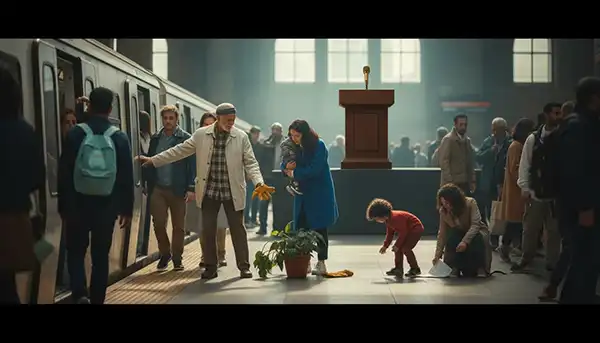
You have been the recipient of a small kindness that changed your day. The stranger who held the door when your hands were full. The colleague who offered to take the meeting when you were overwhelmed. The friend who sent a message at the exact moment you needed to hear from someone.
The research on prosocial behavior has found that acts of kindness produce a ripple effect. A 2025 study published in the Journal of Experimental Psychology: General found that participants who performed a small act of kindness underestimated how much it would be appreciated by the recipient. The underestimation is consistent. We believe our small gestures are smaller than they are. The recipient experiences them as larger.
The gift is not the kindness. It is the decision to act on the impulse. The person who thinks “I should send a note” and does not send it has not offered the gift. The person who thinks it and sends it has. The gap between impulse and action is where the gift either happens or does not.
Solitude is a gift you give to those who need it.
You know the person who is always available. The one who answers every message, who shows up to every event, who makes themselves indispensable. You also know the person who has learned to say no. The one who protects their time, who is present when they are present, who does not offer more than they have.
The research on psychological safety and burnout has found that the capacity to set boundaries is not a form of selfishness. It is a condition of sustained care. The person who gives everything eventually gives nothing. The person who protects their own reserves is the person who can continue to give.
The gift is not the withdrawal. It is the honesty that makes the withdrawal possible. The person who says “I cannot do this today” is not rejecting the other person. They are telling the truth. The truth is a gift. It allows the other person to make their own plans without relying on a promise that cannot be kept.
A cheerful presence is a gift that requires no content.
You have been in the presence of someone whose mood changed yours. They did not say anything profound. They did not offer advice. They simply entered the room with a quality of ease that made the room easier to be in. The research on emotional contagion, pioneered by Sigal Barsade at the Wharton School, has shown that emotional states transfer between people through a process that is rapid and largely automatic. The person who is at ease makes ease possible for others.
The gift is not the cheerfulness. It is the willingness to be the source of it. The person who waits for someone else to lighten the room will wait. The person who decides to be the source of the light is the person who changes the room.
The restlessness is the instruction.
You will not master these gifts. You will practice them, fail, and practice again. The restlessness will return. The gap between your values and your behavior will remain. The gap is not a verdict on your character. It is an invitation to continue the work. The person who feels no restlessness is not a saint. They are asleep.
The person who feels the restlessness and responds to it is the person who is building something. The eight gifts are not a checklist. They are a direction. The direction is toward the person you would like to be. The person you would like to be is available, in small moments, in ordinary interactions, in the decision to listen when you would rather speak, to touch when you would rather withdraw, to laugh when you would rather be serious, to write the note you have been meaning to write.
Epictetus wrote that no one who fails to act on their principles can claim to have those principles at all. The principles are not the point. The action is the point. The action is available now. The restlessness is telling you what it wants. The only question is whether you will listen.