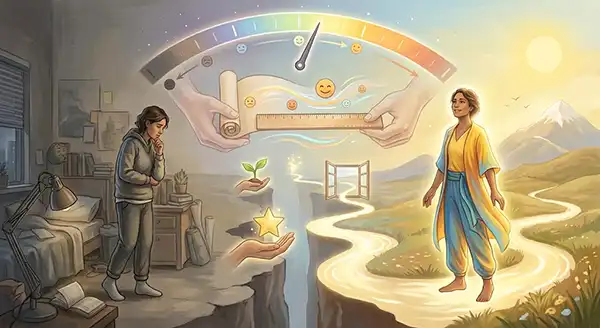
The Self-Improvement Trap: Why Chasing Your ‘Ideal Self’ Is Making You Anxious
The short answer: happiness isn’t about closing the gap between who you are and who you want to be—it’s about learning to see who you already are. Research shows that the discrepancy between your actual self and your ideal self is one of the strongest predictors of depression, anxiety, and low life satisfaction. The larger the gap, the worse you feel. But the solution isn’t always to become someone else. Sometimes, it’s to recognize the person standing right in front of you.
The Day I Stopped Comparing Myself to Strangers
I have a confession. A few years ago, I spent an entire Sunday afternoon scrolling through the Instagram feeds of people I’d never met. I wasn’t curious about their lives. I was measuring mine against theirs. Every photo was a data point in an argument I was losing: They’re more successful. They’re more attractive. They’re living the life I should be living.
By dinner, I felt like I’d been hollowed out. Nothing had happened to me—I hadn’t lost my job, hadn’t ended a relationship, hadn’t failed at anything. But I had spent hours feeding a silent, insidious narrative: I am not enough, and I need to become someone else to be happy.
That night, I opened my journal and wrote down two lists. The first list was “Who I Actually Am.” The second was “Who I Think I Should Be.” The gap between them was enormous. And the worst part was that most of the items on the second list weren’t even mine. They were borrowed—from parents, from culture, from a version of success I’d absorbed without questioning.
It took me years to understand that the gap itself wasn’t the problem. The problem was that I was spending all my energy staring at it instead of stepping into it.
What Carl Rogers Understood About the Self
The humanistic psychologist Carl Rogers divided the self into two parts: the real self—who you actually are—and the ideal self—who you want to be. When these two are aligned, you experience congruence and psychological health. When they’re misaligned, you experience anxiety, depression, and low self-esteem.
Rogers wasn’t the only one to notice this. In 1987, psychologist E. Tory Higgins developed self-discrepancy theory, which distinguished between two types of self-guides. The ideal self is your hopes and aspirations. The ought self is who you think you should be, shaped by duty and others’ expectations. Discrepancies with the ideal self lead to depression-related emotions like sadness. Discrepancies with the ought self lead to anxiety-related emotions like worry and fear.
A 2023 study of over 1,100 young people found that ideal-actual self-discrepancies were associated with increased depressive and anxiety symptoms. Another study found that both types of discrepancies were linked to lower well-being, lower self-efficacy, and poorer emotional adjustment.
What’s striking is how common this is. The self-improvement industry has convinced us that we should always be striving for the “best version” of ourselves. But that striving creates a constant sense of inadequacy. You’re never enough because you’re never allowed to be enough.
Why Chasing Perfection Is a Trap
If you’ve seen Perfect Blue or Black Swan, you’ve watched this play out on screen. In Perfect Blue, Mima is a pop idol trying to transition into acting, torn between who she is and who she thinks she needs to be. In Black Swan, Nina is a ballerina so consumed by her ideal of perfection that she loses touch with reality. Both films are about the same thing: the agony of chasing a version of yourself that doesn’t exist.
These stories resonate because they reflect something many of us experience. The message is always: You’re not there yet. Keep going. Be better. But self-improvement without self-acceptance is a treadmill. You keep running, but you never arrive. Because the goalpost keeps moving.
Research suggests that both self-improvement and self-acceptance interventions can produce similar changes in well-being. But self-acceptance has an advantage: it doesn’t require you to become someone else. It requires you to recognize that you’re already worthy of care and compassion. A University of Michigan study found that self-accepting people have higher levels of happiness and life satisfaction.
As Rabbi Hyman Schachtel put it: “Happiness is not having what you want, but wanting what you have.” That’s not a call to settle. It’s a call to see.
How to Close the Gap Without Losing Yourself
So how do you actually close the gap without falling into the trap of perpetual dissatisfaction?
Start by naming the gap. Write down who you think you should be. Then write down who you actually are. Notice which ideals are yours and which are borrowed. The borrowed ones can be let go.
Distinguish between the ideal self and the ought self. Your hopes, your dreams—those are yours. Others’ expectations, cultural pressure, the “shoulds”—those are not. If you’re chasing a version of yourself someone else wants, you’re not chasing your own life.
Practice wanting what you already have. The 2014 study found that actual self-regard—wanting to be who you already are—is a precursor to well-being. You can build this by noticing what you already appreciate about yourself, not what you’ve achieved, but the qualities you genuinely value.
Cultivate self-compassion. Research shows that self-compassion promotes personal improvement through acceptance. When you make a mistake, ask: What would I say to a friend who did this? Then say that to yourself. It’s not easy, but it works.
Mindfulness can help. A study on mindfulness meditation found that it can reduce the gap between actual and ideal self. Mindfulness helps you see yourself more clearly—not through judgment, but through awareness.
When the Gap Feels Too Wide
If the gap between who you are and who you want to be feels unbridgeable—if you’re experiencing persistent depression, anxiety, or thoughts of self-harm—please reach out to a licensed mental health professional. A therapist can help you work through the underlying beliefs that keep the gap open.
If you’re having thoughts of harming yourself, call or text the 988 Suicide & Crisis Lifeline immediately. Help is available.
Three things worth clarifying
Does self-acceptance mean I stop trying to improve?
No. Self-acceptance is the foundation, not the ceiling. When you accept yourself, you’re not saying “I’m perfect.” You’re saying “I’m worthy of care and compassion, and I also have room to grow.” Growth from wholeness is different from growth from deficiency.
How do I know if my ideal self is mine or someone else’s?
Pay attention to how it feels. If it fills you with excitement, it’s probably yours. If it fills you with dread, obligation, or shame, it’s borrowed. Ask: Would I still want this if no one were watching? If the answer is no, it’s not yours.
What if I genuinely don’t like who I am right now?
Start small. Find one thing you appreciate about yourself—your sense of humor, your reliability, your kindness. Build from there. And consider seeing a therapist who can help you see yourself more clearly.
One last thing
I still have days when I catch myself measuring. Comparing. Wanting to be someone else. But now I notice it faster. And when I do, I remember something I learned the hard way: the person I’m trying to become is not a stranger. She’s already here. She’s just been waiting for me to stop running long enough to see her.
That’s the shift. Not closing the gap by becoming someone else. But closing it by learning to see the person you already are.
That’s not a question. It’s an invitation. And you don’t have to answer it. You just have to look.