What Is Reiki? And Can Its Five Principles Really Help You Live a More Balanced Life?
The short answer is yes—Reiki is a Japanese energy healing technique that many people use to reduce stress, manage anxiety, and cultivate a more balanced life. And its five daily principles, known as the Gokai, offer a simple but powerful framework for approaching each day with more intention and less emotional weight. But Reiki isn’t about curing disease or replacing medical care—it’s about creating the internal conditions where healing and well-being can flourish.
The Night I Realized I Was Running on Empty
I remember the exact moment I hit a wall. It was a Tuesday evening, unremarkable in every way except that I found myself sitting on my kitchen floor, completely still, staring at nothing. I hadn’t received bad news. Nothing had gone wrong. I was just… exhausted. Not physically tired—emotionally drained. The kind of tired that sleep doesn’t fix.
For months, I had been running on a treadmill of worry. Work deadlines, family obligations, the constant hum of anxiety about things I couldn’t control. I was living in the future—rehearsing conversations that hadn’t happened, catastrophizing outcomes that might never come. And I was paying for it with my peace of mind.
That week, a friend mentioned Reiki. I had heard the word before but never paid attention. I assumed it was something spiritual, maybe a little woo-woo, and definitely not for me. But she explained it differently. She said: “Reiki isn’t about believing in anything. It’s about giving your nervous system a chance to reset.” That got my attention.
Where Reiki Comes From and What It Actually Means
Reiki originated in Japan in the early 20th century, developed by a Tendai Buddhist monk named Mikao Usui. The word itself combines two Japanese characters: rei, meaning “universal” or “spiritual,” and ki, meaning “life energy.” Think of it like the Chinese concept of qi or the Indian concept of prana—the idea that a vital energy flows through all living things.
Usui reportedly developed the practice after a long period of meditation and fasting on Mount Kurama, during which he experienced what he described as a spiritual awakening. He began teaching others, and the practice eventually spread to the West through one of his students, Hawayo Takata, who brought Reiki to Hawaii in 1937.
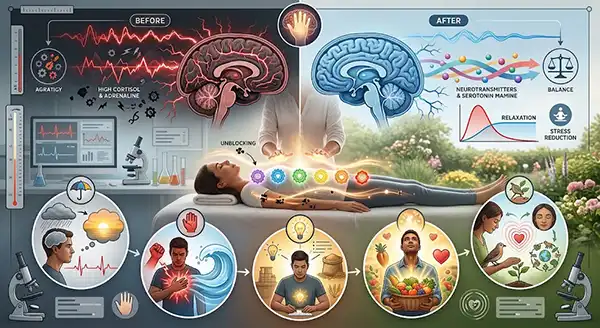
Today, Reiki is offered in hospitals and medical centers across the United States. It’s considered a complementary therapy—something used alongside conventional medical care, not as a replacement. Practitioners place their hands lightly on or just above a person’s body, with the intention of channeling universal life energy to promote relaxation and support the body’s natural healing processes.
What Does Science Say About Reiki?
This is where things get interesting—and a little complicated.
The scientific evidence for Reiki is mixed, but there’s a growing body of research suggesting real benefits, particularly for stress, anxiety, and pain management. A 2025 randomized controlled study published in ScienceDirect found that Reiki was more effective than progressive relaxation exercises in reducing stress levels, and it showed long-term effectiveness for pain and anxiety.
A meta-analysis published in Systematic Reviews in 2025, which included 661 participants, found a significant enhancement in quality of life following Reiki therapy. The analysis suggested that interventions with at least eight sessions, each lasting 60 minutes or more, were most effective for improving quality of life.
Another clinical trial conducted at two university hospital infusion centers evaluated Reiki sessions for cancer patients receiving chemotherapy. Over 392 sessions, participants reported clinically significant improvements in pain, fatigue, anxiety, nausea, and overall well-being. Patients described the sessions as a positive experience that promoted relaxation and symptom reduction.
A 2025 study on Reiki’s effects on stress, anxiety, and depression in nursing students found that stress scores decreased significantly from 27.75 to 22.81, anxiety scores dropped from 19.06 to 11.31, and depressive symptoms decreased by 25%.
That said, not all research is conclusive. Some systematic reviews have not found benefit for depression or other clinical conditions. And the scientific community remains divided, with some researchers calling for more rigorous, high-quality trials.
What most researchers agree on, however, is that Reiki appears to be safe. No adverse events have been reported in connection with Reiki sessions. And for many people, the subjective experience—the feeling of deep relaxation, warmth, and calm—is real and valuable in itself.
Why the Five Reiki Principles Matter More Than the Technique
Here’s what I found most surprising when I started learning about Reiki: the hands-on practice is only half of it. The other half—some would say the more important half—is a set of five daily principles called the Gokai.
Usui didn’t just teach a healing technique. He taught a way of living. These five precepts are meant to be recited every morning and evening, as a reminder to approach each day with intention.
They are:
- Just for today, do not worry.
- Just for today, do not anger.
- Just for today, be grateful.
- Just for today, be honest.
- Just for today, be compassionate toward yourself and others.
These principles sound simple. And that’s exactly the point. They’re not meant to be achieved perfectly. They’re meant to be practiced—one day at a time.
Why “Just for Today” Changes Everything
The phrase “just for today” is the heart of the practice. It’s a psychological hack, really. When you tell yourself you have to stop worrying forever, the task feels impossible. The pressure is crushing. But when you tell yourself “just for today, I won’t worry”—that feels doable. It feels like a choice, not a sentence.
Reiki uses this framing deliberately. The principles aren’t about perfection. They’re about presence. If you fail today, you get to start fresh tomorrow. There’s no cumulative score, no permanent record. Just a daily invitation to show up differently.
I started practicing this on my own—not the hands-on Reiki, just the principles. Every morning, I would sit quietly and repeat them to myself. Not as a mantra, but as a question: Can I try this today? Just for today?
The first week, I failed at all of them. I worried constantly. I got angry at small things. I forgot to be grateful. I wasn’t honest with myself about how I was feeling. I was impatient with everyone, including myself.
But I kept coming back. And slowly, something shifted. I started noticing my worries before they took over. I started catching my anger before it became a reaction. I started looking for small things to appreciate. I started telling the truth—to myself, at least—about what I was actually feeling.
What Each Principle Actually Means in Daily Life
Do not worry. This isn’t about denying reality or pretending everything is fine. It’s about recognizing that most of what we worry about never happens. Worry is a future-oriented emotion—it’s anxiety about something that hasn’t occurred yet. The principle invites you to bring your attention back to the present moment, where most problems are actually manageable.
Do not anger. Anger is often a secondary emotion—a response to something deeper, like hurt, fear, or frustration. The principle isn’t saying you should never feel anger. It’s saying: don’t let anger control you. Notice it, acknowledge it, and choose how you respond.
Be grateful. Gratitude isn’t about ignoring what’s wrong. It’s about recognizing what’s right. Research has shown that gratitude practices can improve mood, reduce stress, and even change brain structure over time. This principle is an invitation to find something—anything—to appreciate, even on hard days.
Be honest. Honesty with others starts with honesty with yourself. This principle asks you to examine whether you’re living in alignment with your values. Are you saying what you mean? Are you showing up authentically? Are you avoiding uncomfortable truths?
Be compassionate. This is the broadest principle, and maybe the most important. Compassion toward others is essential—but compassion toward yourself is where it starts. If you can’t be kind to yourself, it’s nearly impossible to be genuinely kind to others.
A Note on What Reiki Is and Isn’t
I want to be clear about something. Reiki is not a substitute for medical or mental health care. It’s a complementary practice—something you can use alongside treatment, not in place of it.
If you’re experiencing persistent anxiety, depression, chronic pain, or any other condition that interferes with your daily life, please speak with a licensed healthcare professional. A doctor, therapist, or counselor can help you develop a comprehensive treatment plan that addresses your specific needs.
If you’re having thoughts of harming yourself or others, call or text the 988 Suicide & Crisis Lifeline immediately. Help is available, and you are not alone.
Questions people often ask
Do I have to believe in energy healing for Reiki to work?
No. Many people use Reiki simply as a relaxation technique. The benefits—reduced stress, improved mood, better sleep—don’t require belief. They come from the experience of slowing down, being present, and receiving attention. Whether you call it energy or just relaxation, the effect is the same.
Can I practice the principles without doing the hands-on Reiki?
Absolutely. The five principles are a standalone practice. You don’t need to receive a Reiki session or become a practitioner to benefit from them. They’re essentially a framework for mindful living—and anyone can try them.
How long does it take to see results?
Some people notice changes within days—feeling calmer, sleeping better, reacting less strongly to stress. For others, it takes weeks or months. The key is consistency, not intensity. A few minutes of practice each day matters more than an hour once in a while.
One last thing
I still have days when worry gets the best of me. When anger flares up before I can catch it. When gratitude feels like a stretch. But I’ve learned that those days don’t define the practice. The practice is showing up the next morning and trying again.
That’s the gift of “just for today.” It’s not about being perfect. It’s about being present. And presence, I’ve discovered, is the most healing thing of all.
You don’t need to become a Reiki practitioner to live by these principles. You just need to be willing to try—one day at a time.