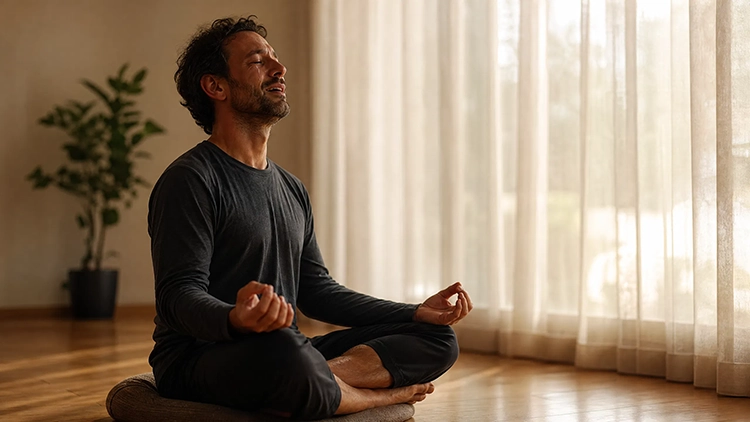
The Somatic Release: Why We Cry When We Sit Still
You close your eyes, cross your legs, and focus on the quiet rhythm of your breath. For the first few minutes, everything feels tranquil. Then, without warning, a lump forms in your throat, your eyes fill with heat, and tears begin to spill down your cheeks.
If your goal was to find calm, this sudden emotional surge can feel unsettling, or even like a failure. You might wonder: Isn’t meditation supposed to make me feel peaceful? Why am I suddenly crying?
Here is the reassuring reality: Crying during meditation is not a sign that you are doing something wrong. It is often evidence that the practice is working exactly as it should.
The Neurobiology of Stored Emotion
In daily life, the human mind operates largely in a protective, analytical mode. When faced with stress, grief, deadline pressures, or relational conflict, your brain prioritizes immediate survival and productivity.
To keep you moving forward, your nervous system suppresses unexpressed emotions, storing their physiological footprints in muscular tension, shallow breathing, and elevated baseline stress hormones like cortisol.
       DAILY STRESS & BUSYNESS
│
▼
[ Emotional Suppression & Muscular Tension ]
│
▼
MEDITATION (STILLNESS)
│
▼
[ Parasympathetic Nervous System Activated ]
│
▼
[ Somatic Release: Tears & Relief ]
When you finally sit down to meditate, you remove the constant noise and distractions that normally keep those suppressed feelings at bay.
As your body shifts from a high-alert sympathetic state (“fight or flight”) into a parasympathetic state (“rest and digest”), the physical armor relaxes. The mind senses safety, and the emotions you were too busy to process yesterday—or even years ago—finally find an exit ramp.
Somatic Release
The physical discharge of stored emotional tension through natural bodily mechanisms—such as crying, deep sighing, or muscular twitching—occurring when the nervous system transitions into a safe state.
Why Modern Life Masks Our Unprocessed Grief
Consider a familiar workplace scenario: You receive sharp, unfair criticism during an afternoon meeting. Your pulse spikes and tears sting your eyes, but you force yourself to smile, nod, and finish your workday. That evening, you cook dinner, answer emails, and scroll through social media until you fall asleep.
Where did that momentary shock go? It didn’t disappear; it was merely shelved.
┌────────────────────────────────────────────────────────┐
│               THE EMOTIONAL PRESSURE VALVE             │
│                                                        │
│   Daily Distractions ──► Holds Pressure Down           │
│   Meditation          ──► Opens the Valve              │
│   Tears               ──► Releases Stored Tension      │
└────────────────────────────────────────────────────────┘
When you meditate, you remove the distractions that hold the pressure down. The tears that fall on your cushion are rarely just about the present moment—they are the backlogged emotional mail your body is finally getting around to opening.
Common Misconceptions About Crying in Stillness
To navigate these moments comfortably, it helps to dismantle three persistent myths about meditation and emotional expression:
| The Myth | The Reality |
| “Crying means I lost control.” | Crying is a biological regulation mechanism designed to lower cortisol and restore equilibrium. |
| “Meditation must equal instant tranquility.” | Meditation is an environment of non-judgmental awareness, not a guarantee of perpetual bliss. |
| “Suppressing tears keeps me stronger.” | Emotional suppression is linked to elevated cardiovascular strain and long-term anxiety. |
How to Work with Tears on the Cushion
If crying catches you off guard during your practice, you don’t need to fight it or analyze it immediately. Instead, use these three practical shifts to navigate the experience safely and productively:
1. Shift from Narrative to Sensation
When tears begin to flow, the mind immediately tries to construct a story: Why am I crying? Is it my job? My childhood?
Steer your attention away from the story and anchor it directly in physical sensation. Notice where the emotion lives in your body—a tightness in the chest, a knot in the stomach, or warmth behind the eyes. Observing physical sensations keeps you grounded in the present moment without getting swept away by mental loops.
2. Practice Observational Curiosity
Instead of scolding yourself with thoughts like “I need to calm down,” adopt the role of a compassionate observer.
Notice the speed of your breath. Observe how the sensation intensifies, peaks, and eventually subsides. Treat the tears as a natural weather pattern passing through a wide sky.
3. Integrate with Post-Practice Care
After a session that involves deep crying, your nervous system requires gentle re-entry into the world.
[ Deep Crying ] ──► [ Emotional Fatigue ] ──► [ Grounding Activity ] ──► [ Restored Balance ]
It is completely normal to feel drained or exposed afterward. Take five minutes to write down whatever thoughts arise in a journal without editing them, drink a glass of water, or take a short walk outdoors to re-orient your senses.
The Immediate Practice: The 3-Breath Grounding Anchor
If tears surface during your next meditation and feel overwhelming, pause the formal practice for a moment and apply this brief somatic check-in:
The 3-Breath Grounding Anchor
- Place one hand over your heart and the other on your abdomen.
- Take a slow, 4-second inhale through your nose, feeling the physical warmth of your hands.
- Exhale smoothly through your mouth for 6 seconds, silently repeating: “This feeling is safe to be here.”
Repeat this cycle three times before deciding whether to continue your meditation or gently open your eyes.
Tears as Evidence of Healing
To sit quietly with yourself and allow whatever arises to exist without judgment is one of the highest forms of self-respect.
Tears on the cushion are not a setback; they are the mind’s way of clearing out accumulated noise to make room for genuine peace. When you stop fighting your emotional landscape, you stop needing to defend yourself against your own inner world.
Have you noticed a specific physical sensation—like a change in your breathing or tension in your shoulders—that usually shows up right before an emotional release happens during stillness?