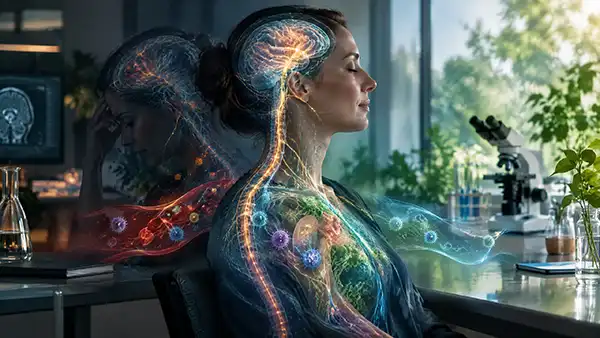
The diary of a thought experiment: what I learned about immunity by paying attention to my own mind
Day one: the question I could not answer
I started this diary because I could not stop thinking about a sentence I read in a press release. The sentence was from a study published in Nature Medicine in January 2026. The study trained eighty-five healthy adults to activate a specific part of their brain—the ventral tegmental area, a cluster of neurons deep in the midbrain associated with reward and motivation—using real-time fMRI neurofeedback. Then the participants received a hepatitis B vaccine. The ones who learned to keep that brain region active produced more protective antibodies. The mental strategies they used to keep it active were strategies of positive expectation. They imagined trips. They recalled moments of joy. They expected good things.
The sentence that stuck with me was not the finding. It was the implication. The researchers wrote that their results established a relationship between reward system activity, positive expectation, and immunity in humans, and revealed a potential neuropsychological mechanism for non-invasive immune modulation. In plain language: the brain can talk to the immune system. And the conversation is shaped by what you expect.
I wanted to know whether this was a real conversation or a statistical echo. I wanted to know whether the effect was large enough to matter for a person sitting in a waiting room, scared, waiting for a diagnosis. I wanted to know whether the old idea that thoughts become biology was a metaphor or a mechanism. I decided to keep a diary for a month and follow the evidence wherever it led.
Day four: the chemicals that carry the message
The first thing I learned is that the conversation is chemical. The messengers are called neuropeptides. Candace Pert, a pharmacologist at Georgetown University, spent her career mapping the distribution of neuropeptide receptors in the brain and body. Her work showed that these receptors are not confined to the brain. They are found throughout the immune system, on the surfaces of white blood cells, in the thymus, in the bone marrow. Neuropeptides are not just brain molecules. They are body molecules. And they carry emotional information.
A review of Pert’s scientific legacy, published in Brain, Behavior, and Immunity, described her central insight: the neuropeptide-receptor network crosses traditional brain-body boundaries, and it provides a biochemical substrate for emotion that operates across organs and systems. When you feel fear, you release chemicals. When you feel hope, you release different chemicals. The immune cells have receptors for both. They are listening.
The listening is not passive. A 2008 review by Jill Littrell in Social Work in Health Care summarized two decades of psychoneuroimmunology research and found that stressful emotions alter white blood cell function. Stress diminishes the response of white blood cells to viral infected cells and to cancer cells. Vaccination is less effective in people who are stressed. Wounds heal more slowly. The immune system is not an isolated defense network. It is an audience. And the performance it is watching is your internal state.
Day nine: the difference between optimism and the absence of pessimism
I had been assuming that optimism was the active ingredient. I was wrong. A reanalysis of sixty-one separate samples, involving more than 221,000 participants, published in American Psychologist in 2021, separated optimism and pessimism into two independent dimensions. The finding was counterintuitive. The absence of pessimism was more strongly related to positive physical health outcomes than the presence of optimism. In other words, it may matter less whether you are a cheerful person and more whether you have stopped expecting the worst.
This finding changed the way I thought about my own mind. I am not a naturally sunny person. I am a person who has spent a lot of energy preparing for disappointment. The reanalysis suggested that my preparation was not neutral. It was a health behavior, and not a good one. The absence of pessimism is not the same as the presence of joy. It is the absence of a low-grade threat signal that the immune system has been receiving for years.
Martin Seligman at the University of Pennsylvania described optimism and pessimism as learned explanatory styles. The pessimist explains setbacks as permanent, pervasive, and personal. The optimist explains them as temporary, specific, and situational. The explanatory style is not a personality trait. It is a habit. Habits can be changed. The changing is not easy, but it is possible. And the change is not just psychological. It is immunological.
Day fourteen: the reward circuit and the vaccine
I went back to the Nature Medicine study. I wanted to understand the mechanism. The researchers did not simply ask participants to think happy thoughts. They trained them, over four sessions, to increase activity in the ventral tegmental area using neurofeedback. The participants chose their own mental strategies. They were not told what to think. They were told to find what worked. The strategies that worked were strategies of positive expectation. Recalling a previous trip. Imagining a future pleasure. The expectation was not a mood. It was a cognitive act that changed the activity of a specific brain region.
The study was small. It measured antibody levels, not clinical protection. The authors were careful to note that larger trials are needed. But the direction of the finding is difficult to ignore. The reward system is not just about pleasure. It is about motivation, anticipation, and the willingness to engage with the future. When that system is active, the immune system responds. The response is not unlimited. It is a modulation, not a cure. But it is a pathway. And pathways can be traveled.
Day eighteen: the problem with Pollyanna
I have a friend who calls this kind of thinking “Pollyanna.” She says it is a way of ignoring reality. She is not entirely wrong. There is a version of positive thinking that is a form of denial. It refuses to acknowledge risk, refuses to grieve, refuses to plan for difficulty. That version is not what the research supports. The research supports something more modest and more honest.
The optimism that predicts better health is not the optimism of the greeting card. It is the optimism of the person who sees the difficulty and still believes that effort can make a difference. It is the optimism of the person who has stopped expecting the worst, not because the worst never happens, but because expecting it does not prevent it and does extract a cost. The cost is paid in cortisol, in inflammatory markers, in the slow erosion of immune function.
The reanalysis in American Psychologist found that the absence of pessimism was the stronger predictor. That is a low bar. It does not require you to be joyful. It requires you to stop rehearsing catastrophe. It requires you to notice when your mind is preparing for a disaster that has not arrived and to ask whether the preparation is helping. Most of the time, it is not.
Day twenty-two: the study I could not stop thinking about
There is a study from Harvard and Boston University that followed thousands of adults for decades. The researchers found that people with greater optimism were not only more likely to live longer, but also more likely to achieve “exceptional longevity,” meaning living to eighty-five or older. Fran Grodstein, a professor of epidemiology at Harvard who led the study, said the reason why optimism matters so much remains unclear, but the link between optimism and health is becoming more evident.
Another study, published in the Journal of the American Geriatrics Society, analyzed more than 150,000 older adults and found that optimism was linked to a variety of physical and emotional health factors. A cardiologist at Mount Sinai, Alan Rozanski, evaluated fifteen studies with more than 200,000 participants and concluded that individuals with higher optimism had a 35 percent lower likelihood of cardiovascular events.
I do not know whether optimism causes better health or whether better health causes optimism. The research does not fully answer that question. But the direction of the association is consistent. And the mechanism, at least in part, is the one I have been tracing: the brain talks to the immune system, and the conversation is shaped by expectation.
Day twenty-six: the limits of the conversation
I have to be careful here. The fact that thoughts influence immunity does not mean that thoughts cure disease. It does not mean that a person who is sick is sick because they were negative. It does not mean that a person who is healthy is healthy because they were positive. The effect sizes in the research are modest. The American Psychologist reanalysis found a correlation of r = .026 for the combined measure of optimism and pessimism. That is a small effect. It matters over populations. It does not determine individual outcomes.
If you are experiencing persistent health anxiety, if you are struggling with a chronic illness, if the fear of getting sick is interfering with sleep, appetite, or daily functioning, the appropriate response is not to try harder to think positive thoughts. It is to speak with a physician or a mental health professional who can help you assess what is happening and develop a plan. The research on psychoneuroimmunology is real. It is also not a substitute for medical care.
Day thirty: what I know now that I did not know then
I started this diary with a question. The question was whether thoughts become biology. The answer is yes, but not in the way I expected. Thoughts become neuropeptides. Neuropeptides become signals. Signals become immune responses. The pathway is real. The effect is measurable. The conversation is ongoing.
The conversation is not a monologue. The immune system is not waiting for you to say the right words. It is responding to the full context of your life: your sleep, your stress, your relationships, your sense of safety, your sense of purpose. Thoughts are one input among many. They are not the only input. They are not even the most powerful input. But they are an input you can influence.
The most useful thing I learned is that the goal is not to be happy all the time. The goal is to stop rehearsing the worst. The goal is to notice when your mind is preparing for a disaster that has not arrived and to ask whether the preparation is serving you. The answer is usually no. And the noticing is the beginning of the change.
I do not know whether my immune system is stronger than it was thirty days ago. I do not know whether the diary changed anything measurable. But I know something I did not know before. I know that the conversation is real. I know that the words I say to myself are part of the conversation. And I know that the conversation continues whether I am paying attention or not.
The choice is not whether to have thoughts. The choice is what to do with them. The choice is available. The choice is yours.