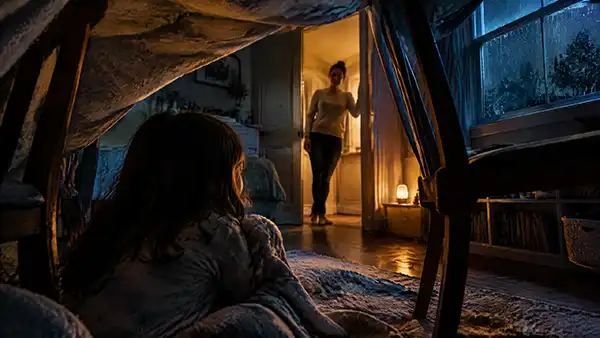
The Night My Daughter Stopped Sleeping
She was five years old when the monsters moved in. Not real monsters—at least, not to me. But to her, they were as real as the furniture in her room. They lived in the closet. They waited under the bed. They crept out when the lights went off and the house grew quiet. Every night, she would call for me. Every night, I would go in, turn on the light, check the closet, look under the bed, and tell her there was nothing there. And every night, she would look at me with eyes that said, “You don’t see what I see.”
I did not understand it then. I thought she was being difficult. I thought she was manipulating me, or seeking attention, or simply refusing to sleep because she preferred my company to her pillow. I did not know that her fear was real—not in the sense that monsters existed, but in the sense that her brain was experiencing a genuine threat response. Her heart was racing. Her muscles were tense. Her nervous system was screaming at her to stay alert. She was not pretending. She was terrified.
That experience sent me down a path of learning that changed how I understand childhood fears. And what I discovered surprised me. The fears that seem irrational to adults are not irrational to children. They are developmental. They are predictable. And they are—in most cases—temporary.
Before we go further, a brief but important note: this article explores childhood fears, anxiety, and parenting strategies from a general, educational perspective. It is not a substitute for professional mental health care. If your child’s fears are severe, persistent, or interfering with daily life, please consult a qualified child psychologist, pediatrician, or mental health professional. Only a trained specialist can provide the individualized assessment and support your child may need.
What Normal Childhood Fears Actually Look Like
Between the ages of three and eight, almost every child develops fears. This is not a sign of weakness or poor parenting. It is a sign of cognitive development. The child’s brain is growing, and with that growth comes the ability to imagine—to picture things that are not there, to anticipate events that have not happened, to understand that danger exists even when they are safe.
The most common fears in early childhood are:
- Fear of the dark
- Fear of being alone
- Fear of monsters, ghosts, or imaginary creatures
- Fear of large animals
- Fear of bad people
- Fear of storms or loud noises
- Fear of injury or illness
- Fear of a parent being harmed or leaving
Research from the National Institute of Mental Health and developmental psychologists like Dr. Jerome Kagan at Harvard has shown that these fears are not only normal but universal. They appear across cultures, across socioeconomic groups, and across generations. They are part of the human blueprint.
Around age seven or eight, the nature of fear shifts. The child begins to understand that death is permanent and universal. They realize that their parents are not invincible. They begin to worry about separation, about loss, about the fragility of the people they love. This is not morbid. It is a developmental milestone. It signals that the child is developing a more complex understanding of the world.
Fear scaffolding is the term I use to describe the process by which children gradually build the emotional and cognitive structures they need to manage fear. It is not about eliminating fear. It is about giving the child the tools to hold it, examine it, and eventually move through it. The parent’s role is not to remove the darkness. It is to stand beside the child until they can face it themselves.
How a Child’s Brain Learns to Be Afraid
To understand why children fear things that are not dangerous, you have to understand how the brain processes threat. The amygdala, a small almond-shaped structure deep in the brain, is the alarm system. It detects potential threats and triggers the fear response before the thinking brain—the prefrontal cortex—has time to evaluate whether the threat is real.
In adults, the prefrontal cortex is fully developed. It can say, “That’s just a shadow. That’s just the wind. There is nothing to be afraid of.” In children, the prefrontal cortex is still under construction. It cannot override the amygdala as effectively. So when a child sees a shadow that looks like a monster, the amygdala fires, and the thinking brain cannot calm it down.
This is why logic does not always work with children. You can explain that monsters are not real. You can show them the empty closet. But their amygdala is not listening. It is responding to the feeling, not the facts.
Dr. Stephen Porges, a neuroscientist at Indiana University, developed a theory called polyvagal theory that helps explain this. He describes how the nervous system evaluates safety not just through conscious thought, but through unconscious cues—tone of voice, facial expression, body posture. When a child feels safe, their nervous system is regulated. When they feel threatened, it goes into defense mode. The parent’s calm presence is not just comforting; it is biologically regulating. It tells the child’s nervous system, “You are safe.”
This is why yelling at a child to “just go to sleep” does not work. It activates their threat response. It confirms their fear that something is wrong. The calm parent is not indulging the fear; they are helping the child’s brain return to a state where fear can be managed.
When Fear Becomes Something More
For most children, fears are transient. They appear, they intensify, and then they fade. The monster under the bed is forgotten by age nine. The fear of the dark gives way to the desire to read under the covers with a flashlight.
But for some children, fears do not fade. They intensify. They spread. They begin to interfere with daily life. This is when normal fear crosses into something that needs attention.
The signs that fear has become excessive include:
- Nightmares occurring three or more times per week
- Extreme distress when separated from a parent, even briefly
- Physical symptoms like stomachaches or headaches before school or social events
- Avoidance of activities the child once enjoyed
- Inability to sleep alone or in their own room
- Persistent fear that interferes with school, friendships, or family life
When fears reach this level, they may be a sign of an anxiety disorder. The most common in childhood are separation anxiety disorder, specific phobias, and generalized anxiety disorder. Obsessive-compulsive disorder can also appear in childhood, often manifesting as fears of contamination or a need for symmetry and order.
Dr. Eli Lebowitz, a professor at the Yale Child Study Center and director of the Program for Anxiety Disorders, has developed a treatment approach called SPACE (Supportive Parenting for Anxious Childhood Emotions). His research shows that when parents learn to reduce accommodation—the behaviors they engage in to help their child avoid anxiety—children improve. The goal is not to be cold or dismissive. It is to be supportive without being controlled by the fear.
If you suspect your child’s fears are more than temporary, do not wait. Speak with your pediatrician or a licensed child psychologist. Early intervention makes a significant difference. Anxiety disorders are highly treatable, and the earlier they are addressed, the less likely they are to persist into adulthood. Seeking help is not an admission of failure. It is an act of love.
Why Reassurance Doesn’t Always Work
The instinct to reassure a frightened child is powerful. “There’s nothing to be afraid of.” “The monster isn’t real.” “I’ll protect you.” These words come from love. But they often do not work. And sometimes, they make things worse.
There are two reasons for this. First, as discussed, the child’s amygdala is not listening to logic. It is responding to the feeling of fear. Reassurance addresses the thinking brain, but the fear lives in the feeling brain.
Second, reassurance can become a compulsion. If every time the child feels afraid, the parent rushes in to reassure them, the child learns that fear is something to be managed by someone else. They do not develop their own capacity to tolerate uncertainty. They become dependent on the parent’s presence to feel safe.
Dr. Lynn Lyons, a psychotherapist who specializes in childhood anxiety, argues that the goal is not to eliminate fear but to change the child’s relationship to it. Instead of saying, “Don’t be scared,” the parent can say, “I know this feels scary. Let’s figure out what to do together.” This acknowledges the fear without being controlled by it. It empowers the child to act, even when they are afraid.
Small Steps That Change Everything
The most effective approach to helping a child overcome fear is gradual exposure. This means helping the child take small, manageable steps toward the thing they fear, rather than avoiding it entirely.
If the child is afraid of the dark, for example, the process might look like this:
- Step one: The child sleeps with the light on.
- Step two: The child sleeps with a dim nightlight.
- Step three: The child sleeps with the nightlight and the door open.
- Step four: The child sleeps with the door open and no nightlight.
- Step five: The child sleeps with the door closed.
Each step should be agreed upon together. The child should feel that they are in control of the pace. The parent’s job is to provide encouragement and support, not pressure. If the child becomes too anxious at any step, they can retreat to the previous step and try again later.
Dr. Fadi Haddad, a child and adolescent psychiatrist, emphasizes that the goal is not to prevent the child from feeling fear. It is to help them discover that they can tolerate it. Each small step proves to the child that they are stronger than they thought. And that proof, repeated over time, builds resilience.
The Words That Help and the Words That Hurt
What you say to a frightened child matters. The wrong words can deepen the fear. The right words can help the child feel seen and supported without feeding the anxiety.
Words that tend to hurt:
- “You’re being silly.”
- “There’s nothing to be afraid of.”
- “Big kids don’t get scared.”
- “If you don’t stop, I’ll leave you alone.”
- “Just go to sleep. It’s fine.”
These statements dismiss the child’s experience. They teach the child that their feelings are wrong. They do not make the fear go away; they make the child feel alone in it.
Words that tend to help:
- “I hear you. That sounds scary.”
- “I wonder what we can do to help you feel safer.”
- “I am here with you. You are not alone.”
- “Let’s take one small step together.”
- “You are brave. And brave does not mean you don’t feel scared. It means you do the thing even when you are scared.”
These statements validate the emotion while encouraging action. They do not promise that the fear will disappear. They promise that the child will not have to face it alone.
Walking Your Child Out of the Dark
The night my daughter finally slept through the night, she was almost six. We had tried many things—nightlights, stuffed animals, checking the closet together. What finally worked was not a technique. It was a shift in my own presence.
Instead of trying to convince her there was nothing to fear, I sat with her in the dark. I did not turn on the light. I did not tell her the monsters were not real. I simply said, “I am here. You are safe. And if you get scared, I am right outside the door.”
She fell asleep within twenty minutes. And the next night, she asked me to sit with her again. But this time, she fell asleep faster. And the night after that, she said, “You can go now. I think I’m okay.”
She was not okay because the monsters disappeared. She was okay because she had learned that she could survive them. She had learned that fear was not a wall, but a doorway. And she had walked through it, one small step at a time.
That is the work. It is not about eliminating fear. It is about building the confidence to face it. And the parent’s role is not to carry the child through the darkness. It is to hold the flashlight until they are ready to hold it themselves.