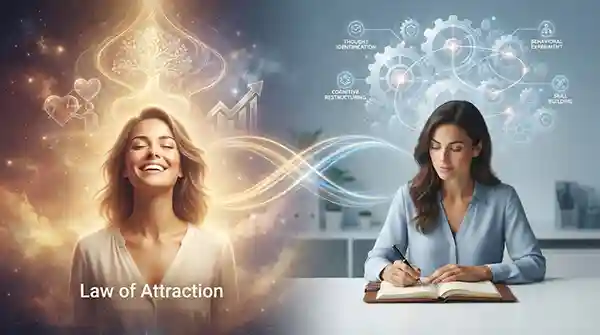
Manifestation Drift: When Law of Attraction Becomes Magical Thinking
I spent two years believing I could think my way into a better life. Vision boards. Affirmations. Gratitude journals with gold-edged pages. I wrote checks to myself for amounts I had not earned. I visualized parking spaces and pay raises and the precise feeling of a book contract arriving in my inbox. And here is the confession that the manifestation influencers never make: none of it worked until I understood what “working” actually meant.
The Law of Attraction, as it is sold in airport bookstores and Instagram carousels, does not exist. The universe is not a cosmic concierge waiting for your vibrational order. But the practices bundled under that name do produce measurable effects. They are psychological. They are neurological. They are not supernatural. And once you strip away the mystical packaging, you find something you can actually use.
Why “ask, believe, receive” fails the evidence test
The research on positive fantasies is uncomfortable for anyone who has ever made a vision board. Gabriele Oettingen at New York University spent years studying what happens when people indulge in positive fantasies about the future. Her findings, published across multiple studies, showed that positive fantasies actually de-energize people. They make energy seem unnecessary. The fantasy provides a kind of premature satisfaction, a psychic rehearsal that tricks the brain into believing the goal has already been achieved.
A 2011 study in the Journal of Experimental Social Psychology found that women who fantasized positively about looking good in high-heeled shoes had lower blood pressure afterward than women who fantasized critically. The positive fantasy was relaxing. But relaxation is not motivation.
Oettingen’s conclusion is blunt: “Instead of promoting achievement, positive fantasies will sap job-seekers of the energy to pound the pavement, and drain the lovelorn of the energy to approach the one they like.”
So the version of the Law of Attraction that says “just visualize it and it will come” is not just unscientific. It is counterproductive. The visualization replaces the action. The fantasy becomes the destination.
What gratitude actually does to your brain
Here is where the story gets more interesting. Gratitude is one of the core practices of the manifestation crowd, and unlike visualization, it has real evidence behind it. Not cosmic evidence. Physiological evidence.
Dr. Tara Swart, a neuroscientist and former senior lecturer at MIT Sloan, has explained the mechanism in terms that make sense to anyone who has ever felt their mood shift after writing down three good things. “Gratitude moves us from cortisol to oxytocin,” she has said, “transforming our brain chemistry from stress to trust.”
Cortisol is the stress hormone. Oxytocin is the bonding hormone. When you practice gratitude, you are not sending a message to the universe. You are sending a message to your own nervous system. The message is: the threat level is lower than you think. The body responds by shifting out of fight-or-flight and into a state where risk-taking feels possible. And risk-taking, as it turns out, is what actually produces outcomes.
A 2023 study published in the journal Psychotherapy Research found that positive thinking interventions produced greater gains in positive affect among participants who had higher levels of CBT skills. The researchers concluded that positive thinking works best when it is paired with the cognitive restructuring tools that help you evaluate whether your thoughts are accurate.
Translation: gratitude without realism is just spiritual bypassing. Gratitude with realism is a nervous system intervention.
Visualization: the good, the bad, and the useless
I used to think visualization was the whole game. Now I think it is a tool that can be used well or used terribly.
The research on visions and goal pursuit is more nuanced than the self-help aisle suggests. A 2024 study published in Current Psychology found that visions—rich, vivid mental images of a desired future—do motivate goal pursuit, but only through a specific pathway. The vision evokes positive affect. That positive affect spills over into the goal itself, making the goal feel charged and worth pursuing. The charged goal produces commitment. The commitment produces progress.
The key word is progress. The vision does not produce the outcome. The vision produces the motivation to do the work that produces the outcome.
A 2025 article in New Scientist quoted neuroscientist Sabina Brennan explaining the same distinction. “Manifesting is the practice of transforming thought into reality by visualising your goal and then developing the discipline to stay focused on and take action to achieve that goal,” she said. “You can’t magically make things happen—you can’t defy physics—but you can change your reality and your future through focused action.”
Brennan also pointed out something that the manifestation industry ignores: many of the practices associated with manifestation are essentially cognitive behavioral therapy in different clothing. CBT teaches people to identify thoughts that influence behavior. Manifestation, stripped of its mystical language, does the same thing.
The self-fulfilling prophecy you are already living
The most useful concept in the entire Law of Attraction conversation is not attraction. It is prophecy.
Robert K. Merton described the self-fulfilling prophecy in 1948. The idea is simple: a belief or expectation can motivate behavior that makes the expectation come true. A study published in the Journal of American Studies examined Generation X insurance agents who practiced the Law of Attraction in their daily work. The researchers found that the agents believed their achievements were the result of consistent practice. But the mechanism was not cosmic. It was behavioral. The belief shaped their thinking. The thinking shaped their actions. The actions produced the results.
Dr. James Doty, a clinical professor of neurosurgery at Stanford University, has made a similar argument in his book Mind Magic: The Neuroscience of Manifestation and How It Changes Everything. Doty does not claim that the universe rearranges itself around your desires. He claims that focused intention, when paired with action, creates new neural pathways in the brain. He likens the process to a “superpower,” but the superpower is neuroplasticity, not magic.
The self-fulfilling prophecy is already operating in your life whether you believe in the Law of Attraction or not. The question is what prophecy you are fulfilling. If you believe you are unlucky, you will notice the evidence that confirms it. If you believe you are capable, you will take the risks that produce capability.
When positive thinking becomes toxic positivity
There is a version of positive thinking that is genuinely dangerous. It is the version that tells you to smile through grief, to find the silver lining in a layoff, to announce that everything happens for a reason while your hands are still shaking.
The research on emotional suppression has shown that this approach backfires. Suppressed emotions do not disappear. They go underground and shape behavior in ways that are difficult to see. The person who insists they are fine while their body is clenched is not practicing optimism. They are practicing avoidance with a cheerful vocabulary.
The 2023 Psychotherapy Research study found something important: positive thinking produced greater gains in positive affect specifically among participants who already had strong cognitive restructuring skills. The people who benefited most were the ones who could also evaluate their thoughts for accuracy. They were not simply replacing negative thoughts with positive ones. They were replacing inaccurate thoughts with accurate ones.
The distinction matters. Toxic positivity replaces grief with a smile. Healthy optimism replaces catastrophizing with a realistic assessment. The first is a lie. The second is a skill.
A practice that survives contact with reality
So what does the Law of Attraction look like when you strip away the quantum mysticism and the vibrational frequency talk? It looks like cognitive behavioral therapy. It looks like gratitude practice. It looks like implementation intentions and deliberate action.
The term I have come to use for the failure mode of the manifestation industry is manifestation drift. Manifestation drift is the slow, unconscious slide from intentional action into magical thinking, where the person begins to believe that focus alone can produce outcomes without the labor that outcomes require. The drift is seductive because it feels like progress. You are doing something. You are visualizing. You are affirming. You are waiting for the universe to respond.
The universe is not responding. Your brain is responding. And your brain responds to action, not intention.
If you want to use the practices that actually work, here is what the evidence supports. Write down three things you are grateful for every day. Not because the universe is keeping score. Because the practice shifts your nervous system from threat detection to possibility detection. Use visualization to remind yourself why the goal matters, not to replace the work. Pair every vision with a concrete if-then plan: if it is Monday morning, then I will write for thirty minutes before checking email. And when the positive thinking starts to feel like a command rather than a choice, stop. That is a signal that something is being suppressed, not processed.
If the practice of positive thinking has become a source of pressure rather than relief, if the gap between what you are affirming and what you are feeling has become a source of shame, the appropriate response is not to try harder to believe. It is to speak with a mental health professional who can help you assess what is actually happening. The research on cognitive behavioral therapy for depression and anxiety is robust. Positive thinking is a supplement. It is not a treatment.
The universe is not listening. But your brain is. And your brain is the only thing that ever was.