You are not having a panic attack: a reality check for people who throw the phrase around
You have said it. Maybe this week. Maybe this morning. I’m having a panic attack. You were stuck in traffic on the I-95. You were late for a meeting. Your chest felt tight. Your heart was racing. And you said the words, because they felt true. Here is the problem. They probably weren’t. And using them the way you just did makes it harder for the people who actually are.
A panic attack is not a synonym for stress. It is not a bad day. It is not the flutter you feel before a presentation or the knot in your stomach when your boss sends a calendar invite with no subject line. A panic attack is a discrete, sudden, overwhelming surge of fear that peaks within minutes and produces physical symptoms so intense that people genuinely believe they are dying. The key word is genuinely. Not “kind of.” Not “sort of.” Actually, medically, convinced they are having a heart attack, a stroke, or a psychotic break. If that has never happened to you, you have not had a panic attack. You have had anxiety. And anxiety is real. But it is not the same thing.
What the numbers actually say
The National Institute of Mental Health estimates that about 2.7 percent of American adults had panic disorder in the past year and about 4.7 percent will experience it at some point in their lives. That is roughly one in thirty-seven adults in any given year. The lifetime figure climbs to nearly one in twenty. Women are more than twice as likely as men to be diagnosed, with a past-year prevalence of 3.8 percent compared to 1.6 percent for men. The numbers are not trivial. Panic disorder is common. But it is not universal. And the gap between “common” and “universal” is where the damage happens. Because when everyone claims to have panic attacks, the people who actually do get dismissed as dramatic. Or they dismiss themselves.
The fear network inside your head
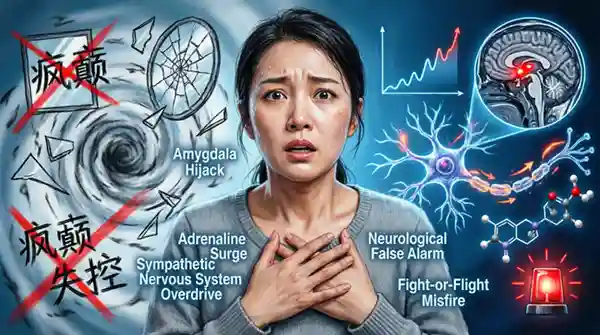
The neurobiology of panic is one of the better-understood systems in psychiatry. Jack Gorman and his colleagues at Columbia University published a revised neuroanatomical hypothesis of panic disorder in the American Journal of Psychiatry in 2000, building on their original 1989 model. Their conclusion was that panic attacks are mediated by a “fear network” centered in the amygdala, a small almond-shaped structure deep in the temporal lobe that evolved to detect threats and initiate defensive responses. The amygdala does not wait for your prefrontal cortex to weigh the evidence. It does not care that you are in a safe office or a parked car. It fires. And when it fires, it recruits the hypothalamus and brainstem, which trigger the racing heart, the shortness of breath, the sweating, the dizziness, the feeling that the walls are closing in.
The system is ancient. It is the same system that kept your ancestors alive when a shadow in the grass turned out to be a predator. The problem is that in panic disorder, the system misfires. It treats a neutral situation as a lethal threat. And the body responds accordingly.
Sigmund Freud described what he called Angstneurose — anxiety neurosis — in 1895, separating it from neurasthenia and from the anxiety that accompanies other conditions. He did not have the tools to see the amygdala. But he recognized the pattern: spontaneous, recurring anxiety attacks with physical symptoms, unrelated to any obvious external trigger. The description has held up. The explanation has changed.
The heart attack that was not a heart attack
This is the part that makes panic disorder so brutal. The symptoms mimic cardiac events with unnerving precision. Chest pain. Heart palpitations. Shortness of breath. Dizziness. Numbness in the limbs. A sense of impending doom. A 2025 review in Frontiers in Psychiatry noted that a significant proportion of emergency department visits for chest pain in low-risk patients end with no cardiac explanation. Many of those patients are experiencing panic attacks. They are not faking. They are not exaggerating. They are terrified. And they are sitting in an ER, hooked up to an EKG, being told their heart is fine, and feeling like the doctor missed something.
The cycle is vicious. The attack comes. The fear of the attack produces more symptoms. The symptoms confirm the fear. The fear intensifies. The body escalates. And then, as suddenly as it began, it stops. Most panic attacks peak within ten minutes and resolve within thirty. The storm passes. But the anticipation does not.
The anticipation is the disorder
A single panic attack is not a diagnosis. The National Institute of Mental Health is explicit about this. Panic disorder is characterized by repeated and unexpected episodes, followed by at least a month of persistent concern about having another attack, or a significant maladaptive change in behavior related to the attacks. That second part is where the disorder lives. It is not the attack itself. It is the fear of the next one.
People with panic disorder start monitoring their bodies the way a hypochondriac monitors WebMD. They count their heartbeats. They carry a blood pressure cuff. They avoid places where escape would be difficult — bridges, tunnels, crowded stores, airplanes. They sit near the exit. They check for the nearest hospital before they agree to go anywhere. The world shrinks. The radius of safety contracts. And eventually, for some, the front door becomes a wall.
The research on this avoidance behavior is extensive. A 2025 randomized controlled trial published in Cognitive Behaviour Therapy found that patients with panic disorder and agoraphobia who received blended cognitive behavioral therapy showed significant improvements in depression symptoms compared to standard CBT alone. The mechanism was not just symptom reduction. It was the gradual dismantling of the avoidance map. The fear network was being rewired.
What actually helps
The treatment guidelines are clear, and they are consistent across major psychiatric bodies. The Brazilian Psychiatric Association published an overview of systematic reviews in 2026 that searched PubMed, SciELO, and Cochrane for randomized controlled trials from 2004 to 2024. The conclusion was unambiguous: SSRIs, SNRIs, TCAs, cognitive behavioral therapy, and behavior therapy achieve the best response, remission, and tolerability. Combined psychotherapy and antidepressants work well together. Benzodiazepines — the fast-acting drugs that many people associate with panic — are not recommended as first-line treatment because of dependency risks and long-term concerns.
Cognitive behavioral therapy is the most extensively researched psychotherapy for panic disorder. A 2025 pilot randomized controlled trial from the University of Göttingen found that adding a digital application to standard CBT improved outcomes, particularly for depressive symptoms. The digital tool did not replace the therapist. It extended the therapy between sessions. The therapist was still the engine. The app was the turbocharger.
The core of CBT for panic is exposure. Not the flooding technique you see in movies, where someone is thrown into their worst fear until they stop reacting. Gradual, controlled, repeated exposure. The patient learns that the physical sensations they fear — the racing heart, the shortness of breath — are not dangerous. They are uncomfortable. They are frightening. But they are not lethal. The learning happens in the body, not just in the mind. And it takes time.
The words you use matter
Here is the practical takeaway. Stop saying you are having a panic attack when you are stressed. Stop saying it when you are anxious. Stop saying it when you are overwhelmed. Use different words. “I am stressed.” “I am anxious.” “I am overwhelmed.” These are accurate. They are honest. They do not steal language from people who are living with a condition that makes them afraid to leave their homes.
The poet and physician Oliver Sacks once wrote that the brain is the most complex structure in the known universe. The amygdala does not know the difference between a bear on the trail and a spreadsheet on the screen. It responds to both the same way. The difference is that the bear is real. The spreadsheet is not. Panic disorder is what happens when the brain forgets the difference.
When to get help
If you are experiencing sudden, intense episodes of fear that peak within minutes and include physical symptoms like chest pain, heart palpitations, shortness of breath, dizziness, or a feeling of impending doom, and if you are worrying about the next attack, avoiding places or situations because of that worry, or feeling like your life is shrinking, the appropriate response is to speak with a mental health professional. Panic disorder is treatable. The evidence is robust. The treatments work. But they work best when they are delivered by someone trained to deliver them.
Do not try to white-knuckle your way through it. Do not rely on the internet. Do not take advice from someone who says they had panic attacks and fixed it by drinking more water. Get a proper assessment. Get a proper diagnosis. Get proper treatment. The difference between panic disorder and ordinary anxiety is not a matter of degree. It is a matter of kind. One is a normal part of the human experience. The other is a medical condition that deserves medical attention.
The words are not the problem. The problem is that we have forgotten what the words are for. Panic is not stress. Panic is not worry. Panic is a biological alarm that fires without a fire. When you use the word for everything, you empty it of meaning. And the people who need it most are left with nothing to say.