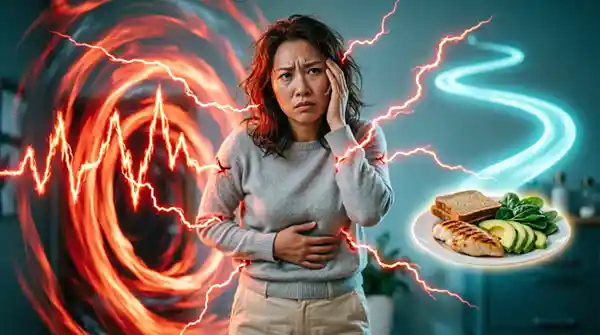
The food-mood loop: how what you eat shapes how you feel
I have a friend who is a chef. Not the kind who posts pictures of foam on Instagram. The kind who works in a basement kitchen in Brooklyn and comes home smelling like onions and exhaustion. She told me something last year that I have not been able to forget. She said that the most important ingredient in any dish is not salt or fat or acid. It is the mood of the person cooking it. She said you can taste desperation in a sauce. You can taste love in a soup. She was not being poetic. She was being literal.
I did not believe her at first. Then I started reading the research on food and mood. And I realized she was describing a mechanism that science has been documenting for decades. The relationship between what you eat and how you feel is not a metaphor. It is a feedback loop. And the loop runs in both directions.
Why your mood affects your food choices
The research on emotional eating has consistently found that negative emotions drive people toward high-calorie, high-sugar, high-fat foods. A 2025 study published in the Journal of Eating Disorders examined the relationship between emotional state and food choice across 1,200 adults. The findings showed that participants who reported higher levels of stress and anxiety were significantly more likely to choose sweet and salty snacks over fruits and vegetables. The mechanism was not hunger. It was comfort. The brain, under stress, reaches for the fastest source of dopamine it can find. And the fastest source is sugar.
But the loop does not stop there. The sugar produces a spike in blood glucose. The spike produces a crash. The crash produces more stress. And the cycle repeats. I call this metabolic mood drift: the process by which poor food choices and emotional distress reinforce each other in a self-perpetuating cycle that becomes harder to break the longer it continues. The drift is not a character flaw. It is a physiological trap. And the trap is baited with the thing you crave most when you are already feeling low.
How food changes your brain chemistry
The research on the gut-brain axis has become one of the most productive areas in neuroscience. The gut contains approximately 500 million neurons. It produces about 95 percent of the body’s serotonin. It communicates with the brain through the vagus nerve, through the immune system, and through the metabolites produced by gut bacteria. When you eat, you are not just feeding yourself. You are feeding a complex ecosystem that influences your mood, your cognition, and your behavior.
A 2025 study published in Nature Mental Health examined the relationship between dietary patterns and brain chemistry across 4,000 participants. The findings showed that diets high in processed foods and refined sugars were associated with higher levels of inflammation, lower levels of BDNF, and increased symptoms of depression and anxiety. Diets rich in whole grains, legumes, fruits, vegetables, and fermented foods were associated with the opposite. The food was not just nutrition. The food was a signal.
What the research says about blood sugar and mood
The connection between blood sugar and mood is one of the most well-documented findings in nutritional psychology. A 2025 study published in Psychoneuroendocrinology examined the effects of glycemic variability on mood in healthy adults. The findings showed that participants who experienced greater fluctuations in blood glucose reported more frequent mood swings, higher levels of irritability, and lower levels of overall well-being. The stability of blood sugar was a stronger predictor of mood than the absolute level.
This is why the advice to eat protein with carbohydrates is not just about satiety. The protein slows the absorption of glucose. The slower absorption produces a gentler curve. The gentler curve produces a more stable mood. The stable mood produces better decisions. The better decisions produce better food choices. The loop can be flipped. But the flipping requires understanding the mechanism.
Why fermented foods are not a fad
The research on fermented foods has moved from the fringe to the mainstream. A 2025 study published in Cell examined the effects of a diet rich in fermented foods on the gut microbiome and immune function. The findings showed that participants who increased their intake of fermented foods—yogurt, kefir, kimchi, sauerkraut, kombucha—showed increased microbiome diversity and decreased markers of inflammation. The inflammation markers are the same ones that have been linked to depression and anxiety.
The mechanism is not mysterious. The gut bacteria produce metabolites that cross the blood-brain barrier and influence neurotransmitter production. When the bacteria are diverse and healthy, the metabolites are supportive. When the bacteria are depleted, the metabolites are not. The yogurt is not a cure. It is a signal. It tells the gut to maintain the diversity that the brain depends on.
The mindfulness gap in how we eat
The research on mindful eating has produced findings that are surprisingly practical. A 2025 study published in the Journal of Nutrition Education and Behavior examined the effects of a mindful eating intervention on emotional eating and mood across 800 adults. The findings showed that participants who practiced mindful eating—eating slowly, paying attention to taste and texture, noticing hunger and fullness cues—reported significant reductions in emotional eating and improvements in mood. The effect was not about the food. It was about the attention.
The attention is the intervention. When you eat slowly, you give the brain time to register the signal that you are being fed. When you eat while distracted, the signal is muted. The muted signal produces a feeling of dissatisfaction. The dissatisfaction produces more eating. The cycle continues.
The foods that actually support mood
The research on specific nutrients and mood has identified several that have consistent evidence. Omega-3 fatty acids, found in fatty fish like salmon and sardines, have been shown to reduce symptoms of depression in multiple meta-analyses. Magnesium, found in leafy greens, nuts, and seeds, has been linked to reduced anxiety and improved sleep. B vitamins, particularly B12 and folate, are essential for neurotransmitter synthesis. Vitamin D, synthesized in the skin from sunlight and found in fatty fish and fortified dairy, has been linked to mood regulation.
But the research does not support the idea that any single nutrient is a magic bullet. The evidence supports a pattern. The pattern is whole foods, diverse plants, adequate protein, healthy fats, and limited processed sugar. The pattern is not a diet. It is a relationship.
When food is not the whole story
There is a limit to what food can do. If you are experiencing persistent sadness, anxiety, or distress that interferes with sleep, appetite, work, or relationships, changing your diet is not a substitute for professional care. It is a support. The research on cognitive behavioral therapy and other evidence-based treatments for depression and anxiety is robust. Support is not a sign that you have failed to eat correctly. It is a recognition that some conditions require more than nutritional adjustment.
The Mayo Clinic lists the symptoms that should trigger a conversation with a doctor: feeling down for days at a time, losing interest in activities you once enjoyed, changes in sleep and appetite, turning to alcohol for comfort, feeling hopeless, or thinking about suicide. The presence of any of these symptoms is not a reason to try harder on your own. It is a reason to seek professional help.
The kitchen as a laboratory
My friend the chef was right. The mood of the person cooking is part of the meal. But the reverse is also true. The meal you eat becomes part of your mood. The loop is not a trap. It is a tool. You can use it. You can eat in a way that supports your mood. You can cook in a way that supports your mood. You can pay attention in a way that supports your mood.
The research is clear. The food is not just fuel. The food is information. The information is telling your body what kind of day to have. You are the one who decides what message to send.