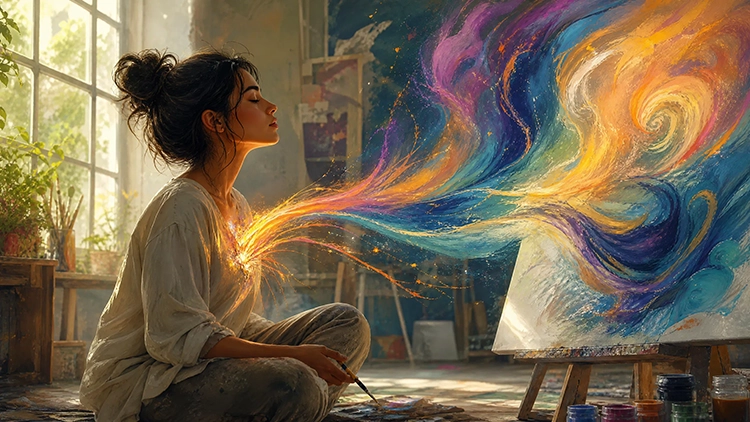
Beyond Words: Why the Canvas Remembers What the Mind Tries to Forget
There is a distinct, quiet frustration that occurs when an emotion becomes too large for language. You feel a familiar tightness in your chest or a sudden wave of unspoken overwhelm, but when someone asks, “What’s wrong?”, your vocabulary fails you. Words feel too rigid, too small, or too clumsy to carry the actual weight of your inner life.
We spend most of our adult lives trapped in the tight geometry of explanation—striving to sound coherent, logical, and composed. But in forcing every human feeling through the narrow filter of articulate speech, we often leave our deepest emotional truths stranded in the dark.
The Artifice of Modern Articulation
From an early age, we are conditioned to translate our internal world into neat, socially acceptable sentences. If you cannot explain why you are anxious, your anxiety is dismissed as irrational. If you cannot name the origin of your grief, you are told to move past it.
Consider a scene that plays out in countless rooms every day: You sit across from someone—a partner, a friend, or a therapist—desperately wanting to share how you feel. But as you open your mouth, you realize that naming the feeling forces you to judge it. The moment an emotion is translated into words, it becomes subject to scrutiny. Does this sound foolish? Am I overreacting? Will they think less of me?
       [ THE ARCHITECTURE OF ARTICULATION ]
Raw Inner Emotion ──► Verbal Filter ──► Intellectual Defense
(Pre-verbal)        (Self-Censorship)    (Rationalized Words)
[ THE SANCTUARY OF ART THERAPY ]
Raw Inner Emotion ──► Tactile Medium ──► Uncensored Truth
(Pre-verbal)        (Paint, Clay, Ink)   (Direct Self-Discovery)
The Emotional Translation Gap: The most profound human experiences exist in the body and the subconscious long before they find linguistic structure. Forcing them immediately into speech often produces intellectual defenses rather than genuine emotional release.
We end up offering sanitized summaries of our pain instead of experiencing true release. We construct verbal walls to protect ourselves, mistaking the ability to talk about our feelings for the actual act of feeling them.
The Subconscious Speaks in Shape and Color
This is where art therapy fundamentally alters the psychological conversation. It is not an art class, nor does it care about aesthetic beauty, technique, or balance. It does not ask you to be an artist; in fact, having zero artistic skill is often a profound advantage.
When you hold a piece of charcoal, a paintbrush, or a block of wet clay without the obligation to create a “good” picture, the protective cerebral guardrails begin to drop.
Imagine putting brush to paper with no blueprint in mind. You choose a dark indigo not because it makes visual sense, but because it matches the weight in your stomach. You press hard against the paper, tearing it slightly, capturing a jagged impulse that words would have smoothed over.
In clinical settings, therapists observe that the subconscious mind does not think in paragraphs; it thinks in symbols, textures, and visceral sensory memories. When you engage in spontaneous creation without performance anxiety, you bypass the inner editor. You allow the subconscious to leave its quiet footprint on the canvas long before the analytical mind can intervene and sanitize the narrative.
Unlearning the Aesthetic Trap
The greatest obstacle adults face when engaging with creative expression is the insidious urge to evaluate. We have been conditioned to treat every effort as a performance meant for an audience—a post to be liked, a product to be judged, or a skill to be mastered.
Children do not paint to decorate a gallery. A four-year-old mixes bright yellow and muddy brown across a sheet of paper simply to feel the resistance of the bristles against the surface and to watch color transform before their eyes. They play without self-consciousness, unburdened by the fear of making a mistake.
Imagine walking into a room filled with jars of vibrant pigment, raw clay, and blank paper, and being given explicit permission to make something utterly ugly, chaotic, or incomplete—with zero risk of judgment.
When you step into that childlike state of uninhibited spontaneity, a subtle shift occurs within your nervous system. The hyper-vigilant part of your brain that constantly asks, “Is this good enough?” goes quiet. The relief is immediate and profound. You are no longer performing your life; you are simply inhabiting it.
The Sanctuary of Symbolic Distance
Why is expressing trauma, confusion, or grief through visual art often far less threatening than speaking it aloud? Psychologists call this phenomenon Symbolic Distance.
When an emotion remains trapped inside your body, it feels all-consuming. But when you externalize that same emotion onto a piece of paper, a crucial psychological distance is created:
- Separation of Identity: The grief, anger, or fear is no longer who you are; it is simply something you made. It sits on the table outside of you.
- Safe Exploration: You can observe the image, turn it upside down, alter it, or simply sit beside it without being overwhelmed by its intensity.
- Non-Verbal Integration: You are able to inspect your inner landscape safely, giving you a sense of agency over feelings that previously felt uncontrollable.
By shifting the narrative from verbal confrontation to creative externalization, art therapy acts as a gentle bridge between what is hidden inside and what can be safely integrated into your life.
The Somatic Canvas: A Five-Minute Reconnection
You do not need a formal studio or expensive supplies to experiment with non-verbal emotional externalization. Try this simple somatic exercise today:
- Gather Simple Tools: Take a blank sheet of paper and two or three writing implements (colored pencils, crayons, or pens).
- Close Your Eyes and Scan: Spend sixty seconds focusing on your physical body. Where are you holding tension? Is it a sharp pain in your shoulders, a heavy ache in your chest, or a nervous flutter in your stomach?
- Translate Without Thinking: Open your eyes and immediately assign that physical sensation a shape, texture, and movement on the page. Draw furiously, softly, jaggedly, or smoothly. Do not try to draw a recognizable object. Focus entirely on transferring the feeling of the sensation onto the paper.
- Observe and Step Back: Set the paper down across the room. Look at it for one minute without trying to analyze or “fix” it. Simply acknowledge: That was inside me, and now it is out there.
When words fall short, the canvas remembers. True healing begins not when we finally figure out how to explain our pain, but when we give ourselves permission to let it exist freely in the light.