Is Time Perception Linear or Circular According to Psychology and Jung
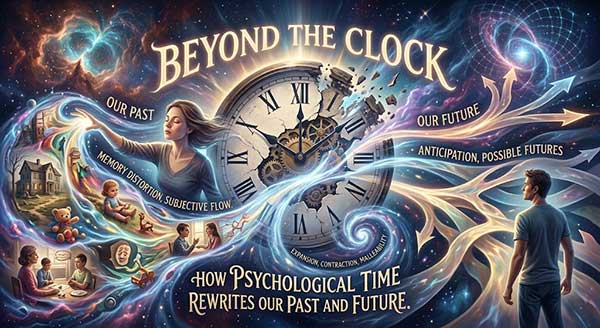
We tend to speak of time as if it were a steady, unidirectional river—an unyielding conveyor belt pulling us from an unchangeable past toward an uncertain future. Yet anyone who has ever sat through a tedious afternoon meeting knows that sixty minutes can feel like an eternity, while a weekend spent with a loved one vanishes in the blink of an eye. This familiar elasticity hints at a startling reality: the mechanical ticking of a clock is merely an arbitrary social agreement, whereas our actual lived experience of time is entirely subjective, constructed moment by moment within the deep corridors of human psychology.
Russian philosopher P. D. Ouspensky famously suggested in A New Model of the Universe that human beings mistakenly view existence as a single, uninterrupted line, failing to see how events arriving from the past and future continuously intersect in complex, rotating circles. When we strip away our reliance on wristwatches and digital displays, we are left with time perception as an intricate cognitive phenomenon. As cognitive linguists like Vyvyan Evans and developmental psychologists like William J. Friedman have long observed, our sense of temporal duration is not an objective recording of reality, but a sophisticated psychological construct shaped by memory, sensory arousal, and our desperate need to make sense of cause and effect.
How brain processes time perception and causality
For decades, neuroscientists operated under the assumption that the human brain relies on a centralized pacemaker—an internal master clock located within the basal ganglia that ticks at a fixed rate. Under this classic model, temporal illusions were explained away as simple fluctuations in physical arousal; when your adrenaline spikes, the master clock speeds up, making the outside world appear to move in slow motion. However, contemporary neurobiological research, including comparative studies on sensory timing mechanisms by researchers like Zeynep Alaşhan and Nihan Ayhan, suggests a far more decentralized reality. The brain does not possess a single isolated clock. Instead, it encodes duration and temporal order directly through the sensory modalities themselves, weaving time into the very fabric of visual, auditory, and motor processing.
This sensory encoding is intimately bound to our psychological need for linear causality. In order to function in a complex environment, the executive centers of our brain construct strict sequential chains: event A happened, which directly caused event B to occur. If you accidentally bump a glass of water off your desk, it falls and shatters. This simple mechanical chain—known in classical philosophy as causa efficiens, or the efficient cause—gives us a reassuring sense of agency and predictability. We trace causes backward into the past to explain our present circumstances. Yet, while efficient cause works exceptionally well for explaining fluid dynamics or planetary orbits, it collapses when applied to the messy, non-linear architecture of human behavior.
What is the difference between efficient cause and final cause
To understand why human lives resist strict linear timelines, we must examine Aristotle’s broader taxonomy of causality, specifically the contrast between efficient cause and final cause (causa finalis). An efficient cause explains an event through its past triggers: the vase broke because an elbow struck it. A final cause, by contrast, explains an event through its future intent or ultimate purpose: you are buying a train ticket today because your best friend is getting married next week. In the realm of final cause, an event that has not yet occurred in physical reality reaches backward through time to reshape your present behavior.
This distinction illuminates the fundamental split between the analytical left hemisphere of the brain and the holistic right hemisphere. The left brain thrives on linear sequence, breaking experiences into discrete units arranged neatly along a timeline of “before” and “after.” It keeps us anchored in practical reality, ensuring we pay our bills on time and arrive at appointments. The right brain, however, processes reality through pattern recognition, emotional resonance, and spatial simultaneity. It does not care about chronological sequence; it seeks underlying meaning by linking disparate events that share a common thematic core.
I was reminded of this temporal friction on a rainy Tuesday evening in late October at Grand Central Terminal in Manhattan. I was sitting on a marble bench beneath the golden glow of the main concourse clock, watching thousands of commuters rush toward their respective departure gates. From a purely linear perspective, every person in that vast hall was being pushed forward by past events—a finished workday, a punched timecard, a missed connection. But as I watched a young woman nervously checking her phone while holding a bouquet of damp tulips, it became obvious that she was not being pushed by her past; she was being pulled forward by a future reunion that had not yet happened. The mechanical clock above her head ticked linearly, but her psychological reality was operating in reverse, shaped entirely by the final cause waiting at the end of the line.
How Carl Jung defined synchronicity and non linear time
The limitations of linear causality in human affairs led Swiss psychiatrist Carl Gustav Jung to formulate one of his most revolutionary concepts: synchronicity. In his 1952 treatise written alongside Nobel Prize-winning physicist Wolfgang Pauli, Jung defined synchronicity as an “acausal connecting principle”—a phenomenon where two or more events occur together without any direct linear cause, yet are bound by an intense, unmistakable unity of meaning. Jung recognized that our obsession with efficient cause forces us to dismiss meaningful coincidences as mere random chance. When a patient dreams of a golden scarab beetle, and at that exact moment a real scarab-like beetle knocks against the therapy room window, linear science sees no physical connection. Jung, however, recognized that the psyche and the material world had briefly aligned around a shared archetypal motif.
This non-linear perspective receives unexpected support from quantum mechanics. Quantum pioneer Werner Heisenberg famously pointed out that at subatomic scales, the rigid definitions of space and time begin to dissolve. At microscopic levels, the absolute sequence of “before” and “after” loses its mathematical precision, demonstrating that under certain conditions, physical processes can appear to operate in temporal reverse. If the physical substrate of reality is not strictly bound by a linear arrow of time, it stands to reason that human consciousness—which emerged from that same physical substrate—is capable of perceiving connections that transcend chronological order.
Standing near the edge of the Hudson River late one evening, watching the tide surge against the dark wooden piers of the Jersey City waterfront, I caught myself trying to decipher whether a sudden, sharp memory of an old friend was a random neural firing or a subtle environmental echo. The streetlights reflected across the churning water like fractured ribbons of light, constantly shifting shape without ever leaving the riverbed. In that quiet darkness, the boundaries between past memory, present sensation, and future expectation felt remarkably permeable. Yet a persistent ambiguity remains: it is extraordinarily difficult to discern where genuine cosmic synchronicity ends and our brain’s insatiable habit of projection begins. We are pattern-seeking creatures, and the line separating an acausal breakthrough from an elegant cognitive trick remains endlessly blurred.
Is time perception linear or circular in psychology
In therapeutic settings, recognizing that time perception is pliable rather than fixed can be profoundly liberating. When individuals view their lives exclusively through the lens of linear, efficient cause, they frequently trap themselves in deterministic despair. They operate under the belief that because their past contained trauma, neglect, or failure, their present and future are permanently ruined by an unbroken chain of cause and effect. They treat themselves as passive objects pushed along by historical momentum.
Introducing the concept of circular time and final cause invites a radical shift in personal agency. Instead of asking exclusively, “What past event caused me to feel this way?”, depth psychology encourages us to ask, “What future self or purpose is trying to emerge through this current struggle?” This teleological approach does not deny past facts, but it strips them of their absolute authority. It acknowledges that while our physical bodies exist within chronological time, our emotional and psychological realities belong to a broader, circular architecture where past memories are continually reinterpreted and reshaped by our present intentions.
By integrating both brain hemispheres—balancing the left brain’s linear structure with the right brain’s capacity for holistic meaning—we cultivate a far richer relationship with existence. We learn to honor the wristwatches that keep our modern world organized without mistaking those ticking hands for the absolute truth of our lived experience. Time is neither a rigid prison nor a straight highway stretching into an empty void; it is a dynamic, multi-dimensional canvas where past, present, and future engage in a perpetual, meaningful dialogue.