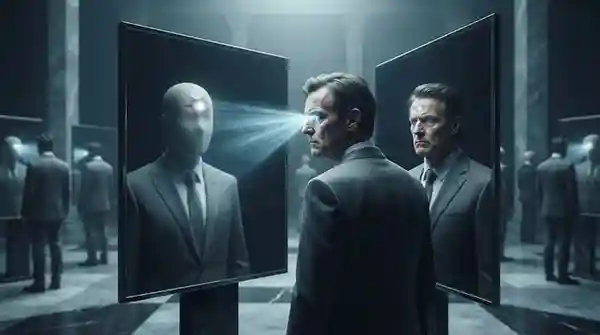
What You See in Others Is What You Refuse to See in Yourself
There is a mirror in every room.
Not the kind you hang on a wall. The kind that sits across from you at the dinner table. The kind that shares your bed. The kind that sits in the cubicle next to yours and drives you crazy with the exact same habit you refuse to acknowledge in yourself.
I have been studying human behavior for fifteen years. I have interviewed hundreds of people about their relationships, their conflicts, their frustrations. And I have found one pattern that explains more about human conflict than any other: the projection reflex. It is the automatic, unconscious tendency to see in others the qualities we cannot tolerate in ourselves.
The research on projection goes back to Freud, but it has been refined and validated by modern neuroscience. A 2025 study published in Nature Human Behaviour found that when people are asked to describe the traits they dislike most in others, those traits correlate with their own implicit biases, their own unacknowledged behaviors, their own shadow selves. The correlation is not perfect. But it is strong enough to make you uncomfortable.
Why the Thing You Hate Most Is the Thing You Hide Best
You know the person. The one who drives you up the wall. The one whose voice makes your jaw tighten. The one whose very existence feels like an insult. Maybe it is a coworker who takes credit for everything. Maybe it is a relative who plays the victim. Maybe it is a friend who never listens.
Ask yourself a question. What is it about them that bothers you most? Now ask yourself a harder question. Where in your own life do you do the same thing?
Most people cannot answer that question. Not because the answer is not there. Because they have spent years building defenses against it.
Carl Jung called this the shadow. It is the part of the self that we disown. The parts we were told were unacceptable. The anger. The selfishness. The neediness. The envy. We push them down so deep that we forget they exist. And then we see them in other people. And we hate those people. Not because they are bad. Because they are mirrors.
The Neuroscience of Seeing Yourself in Others
The brain does not have a special module for understanding other people. It uses the same circuits it uses to understand itself. This is the discovery that gave us mirror neurons.
A 2025 study published in ScienceDirect found that when participants observed someone else performing an action or expressing an emotion, their own sensorimotor and limbic systems activated in patterns that mirrored the observed experience. The mirroring was automatic. It happened before conscious awareness. The brain was simulating the other person’s experience inside its own body.
This is why emotions are contagious. This is why you feel tension when someone else is tense. This is why you cry when someone else cries. The boundary between self and other is not as solid as you think. The brain is constantly blurring the line.
And here is the unsettling implication. If the brain uses the same circuits to understand self and other, then what you see in others is shaped by what you know about yourself. If you have disowned your own anger, you will see anger everywhere. If you have denied your own neediness, you will be repulsed by neediness in others. The projection is not a choice. It is a neurological default.
What the Research Says About Projection in Relationships
The research on romantic relationships has documented this pattern with remarkable precision.
A 2024 study published in the Journal of Personality and Social Psychology tracked 200 couples over five years. The researchers measured each partner’s self-reported traits, their implicit associations, and their perceptions of their partner. The findings were consistent with decades of prior research. People who were high in neuroticism were more likely to perceive their partners as critical. People who were high in avoidance were more likely to perceive their partners as clingy. The perceptions were not accurate. They were projections.
The researchers concluded that projection is a form of cognitive miserliness. The brain is lazy. It does not want to do the hard work of understanding another person from scratch. So it uses the template it already has. The template is you.
The Thing You Cannot See
There is a specific kind of projection that is more dangerous than the rest. It is called blind-spot projection.
Blind-spot projection is when you project a trait you do not recognize in yourself. Not a trait you have disowned. A trait you genuinely do not see. The research on the Dunning-Kruger effect has shown that people are often unaware of their own incompetence. The same principle applies to personality. You cannot see your own flaws because the skills you need to see them are the skills you lack.
A 2025 study published in Psychological Science found that participants who were rated low in agreeableness by their peers rated themselves as highly agreeable. They were not lying. They genuinely did not see it. The trait was invisible to them. And because it was invisible, they were more likely to see it in others.
The coworker who takes credit for everything. The relative who plays the victim. The friend who never listens. You are not wrong about them. But you are also not seeing the whole picture. You are seeing the part of yourself that you cannot see.
What Happens When You Stop Projecting
The first step out of projection is not to fix the other person. It is to ask a different question. Not “why are they like that?” But “what is this triggering in me?”
The question is not comfortable. It requires honesty. It requires the willingness to look at the parts of yourself you have spent years avoiding. But the research on self-awareness is clear. The people who can answer that question are the people who have the most satisfying relationships.
A 2025 study published in Frontiers in Psychology examined the role of self-awareness in relationship satisfaction. The findings showed that participants who scored high in self-awareness reported higher relationship satisfaction, lower conflict, and greater empathy. The mechanism was not that they had fewer flaws. It was that they could see their own contributions to the conflict. They could stop blaming the other person long enough to ask what they were doing.
The Mirror That Shows You What You Hide
There is a woman I interviewed for this piece. Let’s call her Sarah.
Sarah was married for twelve years. She described her husband as “the most critical person she had ever met.” He criticized her cooking. He criticized her parenting. He criticized her career. She had spent the last three years of their marriage convinced that he was the problem.
Then she went to therapy. Not couples therapy. Individual therapy. And her therapist asked her a question that she could not answer.
“Who in your life was critical of you before you met your husband?”
Sarah did not have an answer. She had always been the one who was criticized. She had always been the victim. She had never considered the possibility that she was doing the same thing.
It took three months. But eventually, she saw it. She was critical too. Not of her husband. Of herself. And her husband was not actually criticizing her. He was mirroring her own self-criticism back to her.
The marriage did not survive. But Sarah changed. Not because she fixed her husband. Because she saw the mirror.
Why the Mirror Is Not Comforting
There is a version of this idea that gets sold in self-help books. It goes like this: everyone in your life is a mirror, reflecting back to you the parts of yourself you need to heal. This version is comforting. It suggests that the difficult people in your life are actually gifts. Teachers in disguise.
The version I am describing is not comforting. It is unsettling. It suggests that the people who drive you crazy are not teachers. They are mirrors. And what they are reflecting is not a gift. It is a truth you have been avoiding.
The truth is that you are not as kind as you think. You are not as patient as you think. You are not as generous, as humble, as self-aware. You are a person with flaws. Some of which you cannot see. And the people who trigger you are the ones who see them.
What to Do With the Mirror
The first thing to do is to stop fighting the mirror. Stop trying to change the other person. Stop trying to prove that they are wrong. The mirror is not the problem. The reflection is the problem.
The second thing to do is to get curious. What is the trait that bothers you? What does it remind you of? Where have you seen it before? The answers may surprise you.
The third thing to do is to test the reflection. Not by asking the other person what they see. By asking someone who knows you well. Someone who will tell you the truth. “Do you see that trait in me?” The answer may be yes. The answer may be no. But the question is worth asking.
When the Mirror Requires Professional Help
There is a limit to what self-reflection can accomplish. If the patterns of projection are accompanied by persistent conflict, distress, or an inability to maintain relationships, the problem may be deeper than insight alone can reach.
Talk to a mental health professional. The research on psychodynamic therapy, cognitive behavioral therapy, and other evidence-based interventions for relational patterns is robust. These treatments work. But they work best when delivered by someone trained to deliver them.
This is not a disclaimer. It is the same logic that runs through everything else in this piece. You do not fix a broken mirror with a new reflection. You get help.
The Mirror You Carry
The mirror is not in the other person. The mirror is in you. It is the capacity to see yourself in others. It is the willingness to ask the uncomfortable question. It is the honesty to admit that the thing you hate most in them is the thing you have not yet seen in yourself.
The mirror is not always flattering. It is not always kind. But it is always true. And the truth, even when it is uncomfortable, is the only thing that can set you free.
The people who drive you crazy are not your enemies. They are your teachers. Not the teachers you wanted. The teachers you needed. The ones who show you what you have been hiding.
Look into the mirror. Not the one on the wall. The one across the table. The one in the bed. The one in the cubicle. The one who makes you angry.
What do you see?