The sport that rewires the brain: what a stack of cups reveals about learning, focus, and coordination
The question nobody asks about the cups
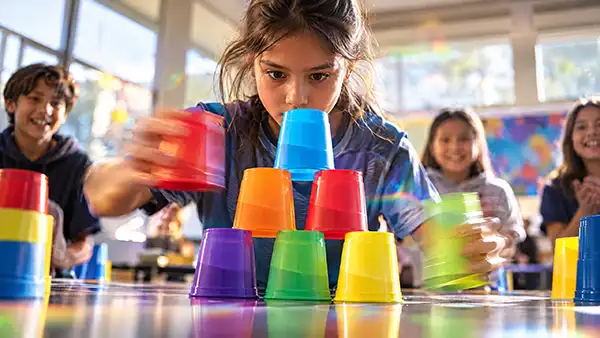
You have seen it. The plastic cups on a table. The hands moving in a blur. The pattern that looks simple until you try it. And you have probably dismissed it as a children’s game, a gimmick, a fad that peaked in a school gymnasium somewhere and never left.
That dismissal is wrong. And the research that proves it wrong has been accumulating for over two decades, in peer-reviewed journals, at universities with names you recognize. The cups are not the point. The cups are a delivery system. What they deliver is something the brain needs more than almost anything else: the experience of using both hemispheres at the same time, under conditions that require speed, precision, and sustained attention.
I want to call this bilateral cognitive loading: the deliberate engagement of both sides of the brain in a coordinated motor task, and the cascade of neurological benefits that follow. The phrase is mine. The phenomenon is not. It has been documented in EEG labs, in physical education studies, and in clinical interventions with populations ranging from second graders to adults with mild cognitive impairment. And it is the reason a stack of plastic cups deserves more respect than the average gym class gives it.
What the EEG machines actually recorded
In 2005, Dr. Melanie Hart and Walter Bixby at Texas Tech University placed electrodes on participants’ scalps and asked them to stack cups. The goal was not to measure speed or accuracy. It was to measure which parts of the brain were active while the hands were moving. The results, published in Research Quarterly for Exercise and Sport, were unambiguous: the electrical activity increased in both hemispheres. Not one side dominating. Not a sequence of activation. Both sides, simultaneously, working in concert. “The results of this study support the claim that cup stacking does utilize both sides of the brain”.
This matters because most daily tasks are hemispherically biased. Language tends to live on the left. Spatial reasoning tends to live on the right. The brain is efficient, and efficiency means specialization. But specialization has a cost. The connections between the hemispheres, the corpus callosum and the associated white matter tracts, are strengthened through use. When they are not used, they weaken. The cup stacking study suggested that this activity, almost uniquely among common tasks, forces the hemispheres into dialogue.
The follow-up question is what that dialogue produces. The answer, according to the research, is a set of cognitive and motor improvements that show up in places you would not expect.
The hand-eye coordination finding that surprised the researchers
Dr. Steven Murray and his colleagues at Mesa State College, now Colorado Mesa University, conducted one of the foundational studies on sport stacking. They took a group of second-grade students and assigned them to either a cup stacking intervention or a control condition. The intervention lasted five weeks. The researchers measured hand-eye coordination and reaction time before and after, using the Soda Pop and Yardstick tests, two validated instruments for assessing these skills in children.
The results, published in Perceptual and Motor Skills in 2004, showed that the cup stacking group improved significantly on both measures. “Cup stacking is indeed effective in enhancing hand-eye coordination and reaction time in second grade,” the authors concluded. The improvement was not marginal. The reaction time gains were substantial enough to be statistically significant in a sample of forty-two children.
The finding has been replicated. A 2025 study published in the Garuda journal examined cup stacking in children aged six to ten and found that three weeks of training, three sessions per week, produced significant improvements in fine motor abilities as measured by standardized tests. The paired samples t-test showed a difference between pretest and posttest scores that was significant at the p < 0.001 level. The researchers concluded that cup stacking “has a positive and measurable influence on fine motor enhancement through repeated, coordinated, and visually guided hand movements”.
Bilateral coordination and the body that learns to work as one
The hand-eye coordination piece is intuitive. The bilateral coordination piece is less so, and it is where the research gets interesting.
Chris Rhea, Kathy Ludwig, and Monique Mokha at Barry University in Miami Shores conducted a study with sixth-grade physical education students. They wanted to know whether a five-week instructional unit in cup stacking would change the way the students used their upper limbs. The results, reported in the Perceptual and Motor Skills journal, showed that cup stacking “has a positive effect on the development of bilateral coordination”. The students were not simply getting faster. They were learning to use both sides of their bodies in a coordinated way, and the learning showed up in tasks that had nothing to do with cups.
A separate study from the University of Würzburg examined the effect of interleaved practice, a method that involves mixing different types of problems or tasks within a single session, on spelling acquisition. The finding, published in Cognitive Research: Principles and Implications, was that children who practiced spelling words in an interleaved sequence made fewer errors than those who practiced in a blocked sequence. The effect was strongest for children with high prior knowledge. The mechanism is the same as the one at work in cup stacking. The brain is forced to retrieve the relevant framework each time it encounters a new problem, and the retrieval strengthens the association.
The academic spillover that the skeptics did not predict
The claim that a cup stacking intervention could improve reading comprehension sounds like the kind of thing that gets published in a press release and never survives peer review. It survived.
A pilot study published in Perceptual and Motor Skills in 2007 examined the influence of a six-week bimanual coordination program on fifth-grade students’ reading achievement. Twenty students participated in the sport stacking program. Twenty-one students served as controls. The experimental group showed a significant increase on the Comprehension subtest of the GMRT-4, a standardized reading assessment. There was no significant difference on the Decoding subtest. “Participation in a bimanual coordination program, using sport stacking as the activity, may improve Grade 5 students’ reading comprehension skills, regardless of sex”.
The finding is not a miracle. It is an example of a well-documented phenomenon called transfer. Skills learned in one domain, when they are fundamental enough, show up in other domains. The bilateral coordination, the sustained attention, the rapid processing of visual and motor information, these are not reading skills. But they are the substrate on which reading skills depend. Strengthen the substrate, and the skills improve.
A 2026 study published in Medicine & Science in Sports & Exercise examined the effect of sport stacking on motor and cognitive function in third-grade learners. The findings, while preliminary, were consistent with the earlier work. The intervention group showed improvements in both motor and cognitive measures that the control group did not.
What happens when the cups are used as therapy
The most striking research on sport stacking has moved out of the school gym and into the clinic.
A randomized controlled trial published in Frontiers in Aging Neuroscience examined the effects of sport stacking on neuropsychological, neurobiological, and brain function performance in patients with mild Alzheimer’s disease and mild cognitive impairment. The intervention was thirty minutes per day, five days per week, for twelve weeks. The findings indicated that sport stacking was effective for patients with MCI and mild AD, with improvements in neurocognitive performance and evidence of enhanced neural plasticity.
The study is not claiming that cup stacking cures dementia. It is not. What it is claiming is that a low-cost, low-barrier motor activity produced measurable changes in brain function in a population where change is difficult to produce. The mechanism, according to the researchers, is likely the same one that operates in children: the coordinated use of both hands, under conditions that demand attention and speed, engages neural circuits that might otherwise remain dormant.
A 2024 case study published in the Journal of Physical Therapy Science examined children with brain lesions and found that sport stacking activities improved upper extremity function and leisure satisfaction. The study was small, and the findings are preliminary. But the direction is consistent. The cups are not a game. They are a tool.
The self-esteem effect that no one measures but everyone notices
There is a category of benefit that does not show up on an EEG or a standardized test. It shows up in the faces of the children who participate.
The Speed Stacks organization, which manufactures the cups and trains instructors, has collected testimonials from teachers and parents for years. One of the most consistent themes is what the organization calls the “leveling effect.” In traditional sports, the athletic kids dominate. The non-athletic kids learn to sit on the sidelines, and they learn it early. Cup stacking, because it requires fine motor speed rather than gross motor strength, allows a different group of children to excel.
The research on self-esteem and sport stacking is thinner than the research on coordination. But a 2020 study published in the Sport Psychology Journal examined the impact of a sport stacking intervention on self-confidence and bimanual coordination in female students. The findings showed significant improvements in both. The mechanism is not complicated. Competence produces confidence. The child who discovers that they are good at something, especially after years of being told they are not good at the things that matter in gym class, carries that discovery into other domains.
The research on self-efficacy, developed by Albert Bandura at Stanford University, shows that mastery experiences are the most powerful source of self-belief. Cup stacking provides mastery experiences in a low-stakes environment. The stakes are low. The feedback is immediate. The learning curve is steep enough to be interesting and shallow enough to be achievable. It is, in the language of developmental psychology, a well-designed learning environment.
What the skeptics get right
The skeptics are not entirely wrong. Cup stacking is not a substitute for physical education. It is not a replacement for reading instruction. It will not make a child smarter in any general sense. The effect sizes in the studies are moderate. Some of the research has been funded by the manufacturer, which is a conflict of interest that should be acknowledged.
But the skeptics miss the larger point. Cup stacking is not being proposed as a cure for anything. It is being proposed as a tool. And the research suggests that it is a tool that works, in a specific way, for a specific set of outcomes. The bilateral coordination. The hand-eye coordination. The reaction time. The sustained attention. These are not trivial outcomes. They are the foundational skills on which almost everything else depends.
If you are looking for a single intervention that will transform a child’s academic trajectory, cup stacking is not it. If you are looking for a low-cost, low-barrier activity that strengthens the neurological substrate on which learning depends, the research says this is worth considering.
When the stacking is not the answer
There is a limit to what any motor activity can accomplish. If a child is struggling with persistent attention difficulties, learning disabilities, or emotional regulation challenges that interfere with daily functioning, cup stacking is not a substitute for professional assessment and support. The research on attention deficit hyperactivity disorder, learning disabilities, and anxiety disorders is robust, and the interventions that work are clinical. A therapist, a pediatrician, or a school psychologist can help determine whether the difficulty is a skill gap or something that requires a different kind of care.
The same is true for adults. If you are experiencing cognitive changes that concern you, if you are having difficulty with memory, attention, or coordination that is affecting your daily life, the appropriate response is not to buy a set of cups. It is to speak with a physician or a neurologist who can assess what is happening.
The cups are a tool. They are not a diagnosis. They are not a treatment. They are not a cure. They are a way of engaging the brain in a specific kind of work, and the research suggests that the work produces specific kinds of benefits. That is enough. That is the whole of it.
The stack that does not fall
The cups go up. The cups come down. The hands move. The brain records. The connections strengthen. The process is ordinary, and the process is remarkable, and the process does not require anyone to believe in it for it to work.
The child who stacks cups is not thinking about hemispheric activation or bilateral coordination or reading comprehension. They are thinking about speed. They are thinking about beating their own time. They are thinking about the small, immediate pleasure of doing something with their hands that they could not do yesterday.
And that, according to the research, is exactly the point. The learning happens in the doing. The brain changes because it is used. And the cups, plastic and unremarkable and easy to dismiss, are simply the vehicle.