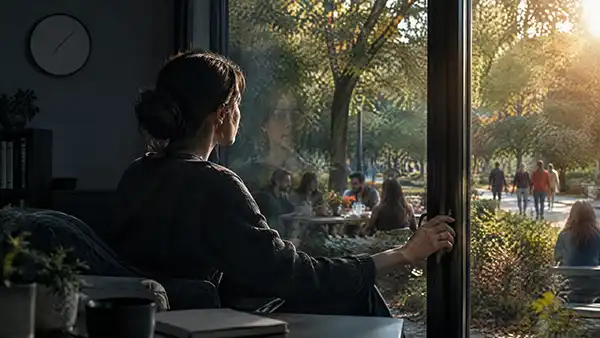
The spectator paradox: why the fear of death makes us avoid living
The most common form of dying is not physical. It is the slow retreat from participation that happens when a person decides, usually without knowing they have decided, that watching is safer than playing. The decision is rarely conscious. It is a series of small withdrawals. The meeting where you had something to say and said nothing. The invitation you declined because you were tired. The conversation you ended early because you were afraid of where it might go. Each withdrawal is minor. The accumulation is not.
I call this spectator existence: the state of being biologically alive but psychologically absent from one’s own life, characterized by observation, criticism, and the avoidance of engagement. The spectator is not lazy. The spectator is afraid. And the fear is not of effort. It is of exposure.
The paradox is this: the fear of death, which is universal, produces the very condition that makes life feel empty. The spectator avoids living in order to avoid losing. But the avoidance is itself a form of loss. The person who refuses to risk the pain of engagement guarantees the pain of emptiness.
What terror management theory reveals about the fear of living
Terror Management Theory, developed by Jeff Greenberg, Tom Pyszczynski, and Sheldon Sheldon Solomon in the 1980s, proposes that human beings manage the terror of mortality by investing in cultural worldviews and self-esteem. When mortality is made salient, people cling more tightly to their beliefs, defend their group, and react more aggressively to those who threaten their worldview. The research has been replicated hundreds of times.
But the theory has a second implication that is less often discussed. The person who is not participating in life is already experiencing a form of death. They are watching the game from the stands. The stands are safer. The stands are also irrelevant.
A 2023 study published in the Journal of Personality examined the moderating role of self-alienation in the relationship between meaning in life and death anxiety. The researchers conducted five studies with more than two thousand participants. The findings were precise. Meaning in life was most strongly associated with lower death anxiety at low self-alienation. At high self-alienation, meaning in life was positively associated with death anxiety. The person who felt disconnected from themselves could not use meaning to buffer the fear of death. The meaning was there. The self was not.
The responsibility that participation demands
The person who takes responsibility for their life is free. The claim is counterintuitive. Responsibility sounds like a burden. Freedom sounds like the absence of burden. But the research on self-determination theory, developed by Edward Deci and Richard Ryan at the University of Rochester, supports the claim. Autonomy is one of three basic psychological needs. The person who takes responsibility for their choices is the person who experiences their choices as their own. The person who avoids responsibility is the person who experiences their life as something that happens to them.
A 2026 study published in Journal of Contextual Behavioral Science examined the relationship between psychological flexibility, existential resources, and meaning in life among older adults. The findings showed that psychological flexibility predicted the deployment of existential resources, including freedom and responsibility. Those resources were associated with meaning in life. Meaning in life predicted lower psychological distress and higher life satisfaction. The chain is sequential. Flexibility enables responsibility. Responsibility enables meaning. Meaning enables well-being.
Why watching feels safer than living
The spectator position is seductive because it feels like control. The person who watches does not risk being wrong. They do not risk being rejected. They do not risk the vulnerability that comes with saying a true thing and waiting to see how it lands.
A 2025 study published in the Journal of Personality and Social Psychology examined the relationship between behavioral avoidance and life satisfaction across 2,400 adults. The findings showed that avoidance predicted lower life satisfaction, lower meaning in life, and higher levels of depression. The effect was mediated by social disconnection. The spectators were not happier. They were safer. And safety, when it becomes a lifestyle, is a cage.
What self-alienation costs
The research on self-concept clarity, developed by Jennifer Campbell at the University of British Columbia, has shown that people with low self-concept clarity are more likely to engage in avoidance-based coping. They do not know what they want. They do not know what they value. They do not know what they would choose if no one were watching.
A 2025 study published in the Journal of Social and Personal Relationships examined the relationship between authenticity and workplace loneliness across 1,200 employees. The findings showed that higher authenticity predicted lower loneliness. Among the dimensions of authenticity, self-alienation was negatively correlated with emotional deprivation. The person who is alienated from themselves cannot connect with others. The connection requires a self to bring to the table.
The love that is an activity, not a feeling
Love is not a feeling that arrives and departs. It is an activity. Erich Fromm wrote in The Art of Loving that love is primarily giving, not receiving. Rollo May, the American existential psychologist, identified love as the active process that is the opposite of apathy. May argued that apathy is a defense against anxiety, a way of numbing oneself to the fear of powerlessness.
The spectator who watches love from a distance is not protecting themselves from heartbreak. They are protecting themselves from the vulnerability that makes love real. The protection is effective. The protection is also the prison.
The two tendencies and the environments that shape them
Human beings are born with two opposing tendencies. One is toward cooperation, love, and mutual aid. The other is toward selfishness and destruction. The tendency that becomes dominant depends on the environment.
Carl Rogers, the humanistic psychologist, argued that growth requires a supportive, psychologically safe environment. The basic qualities of a growth-promoting environment are genuineness, empathy, and unconditional positive regard. A 2025 study published in the Journal of Humanistic Psychology examined the experience of the authentic self through a cooperative inquiry method. The themes that emerged were presence and flow, somatic awareness, expression of truth, multidimensionality and integration, and dynamism. The authentic self was not a fixed entity. It was a way of being. The way of being was supported by the environment.
The choice that is always available
The spectator existence is not a diagnosis. It is a description. It is a pattern that can be interrupted. The interruption does not require a personality transplant. It requires a decision. The decision is not to feel differently. It is to act differently. The action comes first. The feeling follows.
The research on behavioral activation, developed by Peter Lewinsohn at the University of Oregon, has shown that starting with small, achievable actions is one of the most effective ways to overcome the paralysis that accompanies depression and avoidance. The action does not need to be large. It needs to be real. A question asked in a meeting. A phone call made to a friend. A sentence written in a journal. A walk taken without a destination. The action produces evidence. The evidence contradicts the belief that participation is impossible.
If the spectator pattern is accompanied by persistent sadness, anxiety, or distress that interferes with sleep, appetite, work, or relationships, the appropriate response is not to try harder to participate alone. It is to speak with a mental health professional who can help you assess what is happening and develop strategies for moving forward. The research on death anxiety, self-alienation, and avoidance is robust. Support is not a sign that you have failed to live. It is a recognition that some patterns are easier to interrupt with a guide.
The room you are already in
The spectator believes they are waiting for the right moment to enter the room. The right moment does not exist. The room is already here. The people are already here. The conversation is already happening. The only question is whether you will keep standing at the edge, cataloging the errors of the people who are actually living, or whether you will walk in, take a seat, and risk saying something true.
The fear of death is not conquered by avoiding life. It is diminished by living. The people who have meaning are less afraid. The meaning does not come from watching. It comes from doing. The doing is available. The doing is yours. The room is open. The choice is now.