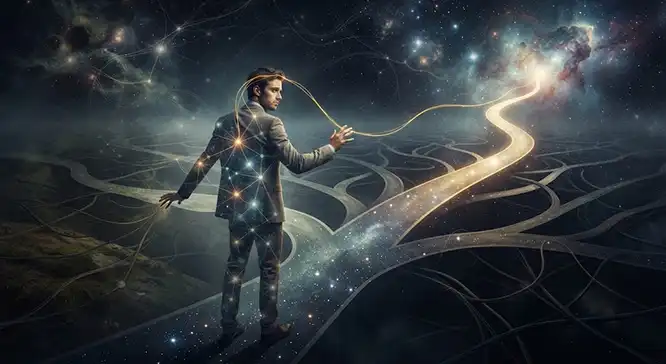
To Choose or Not to Choose: That Is the Real Question
Blaise Pascal once wrote that every choice is a renunciation. I used to think that sounded dramatic—like something you’d say when you’re turning down a second slice of cake and want to sound philosophical about it. But the older I get, the more I realize he wasn’t being dramatic. He was being literal. Every yes is a no to something else. Every door you walk through is a door you close behind you. And the scary part isn’t the closing. The scary part is how often we forget we’re the ones doing the closing.
I remember sitting in a coffee shop in Seattle about four years ago, watching a woman at the next table argue with someone on the phone. She wasn’t yelling, but her voice had that tight, controlled edge that means someone is trying very hard not to cry. She kept saying, “I didn’t choose this. This wasn’t my decision. This just happened to me.” I don’t know what she was talking about—a breakup, a job loss, a medical diagnosis, something. But I remember thinking: She believes that. She genuinely believes this happened to her, not through her.
And I wanted to say something. I didn’t, because that would have been weird and intrusive. But I wanted to say: What if you’re wrong? What if you chose more of this than you realize?
The Uncomfortable Truth About Victimhood
Here’s the thing I’ve learned the hard way. We’re all really good at telling ourselves we’re victims. It’s not even a moral failing—it’s just easier. Victimhood absolves us. It means we didn’t cause this. We didn’t consent to this. We’re just passengers on a train someone else is driving.
But that’s almost never true.
Take the obvious example: infidelity. You find out your partner has been unfaithful. The immediate story you tell yourself is: I was betrayed. I was wronged. This happened to me. And that’s true, in a narrow sense. You didn’t choose to be cheated on.
But here’s the part we skip. Once you know, you have a choice. You can stay or you can leave. Both are choices. Both have consequences. Neither is passive. If you stay, you’re choosing to stay in a relationship that includes deception. You might say, “I can’t leave—we have kids, we have a mortgage, I don’t have anywhere to go.” But that’s still a choice. You’re choosing stability over freedom. You’re choosing not to disrupt your children’s lives. You’re choosing the known discomfort over the unknown uncertainty. Those are all choices. They don’t feel like choices because they’re hard, but they are.
The same applies to smaller things. A job you hate. A friendship that drains you. A city you’ve outgrown. A body you’ve neglected. A habit you’ve let slide. In each of these, the story we tell is: I don’t have a choice. I have to stay. I have to keep going. This is just how it is. But the truth is, we’ve made a series of choices—some small, some large—that have led to this moment. And we keep making them, daily, by not doing anything different.
The Difference Between a Decision and a Default
I think what Pascal was getting at—and what I’ve come to believe—is that not choosing is itself a choice. It’s just a choice you’ve hidden from yourself. You’ve dressed it up as circumstance. You’ve called it fate, obligation, necessity. But it’s still you. You’re still the one not packing the bags, not updating the resume, not having the difficult conversation, not making the phone call. The inaction is an action. The silence is a statement.
I’ve done this plenty of times. I stayed in a job for two years longer than I should have because leaving felt like failure. I told myself I was being responsible, that I had bills to pay, that the economy was uncertain. All of that was true. But it was also true that I was scared. I was scared to start over, scared to look foolish, scared to admit I’d made a mistake. So I framed the choice as “not having a choice.” It felt better that way. It felt like fate. Fate doesn’t make you feel stupid. Fate just… happens.
But here’s what I discovered when I finally did leave: nobody cared. The world didn’t end. My coworkers didn’t judge me. My bank account was fine. The whole drama I’d built in my head was just that—drama in my head. I’d been the one holding the door shut. I’d been the one telling myself the door was locked. And when I finally checked, it wasn’t. It was just heavy.
What We Give Up When We Choose
There’s a flip side to this. Accepting that you’re always choosing means accepting that you’re always losing something too. Every choice is a renunciation. That’s the Pascal part. And that’s hard to sit with.
I think about this a lot with parenting. Choosing to be a parent means choosing not to be childless. It means choosing a particular kind of life—one structured around school drop-offs and bedtime routines and the endless logistics of raising another human. That’s not a complaint. That’s just a description. But sometimes I miss the version of my life that didn’t have those constraints. And I have to remind myself: I chose this. I chose this version. I could have chosen differently. I didn’t. And that’s okay. But I need to own it.
The same goes for the smaller choices. Choosing to live in a city means choosing not to live somewhere else. Choosing a partner means choosing not to be single or with someone else. Choosing a career means choosing not to explore other careers. These are not regrets—they’re just trade-offs. But if you don’t name them, they can metastasize into resentment. You start to feel trapped, even though you’re the one who built the trap.
The Most Important Choice You Make Today
I’m not going to tell you to quit your job or leave your relationship or move to a different country. That’s not the point. The point is to recognize that those are options. They’re real, they’re possible, and you’re allowed to want them. Whether you pursue them or not is your choice. But at least make it a choice. Don’t let it be the default. Don’t let it be the path of least resistance dressed up as destiny.
I’m also not going to pretend this is easy. It’s not. Owning your choices is uncomfortable. It means you can’t blame your boss, your partner, your parents, your circumstances. It means you have to look at yourself and say, “I did this. I chose this. And if I want something different, I have to choose that too.” That’s a burden. But it’s also a freedom. Because if you’re the one choosing, you’re also the one who gets to choose differently. The door opens both ways.
The woman in the coffee shop—I don’t know what happened to her. I hope she’s okay. I hope she realized, eventually, that she had more power than she thought. I hope she found the door. And I hope she walked through it. Not because everything was magically better on the other side. But because walking through is the only way to find out.
A few things worth clarifying
Isn’t this just blaming people for things that aren’t their fault?
I can see why it reads that way. Let me be clear: I’m not saying everyone is responsible for everything that happens to them. Bad things happen without our consent. Tragedy, illness, loss—none of those are chosen. What I’m saying is that our response to those things is chosen. How we interpret them, what we do next, whether we stay or go—that part is ours. And owning that part isn’t blame. It’s power.
But what if I genuinely can’t choose? What if I’m trapped?
Then you’re in a different situation, and I’m not qualified to speak to it. There are real constraints—financial, legal, physical, relational—that make choice feel impossible. If you’re in an abusive situation, for example, the calculus is very different. Please seek professional help if that’s the case. But for most of us, in most situations, the constraints are more psychological than material. They’re fears, not fences. And fears can be examined, questioned, and sometimes walked through.
How do I even know if I’m not choosing versus just being practical?
Ask yourself this: If no one would judge me, if money wasn’t an issue, if failure wasn’t a possibility—what would I do? The answer to that question is what you actually want. Then ask yourself: What would I have to give up to get that? The difference between what you want and what you’re willing to give up is your real decision. Most people don’t lack ambition. They lack willingness to pay the price. And that’s fine—just call it what it is.