Can Reading Heal You? The Surprising Power of Bibliotherapy
I was nine years old the first time a book held me. Not held my attention — held me. The way you hold a child who has fallen off a bike. It was a rainy Saturday in Cleveland, and my father had left for good, and I had found my way to the public library on Lorain Avenue because it was the only place in the neighborhood that did not smell like my mother’s grief. I pulled a book off the shelf almost at random. I do not remember the title. I remember the feeling of sinking into someone else’s story and realizing, with a shock I still cannot fully explain, that other people had been lost too. Other people had felt what I was feeling. The book did not fix me. But it found me. That is the whole difference.
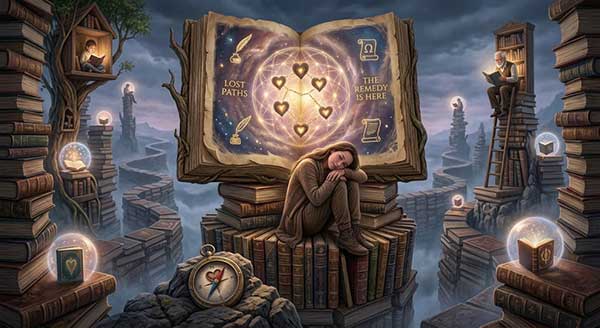
The Greeks had a word for this. They called their libraries “healing places of the soul.” Not because they were quiet. Because they were medicinal. A story, encountered at the right moment, does something that no amount of advice can do: it lets you see yourself from the outside, through the life of someone else.
Psychologists call this bibliotherapy. The term sounds clinical, but the practice is ancient. And the research behind it is real.
What Is Bibliotherapy and Why Is It Suddenly Everywhere
Bibliotherapy is the use of books, usually fiction but sometimes memoir or poetry, as a tool for emotional and psychological healing. It is not a substitute for therapy. It is not a guarantee. But it is one of the oldest and least appreciated forms of mental health support in existence.
The British novelist and bibliotherapist Ella Berthoud, who co-wrote “The Novel Cure” with Susan Elderkin, has been practicing this for decades. Her approach is simple and radical: you tell her what is hurting, and she prescribes you a novel. Not a self-help book. A novel. Because stories are medicine. They work on the imagination, and the imagination is where healing begins.
The use of books in formal therapeutic settings dates back at least to the 1930s, when the term bibliotherapy first appeared in medical literature. But the practice is far older. The ancient Greeks inscribed above their library doors: “A healing place for the soul.” The phrase was not metaphorical. They understood that a well-told story could do what a lecture could not: change how you see yourself.
The Science of Reading as Emotional Regulation
Here is what I did not know until I went looking: there is a body of research on this. Real, peer-reviewed, published research.
A study published in the Journal of Clinical Psychology found that bibliotherapy — specifically the use of carefully selected fiction — can reduce symptoms of depression and anxiety, particularly when used as a supplement to other forms of treatment. Another study, conducted by researchers at the University of Sussex, found that reading can reduce stress by up to 68 percent. That is more than listening to music. More than going for a walk. Reading, it turns out, is one of the fastest ways to calm the nervous system.
The mechanism is not mysterious. When you read, your heart rate slows. Your muscles relax. Your attention narrows from the chaos of your own life to the contained world of the story. This is not escape. It is regulation. It is the body learning, again, how to be still.
But the deeper benefit is cognitive. When you read about a character struggling with something you have been avoiding — grief, shame, anger, fear — you confront your own material at a safe distance. You are not being asked to face your pain directly. You are being asked to watch someone else face theirs. And in the watching, something shifts.
The Mirror That Does Not Judge You
There is a theory in psychotherapy called projection. It is the process by which we see our own disowned feelings in other people. It usually gets talked about as a problem. You are projecting your anger onto your partner. You are projecting your ambition onto your colleague. The implication is that projection is distortion.
But bibliotherapy uses projection differently. When you read a novel, you project yourself into the characters. You feel what they feel. You want what they want. And because the character is not you, you can afford to feel things you could not feel in your own life. The grief you have been swallowing rises to the surface, but it wears someone else’s face. That distance is the gift. It makes the unbearable bearable.
The writer James Baldwin once said, “You think your pain and your heartbreak are unprecedented in the history of the world, but then you read.” That is the whole mechanism, really. You read, and you discover that you are not alone. Not in your suffering. Not in your confusion. Not in the quiet, desperate hope that things might still be okay.
There is a particular kind of loneliness that comes from feeling uniquely broken. Reading dissolves that loneliness. Not by telling you to cheer up. By showing you that someone else has walked through the same fire and survived.
What to Read When You Are Falling Apart
I am often asked for a list. What should I read when I am grieving? What should I read when I am anxious? What should I read when I cannot get out of bed? I understand the impulse. We want the prescription. We want someone to tell us exactly which pages will make the pain stop.
But bibliotherapy is not a vending machine. It is a relationship. The book that heals you is not necessarily the one with the most awards. It is the one that finds you at the right moment, in the right voice, with the right wound.
That said, there are patterns. When I am grieving, I need books that do not rush the grief. Books that let the sadness be sad. When I am anxious, I need books with a strong narrative pull — plot-driven stories that give my mind something to hold onto. When I am exhausted by my own thoughts, I need poetry. Short. Dense. Broken into pieces small enough to carry.
The point is not to read what you think you should read. The point is to read what you need. And only you can know what that is.
There is a line from a poem by Mary Oliver that I come back to often: “Tell me, what is it you plan to do with your one wild and precious life?” I used to hear that as a challenge. Now I hear it as an invitation. Reading is one of the ways I answer. Not by doing. By being. By sitting still long enough for the story to do its work.
How to Begin If You Have Never Tried It
Start small. One book. Not a stack. One book that you choose for no reason other than that it interests you. Not because it is good for you. Not because someone recommended it. Because something in the cover or the title or the first page caught your attention.
Read slowly. You are not trying to finish. You are trying to feel. Pay attention to what the story does in your body. Do you relax? Do you tense up? Does a character say something that makes you want to underline it? That is the bibliotherapy working.
Then, when you are done, let the book stay with you. Do not rush to the next one. Sit with what it gave you. Ask yourself what part of the story is still echoing. That echo is the message. That echo is the medicine.
I do not know what is hurting you right now. I do not know what you are avoiding. But I know that somewhere, on some shelf, in some library or bookstore or cardboard box in a garage, there is a book that can find you. Not fix you. Find you. That is all a book has ever promised. And it is enough.
My first library on Lorain Avenue is gone now, replaced by a parking structure and a coffee shop. But the feeling of being found — that has never left me. It is the reason I still read. Not to escape my life. To understand it. To hold it. To let someone else’s words carry me until I am strong enough to carry myself again.
That is bibliotherapy. Not a cure. A companionship. A hand reaching out from the page, saying: I know. Me too. Keep going.