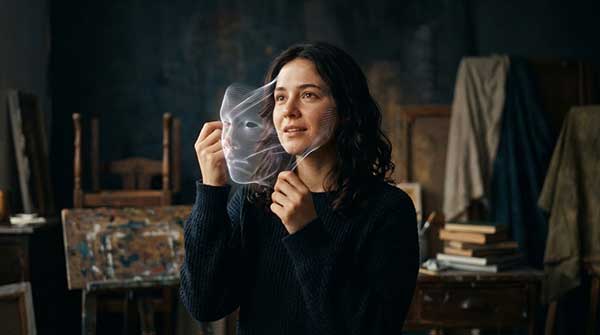
The ghost in the nesting doll: why we struggle to inhabit our own skin
I found an old passport from a decade ago while cleaning out a drawer last Sunday. The person staring back from the grainy, biometric photo was technically me, but the connection felt tenuous, like looking at a distant cousin I hadn’t spoken to since childhood. There was a specific set to the jaw, a particular way the eyes met the lens, that belonged to a version of myself I no longer recognize. We accumulate these “selves” over a lifetime, piling them on like layers of winter clothing. We are the old self, the five-minutes-ago self, and the aspiring self, all occupying the same physical space, often arguing about which one gets to hold the remote control.
This internal overcrowding is what I’ve started thinking of as the Matryoshka Effect. Like those wooden Russian nesting dolls, we present a brightly painted, lacquered exterior to the world—a version of ourselves that is symmetrical, smiling, and easy to understand. But inside that doll is another, slightly smaller version, perhaps less polished. And inside that, another. The deeper you go, the smaller and more unfinished the dolls become, until you reach the center: a tiny, solid piece of wood that hasn’t been painted at all. The tragedy of the modern condition is that we have become obsessed with the craftsmanship of the outermost shell, spending so much time touching up the paint that we’ve forgotten how to inhabit the solid wood at the center.
We are constantly transforming these layers. We tell ourselves that we are “growing” or “evolving,” but often we are simply swapping one painted mask for another. We look back and say, “If I knew then what I know now,” as if wisdom were a linear accumulation. I’m not entirely convinced that’s true. Sometimes, the “now” self is just as confused as the “then” self, only with better vocabulary and more expensive distractions. We treat our identities like an open buffet, selecting a “successful professional” shell for lunch and an “adventurous traveler” shell for the weekend, rarely noticing that the person doing the selecting is becoming increasingly transparent.
The science of the fragmented “I”
There is a psychological framework known as Self-Complexity Theory, which suggests that having multiple “self-aspects” can actually be a buffer against stress. If you fail as a professional but succeed as a parent, the theory goes, your overall self-esteem remains intact. However, there is a nuance here that the textbooks often gloss over. I want to be careful because the research in this area is notoriously difficult to replicate outside of a lab. While having many “roles” can be protective, it can also lead to a sense of profound fragmentation. If you have a different “self” for every person you meet, eventually there is no one left at home when the guests leave.
Neuroscience adds another layer of complexity to this. When we think about ourselves—our past, our future, our current state—we engage the Default Mode Network (DMN) in the brain. This is the same system that activates when we are daydreaming or ruminating. The “self” isn’t a single, localized spark in the prefrontal cortex; it’s a shifting, shimmering pattern of electrical activity across multiple regions. It is more of a process than an object. This is a strange thing to have to say, but the “you” that started reading this sentence is neurologically distinct from the “you” reading this one. We are a parliament of perspectives, not a monarchy.
I’ve often wondered if our obsession with “finding ourselves” is actually a misunderstanding of how the brain works. We look for a static, permanent core, but the biology suggests we are more like a river—constantly flowing, changing its banks, and carrying the silt of everything it has passed. If the river stops moving, it becomes a stagnant pond. Perhaps the “authentic self” isn’t a destination we reach, but the quality of the movement itself.
The digital vanity mirror and the avatar trap
The current era has made this nesting doll problem significantly worse. In the digital world, we aren’t just painting our outer shell; we are building entire plastic avatars. We spend hours refining a social media presence that acts as a high-definition surrogate for our actual lives. This creates a state of self-cannibalization. We consume our real moments—a sunset, a meal, a conversation—just to feed the avatar. If a moment isn’t photographed and “liked,” we feel as though it didn’t quite happen. We have moved from being the protagonist of our lives to being the cameraman for our personas.
This digital layer is the most fragile of the Matryoshka dolls. It requires constant approval to stay upright. We become addicted to the external validation of strangers, creating a loop where our sense of worth is determined by an algorithm we don’t control. This is the deepest distance we can travel from our essence. We are living life “feet first,” just dipping our toes into the water to see how it looks on camera, rather than diving into the deep where the actual meaning lives.
I remember a brief digression from a trip I took to a coastal town a few years back. I spent twenty minutes trying to find the “perfect” angle for a photo of my coffee against the backdrop of the ocean. By the time I took the shot, the coffee was cold and the light had changed. I had the “proof” of the moment, but I had missed the experience of it. I had served the outermost doll while the inner ones were starving for a bit of actual warmth. We are a society of camerapersons filming an empty stage.
The peace treaty with the inner dolls
If we want to stop the savaging of our own identities, we have to declare a peace treaty among our various selves. This begins with the realization that the most sahici—the most authentic—part of us is often the one we are the most embarrassed by. It’s the doll that is unpainted, the one with the rough edges and the knots in the wood. We try to hide our brokenness, our contradictions, and our “failed” versions, not realizing that these are the only parts of us that can actually connect with another human being. You cannot truly bond with someone else’s lacquer; you can only bond with their grain.
We need to fire the cameraperson and step back onto the stage. This requires a radical shift in attention. It means choosing relationships that act as honest mirrors rather than vanity filters. We need people in our lives who don’t just praise our outermost doll, but who recognize the smaller, quieter ones inside. Aranacak şeyler—the things to be found—are never located in the “likes” or the status updates. They are found in the quiet, unrecorded moments where we finally stop performing.
I suspect that the “true self” is simply the one that shows up when no one is watching. It’s the self that exists in the five seconds after you wake up, before you remember who you are supposed to be that day. If we can learn to extend a bit of compassion to that person, we might find that the war with ourselves finally comes to an end. We don’t need to be “better” versions of ourselves; we just need to be the version that is actually present.
Something to try tonight
Before you go to sleep, sit in silence for five minutes with the lights off. Don’t try to “meditate” or achieve a state of zen. Just notice the “selves” that come to visit. Notice the one that is worried about tomorrow’s deadline, the one that is still angry about a comment from three days ago, and the one that is just tired. Instead of judging them or trying to fix them, just acknowledge their presence. Say, “I see you.” By simply observing the layers of the Matryoshka without trying to repaint them, you allow the solid wood at the center to finally breathe.
Sources for further reflection:
- Self-Complexity: Representations of Personal Self-Aspects, Patricia Linville. (On the link between multiple identities and emotional resilience).
- The Man Who Mistook His Wife for a Hat, Oliver Sacks. (A profound look at what happens when the narrative of the self is neurologically interrupted).
- The Presentation of Self in Everyday Life, Erving Goffman. (The classic sociological study on the roles we play).
A few thoughts before we part ways
Is it possible to ever truly find a “core” self, or is identity just an onion with no center?
Research in neuro-philosophy suggests that the “self” is a convenient fiction—a narrative the brain tells itself to keep all the data organized. However, even if it’s a fiction, some stories are more honest than others. The goal isn’t to find a “solid” object, but to ensure that the story you are telling about yourself matches the reality of your internal experience. Authenticity is the closing of the gap between the painted doll and the wood.
How can I stop caring so much about digital validation?
The short answer is you can’t entirely, as we are social animals wired for belonging. But you can change the “diet” of your attention. Start by creating “unrecorded zones” in your life—activities you do purely for yourself that you are forbidden from sharing online. When you build a secret garden, the avatar starts to lose its power because it doesn’t have the full map of your world.
Why does it feel so threatening to let people see my “unfinished” layers?
Exposing the inner dolls feels like walking out into a storm without a coat. We use the outer, lacquered layers as armor. If someone rejects the “perfect” version of you, you can tell yourself they just didn’t see the real you. But if they reject the unpainted wood at the center, it feels like a total defeat. However, the paradox is that no one can love the wood until they see it. Vulnerability is the only currency that buys real intimacy.