The Empty Notebook: What 500 Students Taught Me About the Future of Work
A conference hall in the Midwest. A Saturday morning in early spring. Five hundred students, mostly juniors and seniors, sitting in rows that stretched from the front stage to the back wall. The speakers were good. The advice was solid. And almost nobody was taking notes.
I counted. In a row of twenty-five, maybe three had notebooks open. The rest listened. They nodded. They laughed at the right moments. And then they walked out into the sunshine with nothing to show for it but a vague sense of having been inspired.
That image has stayed with me for months. The empty notebook. The blank page. The gap between what we hear and what we keep.
I have been thinking about that gap ever since. Because it is not just about note-taking. It is about everything.
Why We Forget Almost Everything We Hear
There is a well-known finding in communication research. People remember about 25 percent of what they hear immediately after hearing it. Within a week, that number drops to 10 percent. Within a month, it is closer to 5. The forgetting curve, first described by Hermann Ebbinghaus in 1885, is one of the most replicated findings in psychology.
We are not built to remember what we hear. We are built to remember what we do.
A 2024 meta-analysis published in Educational Psychology Review examined 24 studies comparing handwritten and typed note-taking among college students. The findings were clear. Students who took handwritten notes achieved higher grades than those who typed. The effect size was modest but consistent. Handwritten notes were more useful for studying and committing to memory than typed notes.
But here is the thing. The students at that conference were not typing. They were not writing. They were just sitting. Listening. Absorbing. And forgetting.
The empty notebook is not just a metaphor. It is a diagnosis.
When Parents Become the Problem
One student approached the microphone during the Q&A. He was polite. Nervous. He asked a question that I have heard in different forms from hundreds of young people.
He said his father wanted him to go into engineering. He wanted to study history. He did not want to disappoint his father. He did not know how to tell him.
The room went quiet. You could hear the air conditioning hum.
A 2026 study from North Carolina State University analyzed data from more than 2,000 early-career adults. The finding was startling. Young people whose parents were still very involved in their lives during early adulthood tended to have occupations with less prestige than those whose parents were less involved. Too much parental involvement, the researchers found, actually hindered the child’s ability to launch.
“It is well-established that parental investment during childhood and adolescence has positive outcomes,” said Anna Manzoni, one of the study’s authors. “However, our study points to a shift in parental role as young people mature into early adulthood.”
The shift. That is the thing. The parenting that works for a fifteen-year-old does not work for a twenty-two-year-old. The skills that help you protect a child can cripple an adult.
A 2025 study in the Southern Communication Journal examined the effects of unsupportive career messages from parents. The researchers surveyed 292 college students. They found that unsupportive messages from both fathers and mothers led to a decrease in career confidence. Low socioeconomic status was associated with receiving more of these messages.
The students who needed support the most were getting it the least.
How Do You Choose a Career That Doesn’t Exist Yet?
I asked another student what she wanted to do after graduation. She said she did not know. She said she was interested in sustainability, but she did not know what jobs existed in that field. She said she was interested in healthcare, but she did not want to be a doctor or a nurse. She said she was interested in technology, but she did not want to code.
She was not confused. She was describing a future that has not been invented yet.
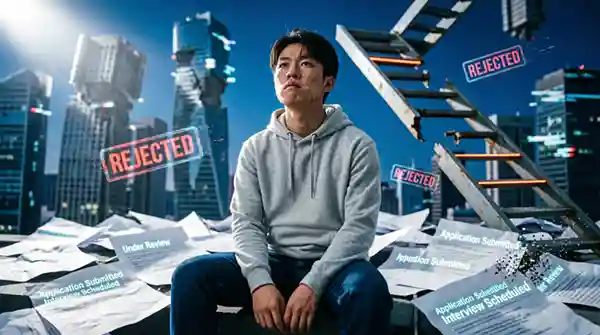
The World Economic Forum published data in 2025 showing that global entry-level job postings had fallen by 29 percentage points since January 2024. The decline was steepest in tech and finance. A separate analysis from Forbes found that junior-level job postings had dropped by 24 percent, while senior roles increased. In tech, junior roles fell by 35 percent.
The jobs are disappearing. The pathways are collapsing. And we are telling young people to follow their passion.
A 2025 survey from ResumeGenius found that one in four Gen Zers regret going to college. They wish they had picked a more lucrative field. They wish they had studied something practical.
But the practical fields are changing too. Artificial intelligence is rewriting the rules of what work looks like. And nobody knows what the rules will be in five years.
The students at that conference are not confused. They are paying attention. They are watching a world that is shifting beneath their feet. And they are trying to figure out where to stand.
A Question That Stopped Me Cold
A young woman in the third row asked a question that stopped me cold.
She said she had been told her whole life that she could be anything she wanted to be. But she did not know what she wanted to be. She had never been taught how to figure that out. She had been taught to follow instructions. She had been taught to get good grades. She had been taught to check boxes. But she had never been taught how to listen to herself.
That is the question we should be asking. Not what do you want to do? But how do you know what you want?
The research on self-concept clarity, developed by researchers including Jennifer Campbell at the University of British Columbia, shows that people who have a clear sense of who they are make decisions more easily. They feel more confident. They feel less anxious. They feel more in control of their lives.
But self-concept clarity does not come from nowhere. It comes from experience. It comes from trying things and failing and trying something else. It comes from paying attention to what feels right and what feels wrong. It comes from the slow, unglamorous work of figuring yourself out.
We are not teaching that. We are teaching compliance.
A 2025 study in Journal of Career Assessment found that career indecision was not a failure of planning. It was a failure of exploration. The students who had the most difficulty choosing a path were the ones who had never been given the space to explore. They had been told what to do. They had never been asked what they wanted.
The empty notebook is not the problem. The empty notebook is the symptom. The problem is that we have taught a generation to wait for instructions instead of learning how to write their own.
Start Asking Better Questions
The most useful moment of the entire conference came not from a speaker but from a student. She stood up during the break and said something to the person next to her. I was close enough to hear.
She said: I have no idea what I am doing. But I am going to figure it out.
That is the thing. That is the whole thing. Not the certainty. The willingness. Not the answer. The question.
A 2024 study in BMC Psychology examined the trajectories of career indecision in young adults. The researchers found that indecision developed in three distinct patterns. Some people started uncertain and stayed uncertain. Some started certain and became uncertain. But some started uncertain and became certain over time.
The difference was not intelligence. It was not resources. It was not luck. It was the willingness to keep exploring. The willingness to tolerate the discomfort of not knowing. The willingness to take action even when you are not sure where it will lead.
The research on post-traumatic growth shows that people grow through challenge, not through comfort. The research on self-efficacy shows that belief in your capabilities comes from experience, not from praise. The research on career development shows that the best decisions are made through exploration, not through planning.
The empty notebook is waiting. The pen is in your hand. The only question is what you will write.
But here is what I need to say, and I need to say it clearly. If you are struggling with persistent anxiety about your future, if the uncertainty feels paralyzing, if you cannot sleep because of the weight of not knowing, that is not a failure of planning. That is a signal. And the research on anxiety and depression in young adults is clear. Professional support helps. A therapist can help you separate the normal uncertainty of early adulthood from something that needs treatment. That is not weakness. That is wisdom.
An Empty Notebook Is Not a Failure
The students walked out of that conference hall into the sunshine. They had heard good advice. They had listened to stories. They had asked questions. And most of them had not written anything down.
That used to bother me. It used to feel like a failure of the event. A failure of the speakers. A failure of the students.
Now I see it differently. The empty notebook is not the end of the story. It is the beginning. The blank page is not a sign that nothing happened. It is a sign that everything is still possible.
The students who walked out of that hall are not empty. They are full of questions. They are full of uncertainty. They are full of the raw material of a life that has not yet been written.
The notebook is empty. The story is not.