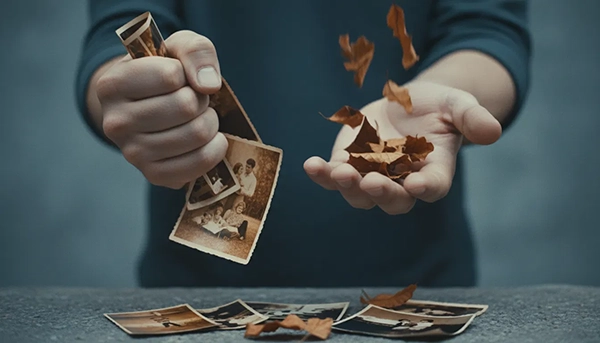
The Open Palm Strategy
There is a subtle linguistic violence hiding inside the word “letting go.” We speak of it as an action—an aggressive, noble act of will, like throwing a heavy suitcase off a cliff. But if you listen closely to the internal dialogue of anyone trying to move on, you’ll hear a quiet, exhausting tug-of-war. One voice screams at you to release your grip, while another whispers, with equal force, hold on. You try so hard to let go that the effort itself becomes a new way of holding. You tighten your muscles, brace your mind, and fight your own hand. Eventually, your fingers start to bleed, not from the thing you’re holding, but from the friction of your own resistance.
Have your hands ever hurt from holding on to a ghost? Mine have.
The tragic comedy of the human mind is that we routinely declare war on ourselves and then wonder why we’re bleeding. We open up internal battlefields over things that happened three years ago, or three hours ago, demanding answers from people who have long since moved on. We replay conversations in the shower, rewrite arguments on the drive home, and construct elaborate courtroom dramas in our heads where justice is finally served. But ask yourself this: Has any internal war you’ve waged ever left you feeling whole? Has a single person who hurt you ever woken up in a cold sweat because you spent three months agonizing over why they did it?
The answer is always the same. You are the only casualty in a war with no winner. You wounded yourself simply because you refused to accept what already is.
We confuse pain with suffering, mistaking the two as the same heavy burden. But they belong to completely different realms of the human experience. Pain is physical, immediate, and honest. You stub your toe, your heart breaks, a promise is shattered—the pain exists right there in the present tense. It is real, and denying it is useless. Suffering, however, is entirely optional. Pain is the raw wound; suffering is the story you write about the wound. Suffering is born the moment you resist reality, the moment you insist that the world should have been different than it was. It is the additional, agonizing layer of misery we generate when we refuse to grant our consent to the past.
Psychologists call this the Egoic Resistance Trap. It is the mind’s misguided mechanism to maintain control over an uncontrollable world. When an outcome shatters our expectations, the ego views acceptance as defeat. It tricks us into believing that if we just ruminate enough, ask “Why?” enough, or stay angry enough, we can somehow rewrite the outcome. But rumination is not problem-solving; it is just a record player stuck in a groove.
When you stop demanding that the past rewrite itself, you can begin rebuilding on solid ground through four essential shifts:
- Surrender the “Why”: The question “Why did this happen to me?” feels like a search for truth, but it is actually a trap designed to keep you looking backward. Swap it for “What is true right now?”
- Bake the Experience into Your Identity: You don’t need to brand every event as a tragedy or a blessing. Put the good and the terrible into your pocket, acknowledge that they shaped your resilience, and keep walking.
- Acknowledge Pain Without Demanding Suffering: Allow the grief or sadness to sit in the room with you like an unexpected guest. You don’t have to fight it, nor do you have to build it a house.
- Stop Re-enacting the Courtroom: The verdict on your past has already been delivered. The trial is over, the pen is broken, and continuing to litigate old grievances only imprisons the judge.
Imagine holding a handful of sand as tightly as you possibly can. The tighter you squeeze, the faster the grains slide through your fingers, leaving your knuckles white and your palm cramped. Now open your hand completely flat. The sand just sits there, resting. It hasn’t vanished, but it no longer hurts to hold.
Lightness isn’t something you achieve by fighting harder; it is what remains when you finally stop squeezing.
A Evening Reality Check
Tonight, before you drift off to sleep and let your mind wander back into old battles, spend three minutes with this simple exercise:
- Identify one old memory or phrase that made your chest tighten today—a “why did they say that” or a “how could they do this.”
- Unclench your physical body. Drop your shoulders away from your ears, release your tongue from the roof of your mouth, and uncurl your fists.
- Say out loud, once, softly: “It happened. It is over. I am here now.”
Then, let your hands rest open on the sheets.
What is one story about your past you are finally ready to stop telling yourself tonight?