How to Calm Down When Everything Feels Like Too Much
The keys were in my hand the whole time. That is the part I kept coming back to, standing in the hallway of my apartment building in Seattle, heart hammering, palms slick, late for a meeting I had been dreading for a week. I had spent eleven minutes tearing the place apart—couch cushions, jacket pockets, the bathroom sink, the kitchen counter. Eleven minutes of escalating panic, my breath getting shorter, my thoughts getting louder, my body convinced it was under attack.
The keys were in my left hand. The same hand I had been using to search.
That is what tension does. It does not just make you feel bad. It makes you stupid. It narrows your vision, floods your system with stress hormones, and convinces you that the worst possible outcome is not just possible but inevitable. The keys are in your hand, and you cannot see them because the part of your brain that solves problems has gone offline.
I am a high school teacher. I deal with pressure daily—lesson plans, grading, parent emails, the particular chaos of thirty teenagers in one room. But that morning in the hallway was different. It was not the meeting I was afraid of. It was the accumulation: the inbox that never emptied, the weekends that never felt restful, the low-grade hum of too much to do and not enough time. The keys were just the trigger.
The psychologist and researcher Robert Sapolsky, at Stanford University, has spent his career studying what stress does to the body and brain. His work shows that our stress response evolved for short bursts—the lion in the grass, the sudden threat that required immediate action. But modern life does not offer short bursts. It offers a constant, low-level thrum. And the body, built for sprints, is being asked to run a marathon.
That morning, my body was running a marathon. It had been running one for months. The keys were just where the wall finally appeared.
The Body Keeps the Score
The thing about tension is that it lives in the body, not just the mind. We talk about it as if it were a mental state—”I’m stressed,” “I’m anxious”—but the physical experience is just as real. The tight jaw. The shallow breath. The churning stomach. The shoulders that creep up toward the ears and stay there.
The psychiatrist and researcher Bessel van der Kolk, in his book “The Body Keeps the Score,” writes about how stress and trauma reshape the nervous system. The body learns to expect danger, even when no danger is present. It stays on high alert, scanning for threats, ready to flood you with adrenaline at the smallest trigger. The keys. The email. The tone of someone’s voice.
I have felt this in my own body. The way my chest tightens when I see a certain name in my inbox. The way my sleep fragments during busy weeks. The way I snap at people I love, not because they did anything wrong, but because my nervous system has run out of room.
The first step in coping with tension, I have learned, is not to think differently. It is to notice what the body is doing. The noticing does not fix anything. But it creates a small gap between the feeling and the reaction. And in that gap, something else becomes possible.
Why Sleep Is Not Optional
There is a reason every list of stress-management tips starts with sleep. It is not because sleep is a nice-to-have. It is because sleep is the foundation everything else is built on.
The researcher and sleep scientist Matthew Walker, at the University of California, Berkeley, has spent his career showing what happens when we do not get enough rest. His book “Why We Sleep” lays out the evidence in detail: poor sleep increases emotional reactivity, impairs judgment, and makes it harder to regulate the stress response. In other words, when you are tired, everything feels worse. The small problems feel big. The big problems feel catastrophic. The keys feel like the end of the world.
I used to wear my short nights like a badge of honor. I’m busy. I’m dedicated. I don’t have time to sleep eight hours. What I did not understand was that I was making everything harder for myself. The tired brain is a reactive brain. The rested brain is a resilient one.
The National Sleep Foundation recommends seven to nine hours for most adults. It is not a luxury. It is maintenance. And when I finally started taking it seriously—same bedtime, no phone in the room, the whole unglamorous routine—the change was not dramatic. It was quiet. The mornings felt less hostile. The inbox felt less personal. The keys, when they went missing, took five minutes to find instead of eleven.
The Small Acts That Reset the Nervous System
Not all coping strategies require a meditation cushion or a weeklong retreat. Some of the most effective ones are almost embarrassingly simple.
There is laughter. Not the polite kind. The real kind, the kind that comes from watching something genuinely absurd. Researchers have found that laughter reduces stress hormones and triggers the release of endorphins, the body’s natural painkillers. It is one of the fastest ways to shift the nervous system out of fight-or-flight. I keep a folder of videos on my phone for the bad days—animals doing ridiculous things, comedians telling stories—and I am always surprised by how quickly my shoulders drop.
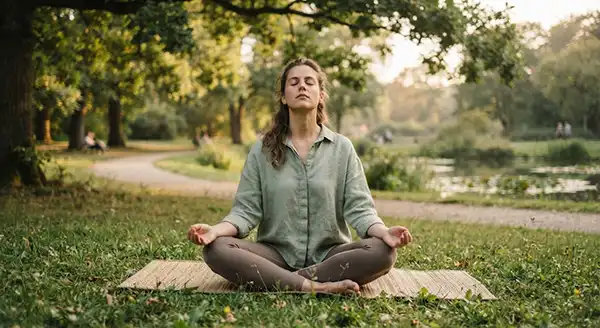
There is breath. Not complicated breathwork. Just slow, deep, intentional breathing. When you are tense, your breath goes shallow and fast. When you deliberately slow it down—long inhale, longer exhale—you send a signal to the brain that the threat has passed. The parasympathetic nervous system comes online. The body begins to settle.
There is order. It sounds almost too mundane, but the connection between physical clutter and mental clutter is real. When my desk is buried in papers, my mind feels buried too. Fifteen minutes of tidying does something to the inner landscape. It restores a sense of agency, a feeling that I am not just being carried along by the chaos.
There is gratitude. Not the performative kind. The genuine practice of noticing what is still good, even on a hard day. The researcher and author Robert Emmons, at the University of California, Davis, has spent years studying gratitude and found that it reliably predicts greater wellbeing. It does not erase the stress. It widens the frame so the stress is not the only thing in view.
The Harder Work of Slowing Down
Some of the most powerful ways to cope with tension are also the most countercultural. We live in a world that rewards speed, productivity, constant motion. Slowing down feels like failure. Rest feels like laziness. Silence feels like a void that must be filled.
I have a friend in Portland, a nurse named Dana, who works twelve-hour shifts in a busy hospital. She told me once that the thing that saved her sanity during the worst of the pandemic was not yoga or meditation or any of the things people recommend. It was ten minutes of sitting in her car in the driveway before going inside. Ten minutes of silence. No phone. No radio. Just her, the steering wheel, and the slow return of her own breath.
“That was the only time I was alone,” she said. “The only time nobody needed anything from me. I would sit there and let the day drain out of me before I walked through the door.”
That is the quiet work of tension management. Not the grand gesture. The small, repeated act of giving yourself a pause. A few minutes of quiet. A walk without a podcast. A meal eaten without a screen. The world does not end. The work does not disappear. But something in you settles, just a little, and that settling makes the next thing possible.
What Actually Happens When You Practice
I want to be honest about the limits of these practices. They are not magic. They will not eliminate tension. Some days, the stress will win. The keys will go missing, the meeting will go badly, the world will feel like too much, and none of the breathing exercises in the world will change that.
But the practices are not about eliminating the stress. They are about changing your relationship to it. The tension is still there. The difference is that you are no longer drowning in it. You are standing beside it, watching it, choosing how to respond instead of simply reacting.
The researcher and author Jon Kabat-Zinn, who founded the Mindfulness-Based Stress Reduction program at the University of Massachusetts Medical School, has spent decades teaching people to relate differently to stress. His work shows that mindfulness—the simple practice of paying attention, on purpose, without judgment—can reduce the symptoms of stress and anxiety. Not by making the stress disappear. By changing how it is experienced.
I have felt this in my own life. The same trigger—the critical email, the crowded schedule, the lost keys—does not hit the same way it used to. The heat still rises. The heart still speeds up. But there is a pause now. A small space where I can choose. And the choosing, even when it is imperfect, is the whole game.
A Different Kind of Ending
The morning of the lost keys, I eventually found them. They were in my left hand. I stood in the hallway for a long moment, breathing, waiting for the panic to recede. Then I did something I had never done before. I called the meeting organizer and told her I was running late. Not because of a car accident or a family emergency. Just because I was running late.
She said, “No problem. See you when you get there.”
The world did not end. The meeting happened. The work continued. And I arrived a little rattled but still intact.
That is the thing about tension. It feels like an emergency. It feels like the stakes could not be higher. But most of the time, the stakes are lower than we think. The meeting can wait. The email can wait. The keys were never lost at all.
I still get tense. I still lose my keys, still snap at the wrong person, still lie awake at night running through the list of everything I should have done differently. But the tension does not own me anymore. I know it now. I know its shape, its triggers, its familiar ways of taking hold.
And I know, too, that there are small, ordinary things I can do to loosen its grip. The sleep. The laughter. The slow breath. The quiet minutes in the car before I walk through the door.
They are not a cure. But they are a practice. And the practice, over time, becomes a kind of home. A place to return when the world gets loud.
The next time you feel the tension rising—the lost keys, the full inbox, the overwhelming day—pause. Breathe. Look at what is actually in front of you.
The keys are probably in your hand. The meeting can wait. The world is not ending.
You are just tense. And tension, it turns out, is something you can learn to ride.