The Architecture of the Mind’s Prism
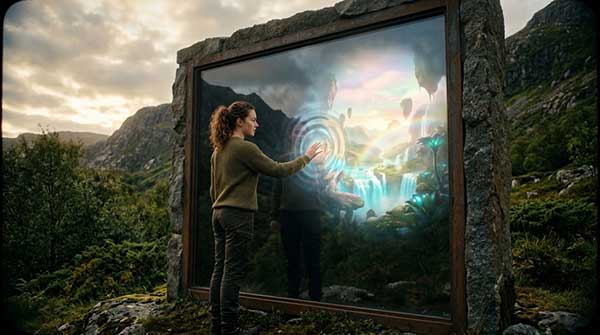
We walk through the world like curators in a gallery of our own design, convinced that the frame we built around reality is the wall itself.
Galileo once suggested that if consciousness were somehow swept away, flavors, colors, and scents would vanish with it, leaving behind a mute, unadorned universe. Most days, we prefer not to test that hypothesis. We reach for a ceramic mug, watch steam rise into the cool morning air, and assume our senses are acting as honest windows into an objective truth.
Yet, as neuroscientist Israel Rosenfield noted, nature does not actually manufacture color; it merely hurls shifting bands of electromagnetic radiation across space. The vivid blues, deep reds, and comforting greens we swear we are touching reside entirely within the dark theater of our skulls.
When your brain translates vibrating sound waves or photons into a familiar shape, it is not recording history; it is authoring fiction to keep you alive.
The Illusion of the Direct Line
We treat perception as a passive camera lens, but it is closer to an overactive novelist filling in missing chapters on zero sleep.
The human sensory toolkit extends far beyond the five textbook entries we learned in school. We navigate our days guided by proprioception, telling our muscles where they float in the dark; interoception, whispering secrets from our internal organs; and vestibular awareness, keeping gravity from feeling like a daily negotiation.
Reality is never experienced raw; it is filtered through an intricate web of biological inheritance, personal history, and quiet, persistent biases.
Consider what happens when you step onto a familiar sidewalk. Your brain instantly categorizes the shuffle of footsteps, the cut of a stranger’s jacket, or the tone of an accent, pulling from an archive of cultural shortcuts. As psychologist Daniel Kahneman’s dual-process theory reminds us, our minds default to fast, automatic cognitive shortcuts precisely because deep, objective analysis burns too much metabolic energy.
[ Raw Sensory Input ] ──► [ Automatic Cognitive Shortcut ]
│
( Cultural / Personal Bias )
▼
[ The Constructed Narrative ]
We see a coiled rope in the dim evening light and our adrenaline spikes, convinced it is a venomous snake. The threat is a phantom, but the sweat on your palms is entirely real.
Why the Mind Closes Its Doors
The danger isn’t simply that our senses occasionally hallucinate; it is that we treat these localized hallucinations as universal laws.
When two people stare at the exact same social interaction, cultural friction, or political debate, they often inhabit entirely different emotional universes. Information deficits prompt the brain to violently stitch together missing details with whatever prejudice or convenience is closest at hand.
When your internal narrative hardens into absolute certainty, dissent stops looking like a difference of perspective and starts looking like a moral failing.
Try this today: the next time an unexpected flash of irritation or judgment flares up in your chest during a conversation, treat it like an alarm bell not for the other person, but for your own perceptual machinery. Pause for five seconds. Ask yourself whether your brain is reacting to what is actually happening in front of you, or simply defending an old story you wrote years ago.
Let the certainty wobble. That small, uncomfortable moment of doubt is the exact spot where the doors of perception finally crack open.
Frequently Asked Questions
Why does our brain alter reality instead of showing us the objective truth?
Our brains evolved primarily for survival, not philosophical accuracy. Processing raw, unfiltered data from the universe would demand unsustainable amounts of metabolic energy and time, so the mind relies on rapid categorization, evolutionary instincts, and past experiences to construct a functional version of reality.
How do unconscious biases shape our everyday sensory experiences?
Unconscious biases act as mental filters that dictate how we interpret ambiguous inputs—such as facial expressions, tones of voice, or body language. They cause us to project pre-programmed cultural stereotypes and past grievances onto neutral situations, making us believe we are seeing facts when we are actually seeing assumptions.
What is a practical way to challenge our own perceptual distortions?
Start by recognizing that your initial emotional or judgmental reaction to an event is an internal interpretation rather than an absolute fact. When a strong reaction occurs, intentionally pause, separate the concrete evidence from your assumptions, and remain open to the possibility that your mind is filling in missing gaps with fiction.