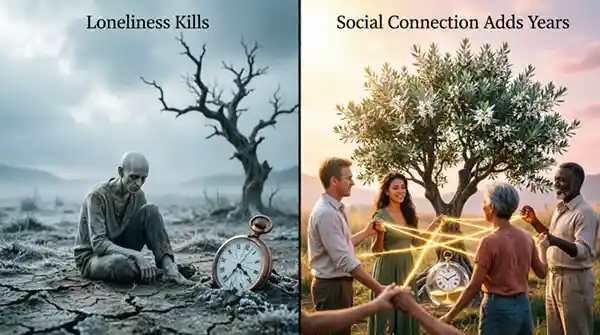
How social connection adds years to your life: the science of longevity and loneliness
Loneliness is not a mood. It is a medical risk factor. The research on social connection and mortality has produced a finding that is difficult to ignore: people with strong social ties are significantly more likely to survive over time than people who are isolated. The effect is not small. A landmark meta-analysis of 148 studies found that individuals with adequate social relationships had a 50 percent greater likelihood of survival compared to those with poor or insufficient social relationships. The mortality risk associated with social isolation is comparable to smoking 15 cigarettes per day and exceeds the risk associated with obesity. I call this social metabolism: the rate at which your body and brain process the presence or absence of social connection, converting relational experience into physiological signals that either repair or degrade your health. Understanding how social metabolism works is the first step toward changing it.
Why loneliness is as deadly as smoking
The comparison is not rhetorical. It is quantitative. Julianne Holt-Lunstad, a professor of psychology at Brigham Young University, and her colleagues Timothy Smith and J. Bradley Layton published a meta-analytic review in PLoS Medicine that pooled data from 148 studies involving more than 300,000 participants. The random effects weighted average effect size was OR = 1.50, which indicated a 50 percent increased likelihood of survival as a function of stronger social relations. The fail-safe N was 4,274, meaning that thousands of unpublished studies with zero effect would be needed to render the finding negligible.
The comparison to smoking is not a metaphor. A 2024 review published by researchers at Indiana University described loneliness as a significant biopsychosocial stressor with a mortality risk comparable to smoking more than 15 cigarettes a day and more harmful than alcoholism, obesity, and lack of physical activity. The mechanism is not mysterious. Chronic loneliness activates the hypothalamic-pituitary-adrenal axis, the body’s central stress response system. The result is sustained elevation of cortisol, which over time produces chronic low-grade inflammation, impairs immune function, and accelerates cellular aging.
What the research on social ties and mortality actually shows
The evidence is not limited to one meta-analysis. A 2025 meta-analysis published in Alzheimer’s & Dementia: The Journal of the Alzheimer’s Association by researchers at the Centre for Healthy Brain Ageing at UNSW Sydney examined thirteen international studies of adults aged 65 and older. The findings were consistent with the broader literature. Frequent interactions with family and friends—monthly or weekly—and having someone to talk to reduced the risk of dementia. Living with others and engaging in community activities reduced the risk of dying.
The Harvard Study of Adult Development, which has followed participants for more than eighty years, found that positive social relationships at midlife were a better predictor than cholesterol levels of being healthy thirty years later. The study is the longest in-depth longitudinal study of adult life, and its central finding is that relationships matter more than almost any other variable the researchers have measured.
A 2025 study from Harvard T.H. Chan School of Public Health examined the biological markers of aging in people with rich social lives. The findings showed that participants with robust relationships with family, friends, and community groups had biological markers showing slower cellular aging and reduced levels of chronic inflammation compared to their less-connected peers.
How social connection changes your biology
The biological pathways through which social connection affects health are increasingly well understood. Social connection is not just a psychological experience. It is a physiological regulator. When you are embedded in meaningful relationships, your body operates differently than when you are isolated.
The first pathway is stress buffering. Close relationships provide a buffer against stress. When you confide in someone and receive support, the stress response is dampened. The research on social support has consistently found that people with strong support networks show lower cortisol reactivity and faster recovery from stress.
The second pathway is behavioral influence. Family, friends, and community members influence health behaviors. The phenomenon is called social contagion. Your friends drag you to a Saturday morning run. Your family encourages you to eat vegetables. Your community group gives you a reason to leave the house.
The third pathway is inflammatory regulation. Isolated individuals show elevated levels of pro-inflammatory cytokines, including IL-6 and TNF-alpha, which contribute to age-related diseases across multiple organ systems. Social connection reduces systemic inflammation and supports immune surveillance.
The fourth pathway is mitochondrial function. Chronic stress from loneliness impairs mitochondrial efficiency, reducing ATP production and increasing oxidative stress. This feeds into a cycle where damaged mitochondria produce more reactive oxygen species, which in turn damage cellular proteins, lipids, and DNA.
When isolation becomes a health emergency
The research on social isolation has moved from the margins of public health to the center. In 2023, U.S. Surgeon General Vivek Murthy declared a national social disconnection epidemic, warning that about 50 percent of adults in the country are struggling with loneliness. The United Kingdom and Japan have appointed special ministers tasked with combating the crisis.
The finding that loneliness increases the risk of premature death by 26 percent and social isolation by 29 percent has been replicated across multiple studies. The effect holds across age groups, though the magnitude is particularly pronounced in older adults, likely because aging compounds the physiological vulnerabilities that isolation exacerbates.
A 2025 study published in The Lancet Regional Health – Western Pacific examined the association between social isolation and mortality among Japanese older adults. The researchers found that social isolation was associated with a 69.5-day shorter survival time, and the association was stronger among those with lower education and income. The finding suggests that social isolation is not evenly distributed. It compounds existing disadvantage.
What the Harvard study found after 85 years
The Harvard Study of Adult Development began in 1938 with 724 men. It has followed them and their descendants for more than eighty years. The study’s central finding is not about cholesterol or blood pressure or exercise. It is about relationships. The men who were most satisfied in their relationships at age fifty were the healthiest at age eighty.
The finding is not about quantity. It is about quality. The study found that it is not the number of friends that matters. It is the depth of the connection. A person with one or two close relationships in which they can be vulnerable is better off than a person with a wide network of superficial contacts.
The Harvard researchers also found that relationships protect the brain. People who are securely attached in their relationships have better memory and cognitive function as they age. The finding aligns with the UNSW meta-analysis showing that social connection reduces the risk of dementia.
How to build social connection when you feel isolated
The research on social metabolism suggests that the body responds to the presence or absence of connection. If you are isolated, the body registers the absence. The solution is not to wait for a grand social life to appear. It is to make small, repeatable deposits into the relational account.
The first deposit is proximity. You cannot build relationships with people you never see. The research on friendship formation has consistently found that proximity and repeated interaction are the strongest predictors of friendship. Join a group that meets regularly. Go to the same coffee shop at the same time. Volunteer for a cause you care about.
The second deposit is disclosure. Relationships deepen through vulnerability. The research on self-disclosure has shown that sharing something personal invites reciprocity. You do not need to share your deepest secrets. You need to share something real. A frustration. A hope. A small fear.
The third deposit is consistency. The research on habit formation has shown that relationships, like habits, are built through repetition in a stable context. The Tuesday night dinner. The Sunday morning walk. The monthly book club. The consistency is the mechanism.
When loneliness is not a choice
There is a difference between chosen solitude and imposed isolation. Some people are alone because they prefer it. The research on solitude has shown that chosen solitude can be restorative. But imposed isolation is something else. It is the product of circumstance: the death of a spouse, the loss of a job, the move to a new city, the chronic illness that keeps you home.
If you are experiencing persistent loneliness that interferes with sleep, appetite, work, or relationships, the appropriate response is not to try harder to build a social life on your own. It is to speak with a mental health professional who can help you assess what is happening and develop strategies for moving forward. The research on loneliness and depression is robust. Effective support exists. Social prescribing programs in the United States and the United Kingdom are already connecting patients with community resources, walking groups, and volunteering opportunities.
What the social metabolism means for your life
The body is not a machine that runs independently of its social environment. It is a social organ. It registers connection and disconnection the way it registers hunger and thirst. The presence of others changes your physiology. The absence of others changes it too.
The research is clear. Social connection adds years to your life. Loneliness subtracts them. The effect is not small. It is comparable to the effect of smoking. It exceeds the effect of obesity. It is one of the most powerful variables in the entire field of health research.
The choice is not whether you will have a social metabolism. You already have one. The choice is what you will feed it. The Tuesday night dinner. The phone call to a friend. The walk with a neighbor. The small deposits. The consistency. The connection. The years.